
American Bologna
Also known as Bologna sausage, Baloney
United States
Overview
American Bologna is a large-format cured cooked sausage with a smooth, uniform slice. Beef and pork are common, although the United States standard also permits other specified meat combinations. Unlike Mortadella Bologna, it does not display a mosaic of white jowl-fat cubes. It may be smoked, sold as a straight chub or made in smaller rings, and ranges from a fine lunch-meat emulsion to a slightly coarser country style.
Where it's from
The cut
Identity and terminology
Bologna takes its name from the Italian city through the older expression Bologna sausage; the American pronunciation produced the spelling baloney. Federal law places bologna in a group of comminuted, semisolid cooked sausages with frankfurters and related products. The name does not confer the Italian Mortadella Bologna PGI. German Bologna and Polish Bologna in American butcher usage describe seasoning or community styles, not German or Polish protected geographical designations.
Composition and characteristics
The governing United States standard limits finished fat and the combined contribution of fat and added water. A typical slice is pink, moist, elastic and free from visible fat cubes or coarse connective tissue. Coriander, white pepper, paprika, nutmeg, mace, allspice and garlic appear in different formulas. Country-style Bologna retains a fine granular cut, while the mainstream version is emulsified. Large chubs produce sandwich slices; ring Bologna gives a smaller curved section suited to heating.
Production and process
Lean meat, fatty pork and back fat are kept cold, comminuted and mixed with salt, cure, spice and ice or water. Fine versions are emulsified in stages so that the meat proteins bind the fat and liquid without breaking. The batter is packed into a large casing, cured under refrigeration, smoked when the style calls for it, fully cooked and rapidly cooled. Coarse country Bologna follows the same safety sequence but stops before a complete emulsion forms.
History and regional forms
American English records the food name by the mid nineteenth century, and newspaper advertising shows Bologna sausage in United States provision shops by the 1870s. Its exact route into American butchery is less certain than the familiar story of a single immigrant group: Italian mortadella supplied the place-name and model, while German-speaking and other European sausage makers adapted finely comminuted cooked meats to local shops and industrial packing. Later lunch-meat production made sliced Bologna inexpensive and nationally familiar. Country, ring, garlic, German-American and Polish-style forms preserve regional butcher-shop differences.
Use, storage and related products
American Bologna is most closely associated with cold sandwiches, but thick slices are also fried, grilled or cubed for snacks. Ring Bologna is commonly warmed whole or split and browned. The sausage is refrigerated even when smoked. Mortadella Bologna PGI is an Italian pork product with visible fat and a protected specification; Lebanon Bologna is a tangy Pennsylvania beef sausage with a fermented identity. Neither should be collapsed into the ordinary American cooked-emulsion entry.
Recipe and cure
This is not a finished recipe. It is a window into how this meat is traditionally cured. Before you follow any process, run it through one of our curing calculators so the salt, cure and timings are right and safe for your own batch.
Make this — the measured Curesmith version →“Make this” opens the same cure as a measured recipe, scaled to your batch.
- Meat
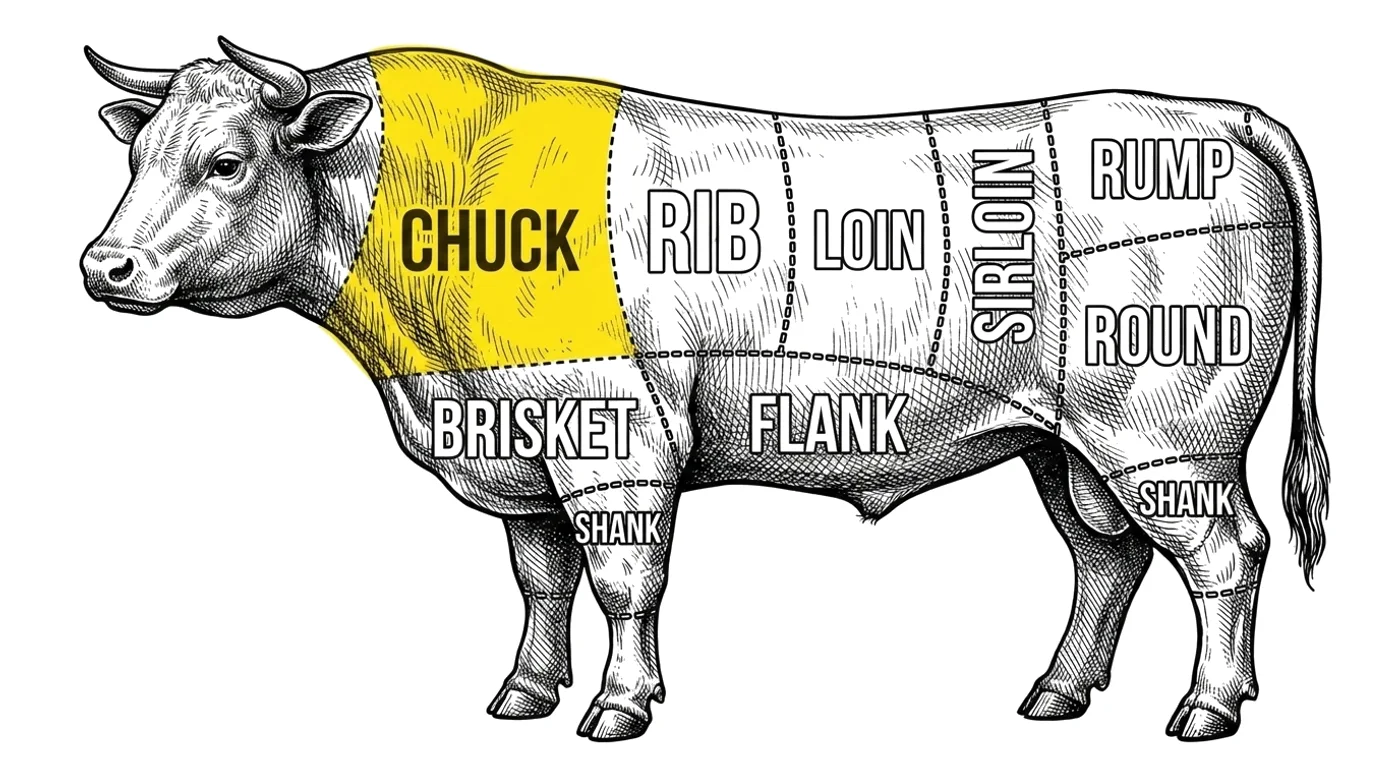
- Beef chuck, connective tissue trimmed
- Cut
- Beef chuck, connective tissue trimmed
- Salt (%)
- 1.8
- Curing salt
- Cure #1 as specified in the recipe
- Fermented
- No
- Smoked
- Yes
- Maturation
- 0–4°C; consume within 7 days after opening or freeze
- Basis
- per 1,000 g beef chuck, connective tissue trimmed
- Style
- US-style cured smoked cooked emulsion sausage
Ingredients
- Beef chuck, connective tissue trimmed100% · 1000 g
- Pork shoulder25% · 250 g
- Pork back fat5% · 50 g
- Fine salt1.8% · 24 g
- Cure #1, 6.25% nitrite0.23% · 3 g
- Ground white pepper0.21% · 2.5 g
- Ground coriander0.1% · 1.5 g
- Sweet paprika0.1% · 1.5 g
- Ground nutmeg0.05% · 0.7 g
- Fresh garlic, finely minced0.31% · 4 g
- Potato starch5.1% · 66.5 g
- Ice-cold water24.6% · 320 g
Method
- Chill beef, pork and fat until firm. Grind each component separately through 10 mm.
- Process beef with half the ice water, salt, Cure #1 and spices until a sticky fine matrix forms.
- Add pork, then back fat and potato starch while feeding in the remaining water. Process to a uniform fine emulsion.
- Stuff tightly into the fibrous casing and clip securely, excluding air.
- Hold the stuffed chub at 0–4°C for 8–12 hours, then dry the casing surface in the smokehouse without smoke.
- Apply light smoke at 50–55°C until the desired colour is reached.
Safety. Maintain emulsion temperature, verify a full cook at the cold point, cool rapidly and refrigerate. Smoke and cured colour do not make Bologna shelf stable.