
Overview
American Country-Cured Pork Shoulder is a U.S. standardised dry-cured whole-muscle product. Federal rules cover the names Country Pork Shoulder, Country Style Pork Shoulder and Dry Cured Pork Shoulder. The product is uncooked, dried and may be smoked or unsmoked.
Where it's from
The cut
Identity and boundaries
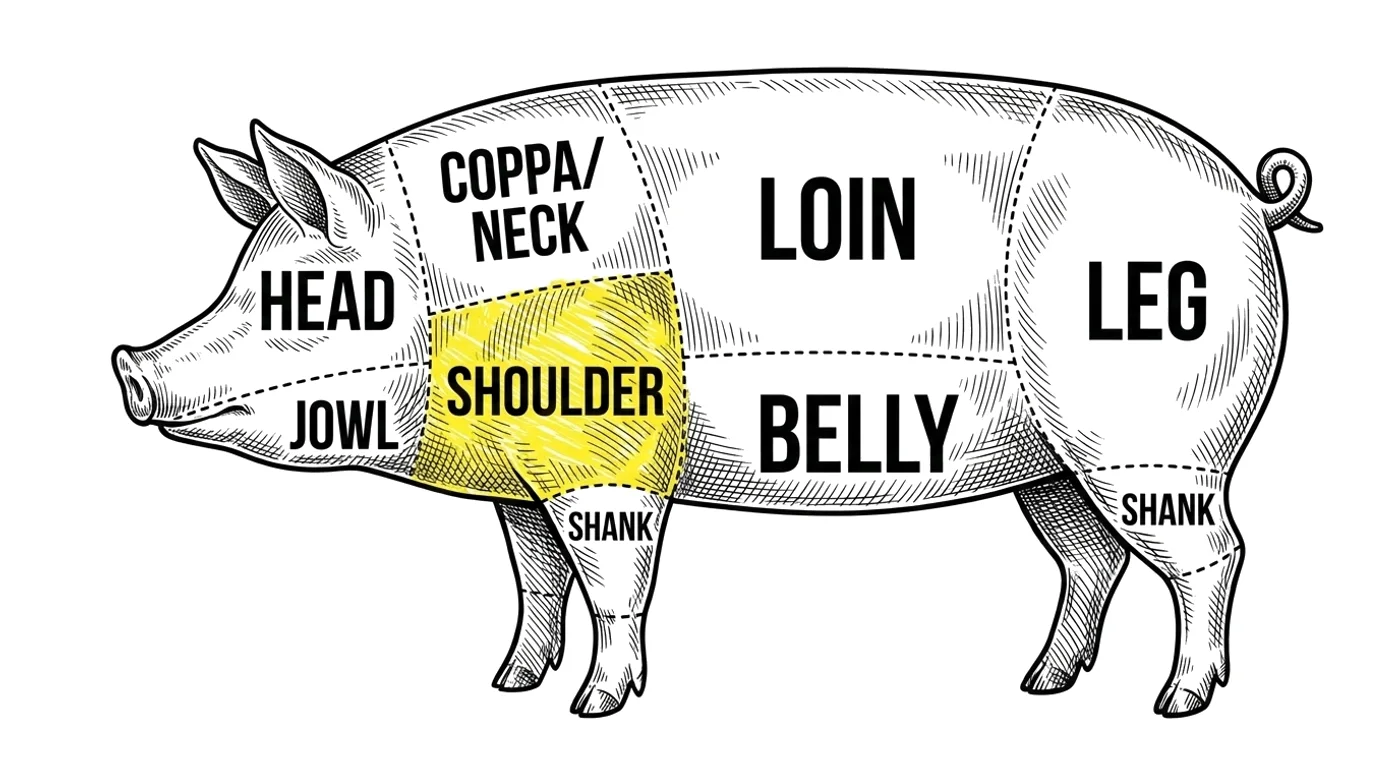
The identity applies to a single piece from the pork shoulder, not the hind leg used for country ham. Cure must be applied dry over the exterior. Injection with curing solution and immersion in curing solution are prohibited, so pumped picnic shoulder cannot use this standardised name. The federal identity is important because country-style language is sometimes used more loosely in commerce, while this entry follows the standardised shoulder product.
Composition and characteristics
The product consists principally of one shoulder piece, salt and permitted optional sweeteners, spices, seasonings, flavourings and curing agents. Drying concentrates flavour and produces a firm slice. Bone-in and boneless presentation may differ, but chopped, formed or multi-piece products fall outside the single-piece identity.
Production and ageing
Salt or salt with permitted ingredients is rubbed over the entire exterior and may be reapplied for penetration. The shoulder is cured, equalised, dried and optionally smoked. Federal release controls include specified salt or water-activity conditions and a finished weight at least eighteen percent below fresh weight. Weight reduction is a legal identity measure, but release also depends on the applicable salt or water-activity pathway and the product’s labelling and handling state.
History and context
Country curing developed in the American South and rural uplands as a way to preserve pork after winter slaughter. Shoulder was less prestigious than hind-leg ham but suited the same dry-salt, smoke and ageing culture. Federal standardisation later protected the process meaning of the country-cured names.
Culinary use and relationships
The shoulder is sliced and cooked or otherwise prepared according to producer instructions, often for biscuits, beans, greens or breakfast dishes. It relates to American Country Ham but differs anatomically. Smithfield Ham is a legally restricted ham child and cannot be treated as shoulder. It should appear beside, but not under the same anatomical identity as, country ham and Smithfield Ham.
Recipe and cure
This is not a finished recipe. It is a window into how this meat is traditionally cured. Before you follow any process, run it through one of our curing calculators so the salt, cure and timings are right and safe for your own batch.
Make this — the measured Curesmith version →“Make this” opens the same cure as a measured recipe, scaled to your batch.
- Meat
- Single boneless pork-shoulder piece
- Cut
- Single boneless pork-shoulder piece
- Salt (%)
- 3
- Curing salt
- Cure #1/#2 as specified
- Fermented
- No
- Smoked
- Yes
- Basis
- per 1,000 g single boneless pork-shoulder piece
- Style
- Dry-applied cured and smoked pork shoulder inspired by the U.S. identity.
Ingredients
- Single boneless pork-shoulder piece100% · 1000 g
- Fine salt3% · 30 g
- Cure #2 containing 6.25% sodium nitrite0.25% · 2.5 g
- Brown sugar1% · 10 g
- Black pepper0.2% · 2 g
- Crushed bay leaf0.05% · 0.5 g
Safety. Country-cured pork shoulder is an uncooked dry-cured whole muscle. Safe release requires compliance with the applicable salt or water-activity controls, required weight reduction, hygienic ageing and validated storage. It must not be produced by injection or immersion under the U.S. identity.