
Andouille Sausage
Also known as Louisiana andouille, Cajun andouille
Louisiana, United States
Overview
Louisiana andouille is a heavily smoked pork sausage associated above all with the River Parishes west of New Orleans and with Cajun and Creole cooking. It is usually coarser, firmer and smokier than French andouille, and it is used less as a table sausage than as a seasoning meat for gumbos, beans and stews.
Where it's from
The cut
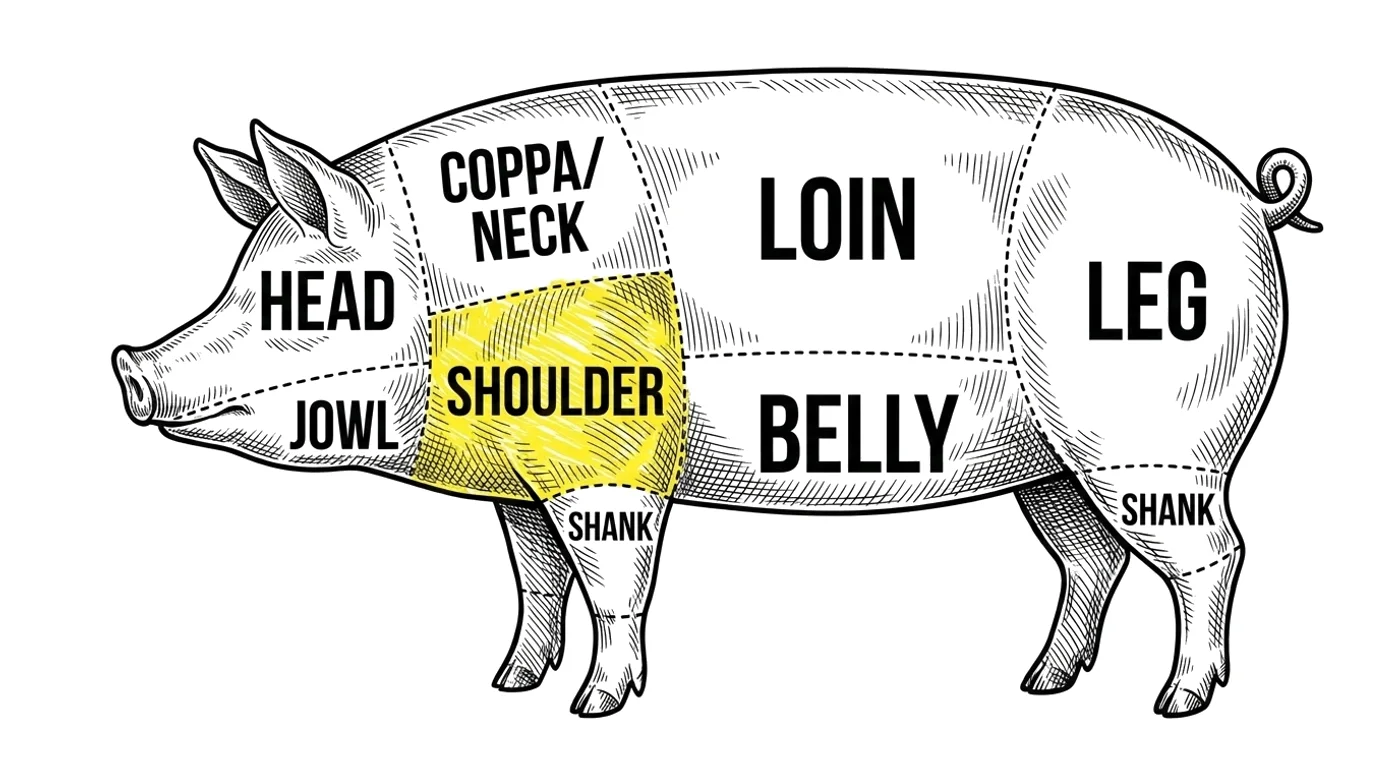
Identity and terminology
The word andouille is French, but the Louisiana product is not a direct duplicate of metropolitan French andouille, which is commonly made from intestines and stomach. Louisiana andouille developed as a local smoked pork sausage. The name therefore identifies a Louisiana branch of a wider French sausage family rather than a universal formula.
Composition and characteristics
Louisiana versions are generally based on pork shoulder or other lean pork with firm fat, garlic, pepper and regional seasoning. The cut face is visibly coarse, sometimes showing hand-cut cubes, and the casing is usually relatively large. Smoke is a defining flavour, often from pecan, hickory or other local hardwoods.
Production and process
Production combines curing, coarse cutting or mincing, stuffing and hot smoking or smoking followed by cooking. Traditional smokehouses produced a firm sausage with a deep reddish-brown exterior. Modern commercial and home production must distinguish a fully cooked smoked branch from sausages that have only been cold smoked and still require cooking.
History and regional forms
French colonists brought the name andouille to Louisiana, but the local sausage took shape in a multi-ethnic food region shaped by French, German, African, Spanish, Caribbean and Native American influences. The Smithsonian's account of Louisiana foodways places andouille on the old German Coast of the Mississippi River, where German-speaking settlers contributed strong sausage-making traditions.
Use, storage and related products
Andouille flavours gumbo, red beans, jambalaya and other one-pot dishes. It is related to smoked Cajun sausage but normally has a more pronounced garlic-and-smoke profile and a coarser structure. Louisiana andouille should not be conflated with French andouillette, French tripe andouille or uncooked fresh sausage.
Recipe and cure
This is not a finished recipe. It is a window into how this meat is traditionally cured. Before you follow any process, run it through one of our curing calculators so the salt, cure and timings are right and safe for your own batch.
Make this — the measured Curesmith version →“Make this” opens the same cure as a measured recipe, scaled to your batch.
- Meat
- Pork shoulder
- Cut
- Pork shoulder
- Salt (%)
- 1.6
- Curing salt
- Cure #1 as specified in the recipe
- Fermented
- No
- Smoked
- Yes
- Maturation
- ≤4°C; use within 5 days or freeze
- Basis
- per 1,000 g pork shoulder
- Style
- Cured, hot-smoked, fully cooked sausage
Ingredients
- Pork shoulder100% · 1000 g
- Fine salt1.6% · 16 g
- Cure #1, 6.25% sodium nitrite0.25% · 2.5 g
- Coarsely cracked black pepper0.6% · 6 g
- Fresh garlic, finely chopped1% · 10 g
- Dried thyme0.2% · 2 g
- Cayenne pepper0.4% · 4 g
- Ice-cold water10% · 100 g
Method
- Chill meat, grinder parts and water. Keep meat at 0–3°C.
- Grind pork shoulder once through 6 mm.
- Dissolve salt and Cure #1 in the cold water. Add to the meat with all seasonings and mix until the mass becomes tacky and binds to the hand.
- Stuff firmly into 38–40 mm hog casings and form links.
- Refrigerate the stuffed sausage for 12–24 hours at 2–4°C.
- Dry at 54°C without smoke for 45–60 minutes, until the casing is dry to the touch.
Safety. Smoking alone does not establish a ready-to-eat product. The article and recipe must state whether the sausage is fully cooked or remains cook-before-eating.