
Overview
Androja is a traditional farinaceous sausage-like preparation from the eastern mountains of León in Spain. It is made principally from pork lard, flour, water and pimentón rather than from a conventional minced meat block.
Where it's from
The cut
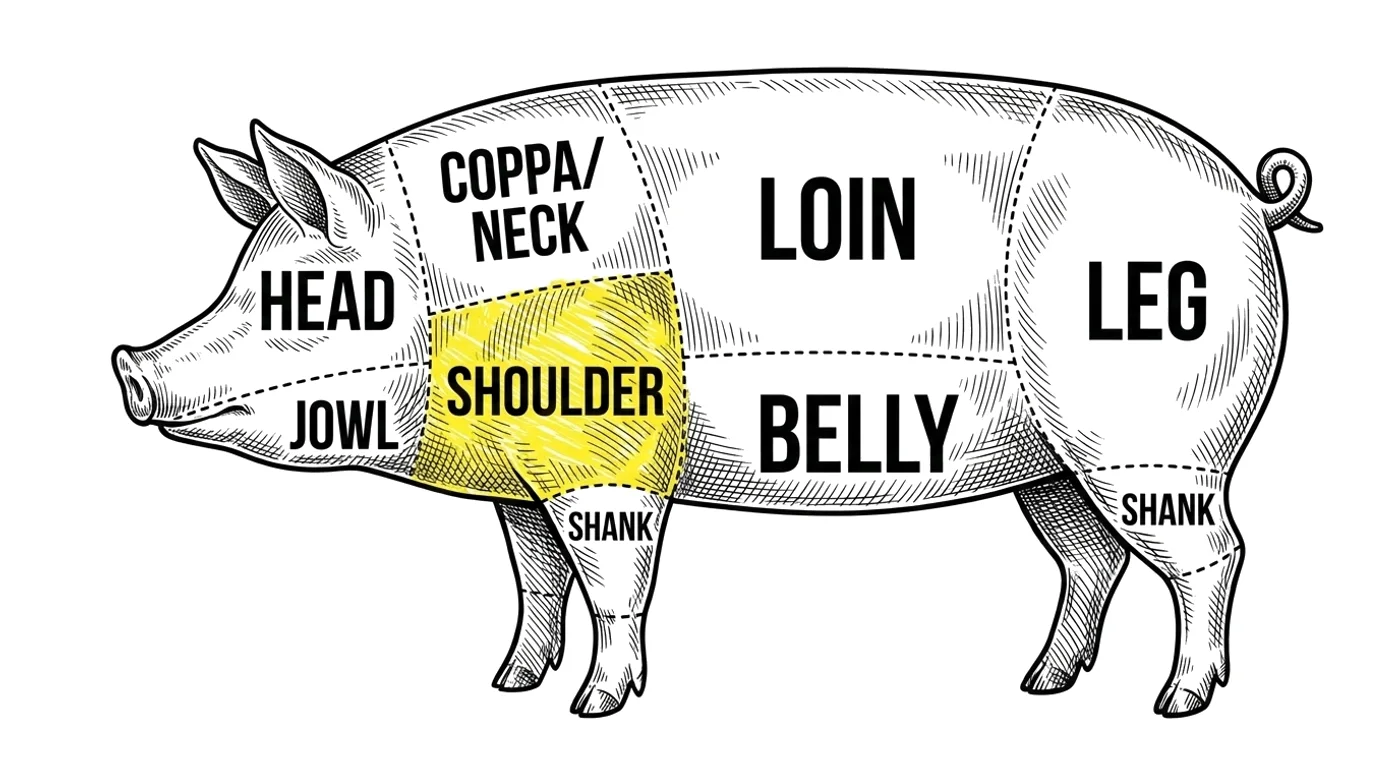
Identity and terminology
The name belongs to a local mountain food and should not be treated as a generic meat sausage. Its exact spelling and composition distinguish it from androlla, androia and other north-western Iberian pork products.
Composition and characteristics
The filling is a cooked or heated paste of lard and wheat flour coloured with sweet and hot pimentón. It has a dense, soft, sliceable interior and a strong paprika-and-pork-fat aroma.
Production and process
Flour is incorporated into hot seasoned fat and water to form a homogeneous paste, which is packed into casing or cloth and cooked. It is reheated or sliced for service rather than matured as a raw sausage.
History and regional forms
Androja reflects the subsistence economy of León's mountain communities, where flour and rendered pig fat extended the value of the annual slaughter. It belongs to the same practical world as farinaceous blood sausages and bread-based embutidos, while retaining its own local identity.
Use, storage and related products
It is eaten hot, sliced or incorporated into robust winter meals. It differs from morcilla because it contains no defining blood component and from ordinary pork sausage because flour and lard form the body.
Recipe and cure
This is not a finished recipe. It is a window into how this meat is traditionally cured. Before you follow any process, run it through one of our curing calculators so the salt, cure and timings are right and safe for your own batch.
Make this — the measured Curesmith version →“Make this” opens the same cure as a measured recipe, scaled to your batch.
- Meat
- Plain wheat flour
- Cut
- Plain wheat flour
- Salt (%)
- 1.7
- Curing salt
- None
- Fermented
- No
- Smoked
- No
- Maturation
- Cooked product 0–4°C for up to 5 days; freeze for longer storage
- Basis
- per 1,000 g plain wheat flour
- Style
- Cooked lard, flour and pimentón sausage
Ingredients
- Rendered pork lard65% · 650 g
- Water12.6% · 82 g
- Sweet pimentón8.4% · 54.5 g
- Hot pimentón7% · 45.5 g
- Plain wheat flour153.8% · 1000 g
- Fine salt1.7% · 11 g
Method
- Warm water and lard together over low heat until fully melted; do not brown.
- Whisk in salt and both pimentóns.
- Add flour gradually while stirring until a thick rough paste forms.
- Pack firmly into the selected casing or wrapper and tie securely.
- Poach at 80–85°C until the cold point reaches 74°C, generally about 60 minutes.
- Cool rapidly and refrigerate.
Safety. A cooked high-fat flour product still requires hygienic cooling and storage. Historical room-temperature practice should not be assumed safe.