
Austrian Knackwurst
Also known as Knacker, Beamtenforelle, Maurerforelle, Salzburger
Austria
Overview
Austrian Knackwurst is a thick individual scalded sausage made from a fine cured farce related to Extrawurst. It is commonly called Knacker, while humorous regional names include Beamtenforelle and Maurerforelle. Unlike the narrower German cooked Knacker group, the Austrian product has a clear Codex formula class built around mixed beef or pork, bacon, added water and potato starch.
Where it's from
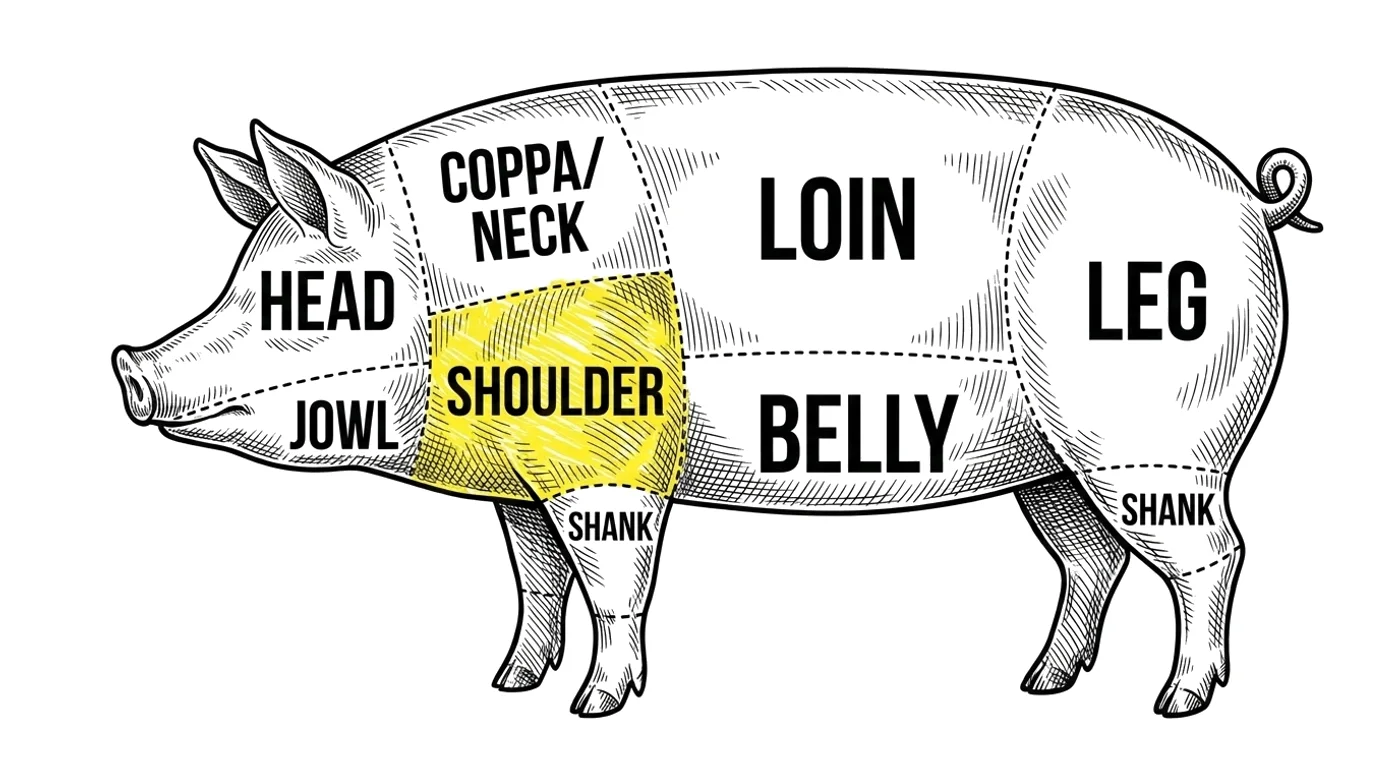
The cut
Identity and terminology
The Austrian Food Codex places Knackwurst in Brätwurst quality class 2 alongside ring Extrawurst, Schübling, Salzburger, Dampfwürstel and several other products. The official manufacturing guidance assigns defined parts of meat, bacon and water, plus starch. Knackwurst is therefore not simply any sausage that cracks when bitten. Its national identity depends on fine comminution, a resilient emulsion and an individual thick-link form.
Composition and characteristics
The farce combines lean or regular beef and pork with firm bacon and a substantial ice-water addition. Potato starch supports water binding and the soft yet springy cut. Salt and nitrite cure give the characteristic clean pink colour. Pepper, mace and allspice provide a mild central European seasoning profile. The casing may be smoked or left pale depending on material and presentation, but the interior should remain smooth and cohesive.
Production and process
Meat and fat are chilled, ground separately and fine-cut with salt, cure and ice. Water must be incorporated gradually so the emulsion remains stable rather than becoming wet or rubbery. Starch and seasoning enter after protein extraction. The filled links are cured under refrigeration, optionally smoked, then scalded to a measured centre temperature. Rapid chilling sets the emulsion and reduces the risk created by a moist, ready-to-eat sausage.
History and regional forms
Austrian food culture often serves Knackwurst as an inexpensive everyday item rather than ceremonial charcuterie. The nickname Beamtenforelle, meaning civil servant’s trout, plays on its modest status and fish-like single portion. In parts of Upper Austria a split sausage with onion may be called Maurerforelle. Schübling is related but the Codex and regional practice distinguish its starch use, grain and geographic distribution.
Use, storage and related products
Knackwurst can be warmed in water, split and pan-fried, served with mustard and bread, or sliced into vinegar-and-onion salads. It remains perishable despite curing and smoke. The prepared sausage should show a uniform fine pink slice without fat separation or air holes. Ingredient declarations must include potato starch, and any allergen or additive carried by a commercial seasoning blend must be disclosed separately.
Recipe and cure
This is not a finished recipe. It is a window into how this meat is traditionally cured. Before you follow any process, run it through one of our curing calculators so the salt, cure and timings are right and safe for your own batch.
Make this — the measured Curesmith version →“Make this” opens the same cure as a measured recipe, scaled to your batch.
- Meat
- Beef chuck and pork shoulder
- Cut
- Beef chuck and pork shoulder
- Salt (%)
- 1.8
- Curing salt
- Cure #1 as specified in the recipe
- Fermented
- No
- Starter or mould
- None; this product is not fermented
- Smoked
- No
- Maturation
- Refrigerate at 0–4°C; use within 4 days or freeze promptly
- Basis
- per 1,000 g beef chuck and pork shoulder
- Style
- fine cured Austrian scalded sausage with potato starch
Ingredients
- Beef chuck and pork shoulder100% · 1000 g
- Pork back fat and fatty belly35% · 350 g
- Ice water50% · 675.5 g
- Potato starch3% · 41 g
- Fine salt1.8% · 24.5 g
- Cure #1, 6.25% sodium nitrite0.22% · 3 g
- White pepper0.2% · 2.5 g
- Ground mace0.1% · 1.5 g
- Ground allspice0.1% · 1.5 g
Method
- Trim and chill meat, fat, water and equipment to 0–2°C.
- Grind meat through 3 mm and fat through 5 mm.
- Dissolve Cure #1 in part of the ice water; fine-cut meat with salt, cure and water before adding fat, starch and spices.
- Fill casings, remove air, form thick links and refrigerate for 8–12 hours.
- Dry the casing and apply a controlled warm smoke where a smoked presentation is intended.
- Poach at 78–80°C until the cold point reaches 71°C.
Safety. Keep the emulsion cold, add water gradually, measure Cure #1 against meat and fat, cook to 71°C and refrigerate.