
Austrian Speckwurst
Also known as Österreichische Speckwurst, Wiener Speckwurst, Speckwurst als Fleischwurst
Vienna, Austria
Overview
Austrian Speckwurst is a cooked Fleischwurst defined by large pieces of bacon or fatty pork set into a finely comminuted cured-meat batter. The contrast is visible immediately: pale cubes occupy much of the cut face against a pink-red background seasoned noticeably with paprika. It is commonly packed in a beef middle as a ring or in a broad artificial casing as a straight section, smoked and scalded, then sliced cold. It is rich, compact and deliberately bacon-forward.
Where it's from
The cut
Identity and terminology
Speck means bacon or firm pork fat and Wurst means sausage. Wiener Speckwurst identifies the Vienna-associated Fleischwurst form, but the Austrian official register treats Speckwurst as a national traditional-food entry rather than a protected geographical indication. It also distinguishes Salzburger Speckwurst, a different Brätwurst with a higher fine-batter and water proportion. German Speckwurst often denotes a cooked blood sausage and must not inherit the Austrian composition merely because the name is identical.
Composition and characteristics
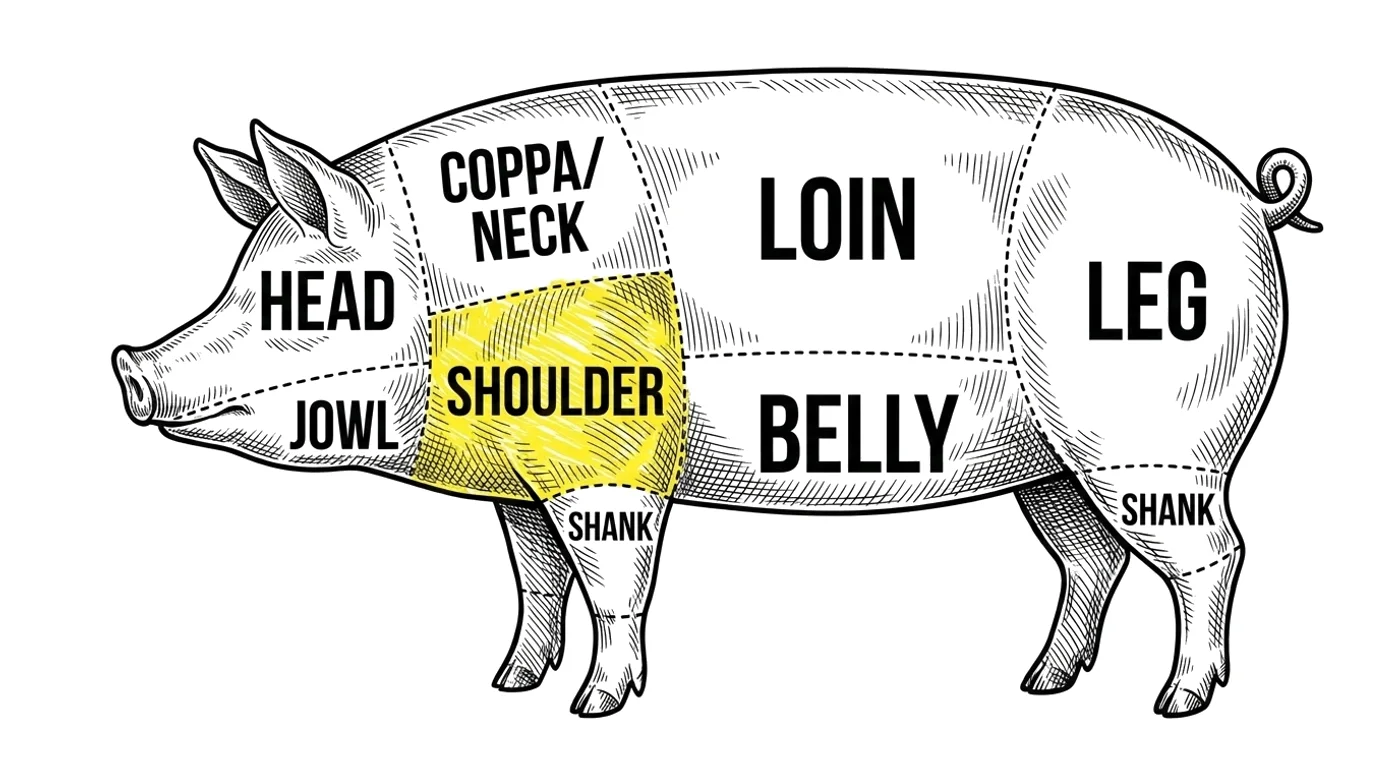
Firm back fat, pork belly or jowl provides the coarse white show pieces. A smaller fine batter made from beef or pork creates the adhesive background. Sweet and hot paprika colour the matrix and reinforce its warm aroma; pepper, marjoram, coriander, caraway, garlic and mustard seed round out the spice profile. The finished slice should display clean fat edges without smearing or grease pockets. The binding phase must be strong enough to hold the heavy inclusion load when sliced thinly.
Production and process
Lean meat is finely comminuted with ice, salt, curing salt and spices to extract protein and form a stable batter. Bacon is kept very cold and cut into regular pieces before gentle folding. The sausage is stuffed tightly into its ring or straight casing, smoked traditionally over beechwood or another clean hardwood and heated through. Rapid cooling sets the fat and stabilises the mosaic. Despite older classification as a Dauerwurst, the home branch is treated as refrigerated, not ambient stable.
History and regional forms
Austria's traditional-food register traces Speckwurst to Vienna street markets around the turn of the nineteenth century and cites an 1844 description of a sausage sold by the Würstelmann. By the early twentieth century it appeared in Austrian butcher training and recipe books as part of the standard Fleischwurst repertoire. Those records show commercial continuity rather than a single inventor. The register also documents later regional forms such as Mostviertler Speckwurst and the separate Salzburger variant.
Use, storage and related products
Serve Austrian Speckwurst thinly sliced with bread, mustard, pickles or in a cold sausage salad. A warm portion can accompany vegetables, but overheating encourages the abundant bacon to render. Declare mustard and keep the sausage refrigerated. Compare it with Salzburger only as a related Austrian branch; the Salzburger has a finer, wetter Brätwurst construction. German blood Speckwurst, Czech Špekáček and Italian speck are different products despite overlapping fat-related names.
The recipe for this product is in preparation and will be published once it has been verified.
Safety. Keep bacon semi-frozen for clean dice, calculate cure on all animal material, declare mustard, cook to a verified centre and chill quickly.