
Austrian Tiroler
Also known as Tiroler sausage, Tiroler Fleischwurst
Tyrol, Austria
Overview
Austrian Tiroler is a smoked Fleischwurst with a visibly coarse mixture of pork, hock meat, beef and belly held in a finer binding phase. The current Austrian Food Codex places Tiroler in Fleischwurst Sorte 2 b), alongside but compositionally distinct from Polnische, Käsewurst, Stuttgarter, Debreziner and Cabanossi. It is cooked after smoking and remains a refrigerated product. The dark exterior often seen commercially may come from a coloured artificial casing rather than exceptionally heavy smoke.
Where it's from
The cut
Identity and terminology
The name Tiroler means Tyrolean, but the Austrian Codex treats it as an established product designation with defined material guidance, not as an EU PDO or PGI. It must also be separated from Tiroler St. Johanner, which the same Codex places in a different subcategory and gives a different composition. The source's short title is therefore retained with Austrian as a geographic qualifier, while any claim such as original Tyrolean manufacture still requires truthful provenance.
Composition and characteristics
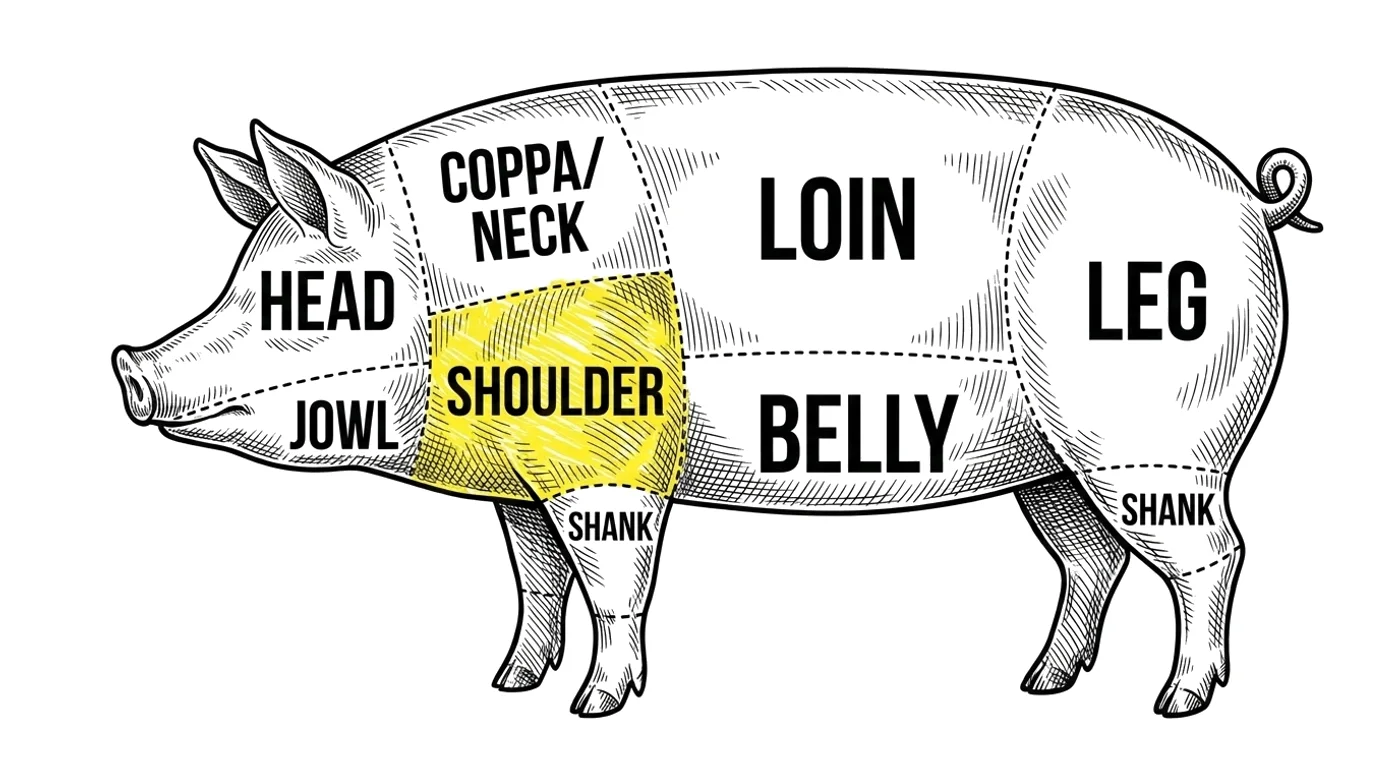
The Codex architecture combines quality pork or some beef, coarsely trimmed hock meat, firm speck and a substantial brät fraction. The executable source branch approximates that structure through coarse pork, collagen-rich hock, belly and beef worked with ice. Pepper, caraway, coriander, juniper, garlic and a small mustard-seed addition create a central-European profile. The cut face should be reddish, moist and cohesive with visible coarse particles, not a smooth bologna or a dry salami.
Production and process
Beef is ground fine enough to form the binding phase, while pork remains coarser and belly is reduced separately. Ice, salt and curing salt are worked into the lean fraction below the fat-smear threshold. The filling is packed into a broad casing, surface-dried, smoked and scalded to a verified centre. Clean food-approved hardwood smoke is required. Burning resinous conifer wood to force a black coating is neither necessary nor adopted in the controlled formula.
History and regional forms
The source attributes the product to the early twentieth century and describes a formerly black-smoked style. The current Austrian Codex is firmer evidence for modern identity and composition than that unsourced origin story. It also shows that Tiroler remains part of Austrian trade practice and that smoked labelling is expected. Modern mass-produced examples, black casings and regional butcher versions can vary, but the Codex boundary prevents the name from becoming a generic dark sausage.
Use, storage and related products
Slice Tiroler cold for a Jause with bread, mustard, pickles and cheese, or warm a portion gently. Declare mustard in this branch and check any artificial casing before service. Tiroler differs from Kochsalami because the Austrian Codex classifies it as Fleischwurst, from Speckwurst through its balanced meat structure, and from Tiroler St. Johanner through category and composition. Refrigerate the cooked sausage and freeze surplus rather than attempting optional home drying.
The recipe for this product is in preparation and will be published once it has been verified.
Safety. Follow the Austrian Codex material boundary, declare mustard, reject resinous smoke, verify a 72°C centre and keep the moist product refrigerated.