
Overview
Bangers is the familiar British informal name for fresh sausages, especially the pork sausages served with mashed potatoes as bangers and mash. It is not one historical regional recipe. The word covers a broad market class ranging from coarse butcher's sausages to finely minced, rusk-containing catering sausages.
Where it's from
The cut
Identity and terminology
Banger is colloquial rather than a protected or compositional name. British products are normally sold under more precise labels such as pork sausage, beef sausage, Cumberland sausage or Lincolnshire sausage. The popular explanation that the name arose because high-water wartime sausages burst in the pan is widespread, but the term was recorded before the Second World War and should not be presented as a proven single-origin story.
Composition and characteristics
Typical British bangers combine meat and fat with salt, pepper, herbs or spices, and often rusk or breadcrumbs with water. The cereal component contributes binding, moisture retention and the soft, cohesive texture associated with many British sausages. Natural or collagen casings and linked forms are common.
Production and process
They are made as raw fresh sausages by mincing chilled meat and fat, hydrating any rusk or crumb, mixing to a bind and stuffing into links. Butcher-made versions may be coarse and highly seasoned, while mass-market bangers are often finer and more uniform. They are grilled, fried, roasted or baked.
History and regional forms
The category reflects the industrialisation of British sausage manufacture and the long British practice of extending sausage meat with bread, meal or rusk. It became especially visible in institutional catering, workers' meals and wartime food economies, then entered popular culture through the phrase bangers and mash.
Use, storage and related products
Bangers are served with mash and onion gravy, in cooked breakfasts, casseroles, toad in the hole and sausage sandwiches. They remain distinct from protected regional sausages and from cooked frankfurter-type products. Raw links require refrigeration and full cooking.
Recipe and cure
This is not a finished recipe. It is a window into how this meat is traditionally cured. Before you follow any process, run it through one of our curing calculators so the salt, cure and timings are right and safe for your own batch.
Make this — the measured Curesmith version →“Make this” opens the same cure as a measured recipe, scaled to your batch.
- Meat
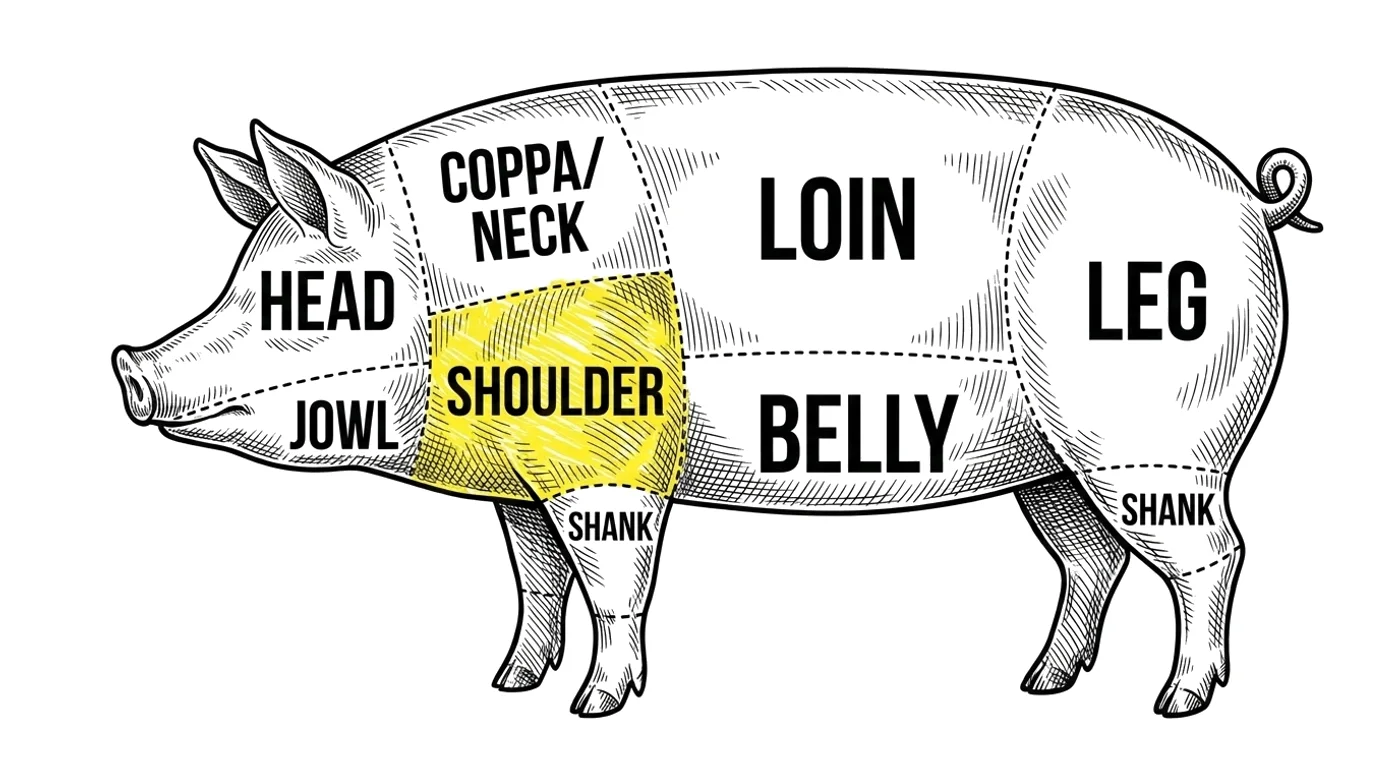
- Pork shoulder
- Cut
- Pork shoulder
- Salt (%)
- 1.8
- Curing salt
- None
- Fermented
- No
- Smoked
- No
- Maturation
- Raw sausage ≤4°C for up to 2 days; freeze for longer storage
- Basis
- per 1,000 g pork shoulder
- Style
- Fresh pork sausage; cook before eating
Ingredients
- Pork shoulder100% · 1000 g
- Skinless pork belly45% · 450 g
- Fine rusk5.9% · 85.5 g
- Ice-cold water11.8% · 171.5 g
- Fine salt1.8% · 25.5 g
- Fresh garlic, finely minced0.99% · 14.5 g
- Ground black pepper0.2% · 3 g
- Dried marjoram0.05% · 0.7 g
- Dried oregano0.05% · 0.7 g
- Dried savory0.1% · 0.7 g
- Dried rosemary, finely ground0.1% · 0.7 g
- Dried thyme0.05% · 0.7 g
Method
- Chill the pork, belly and equipment to 0–3°C.
- Grind shoulder and belly together through 6 mm.
- Combine rusk with the measured water and stand for 5 minutes.
- Add salt, garlic, pepper and herbs to the meat, then add hydrated rusk. Mix until evenly distributed and lightly tacky.
- Stuff into 32–36 mm hog casings and link at the required size.
- Refrigerate for 4–12 hours at 2–4°C to allow even hydration and flavour distribution.
Safety. Bangers are raw sausages. Browning and casing split are not reliable indications of doneness.