
Overview
Bierschinken is a large German cooked sausage built around a pale-to-pink fine emulsion carrying conspicuous pieces of lean cured pork. Its visual identity is the point: a slice should show plentiful red meat islands in a cohesive matrix. Despite the name, beer is not a defining ingredient; the sausage is conventionally eaten with bread and beer rather than made from beer.
Where it's from
The cut
Identity and terminology
Germany's current meat-product guidelines place Bierschinken among Brühwürste mit Einlagen, cooked sausages with inclusions. They describe low-fat, low-connective-tissue meat pieces, generally cherry- to walnut-sized, in a fine base and normally in a large casing. For samples over 600 g, the coarse lean-meat inlay is expected to constitute at least half the product. The guidelines express established trade understanding and function as expert benchmarks; they are not a geographical indication.
Composition and characteristics
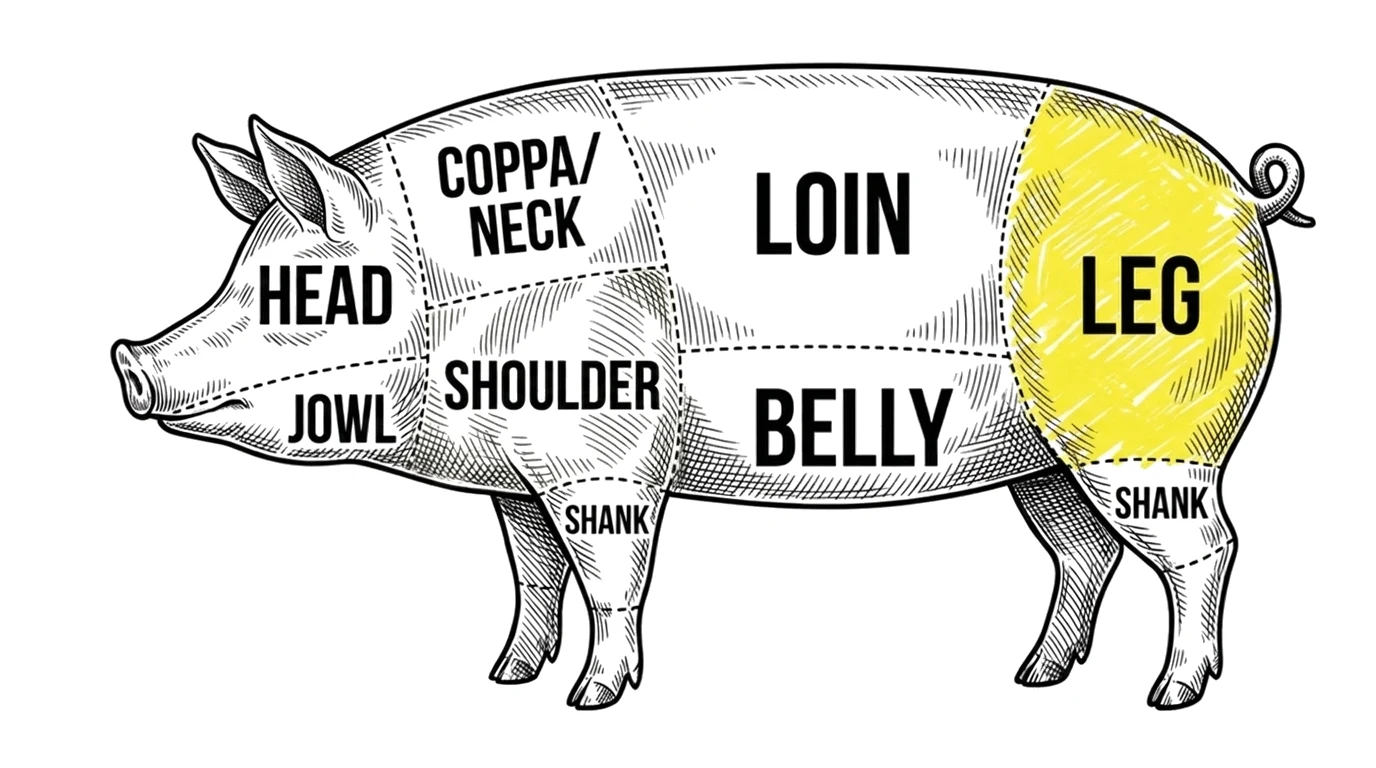
The characteristic cut face separates Bierschinken from uniformly fine Lyoner-type sausage. Lean ham or shoulder supplies the show pieces; a finely comminuted pork-and-fat matrix binds them. The lean pieces are more than decoration: they are the reason the product carries a ham-like identity and higher meat expectation. Curing gives the meat pieces their red colour, while pepper, mace and restrained warm spices support rather than obscure the pork. A good slice is firm and clean-cut, with distributed inlays instead of a few token cubes.
Production and process
The show meat is cut coarsely and cured separately so that it retains colour and structure. The remaining lean pork and fat are minced or emulsified with chilled water and seasoning to form a sticky matrix. The components are folded together without smearing, filled into a broad casing and cooked through. The large diameter makes cold-point temperature, rather than a fixed clock time, the decisive cooking control.
History and regional forms
Bierschinken belongs to the mature German Brühwurst tradition in which named products are distinguished by raw-material quality, particle size, casing and visible inlay. The name is best understood as a serving association rather than an ingredient list. No single town origin or invention date is established for it.
Use, storage and related products
Bierschinken is commonly sliced cold for bread, rolls and mixed cold-cut plates. It is related to Jagdwurst and other inlay sausages but is distinguished by its notably high proportion of coarse lean meat and large format. It should not be confused with Bierwurst, whose identity is coarser-grained, strongly seasoned and often smoked. The cooked product remains perishable and refrigerated.
Recipe and cure
This is not a finished recipe. It is a window into how this meat is traditionally cured. Before you follow any process, run it through one of our curing calculators so the salt, cure and timings are right and safe for your own batch.
Make this — the measured Curesmith version →“Make this” opens the same cure as a measured recipe, scaled to your batch.
- Meat
- Lean pork ham, diced 10 mm
- Cut
- Lean pork ham, diced 10 mm
- Salt (%)
- 1.75
- Curing salt
- Cure #1/#2 as specified
- Fermented
- No
- Smoked
- Yes
- Basis
- per 1,000 g lean pork ham, diced 10 mm
- Style
- Cooked fine matrix with visible cured ham cubes.
Ingredients
- Lean pork ham, diced 10 mm100% · 1000 g
- Pork shoulder90% · 900 g
- Lean beef40% · 400 g
- Pork back fat25% · 250 g
- Fine salt1.7% · 44 g
- Cure #1 containing 6.25% sodium nitrite0.25% · 6.5 g
- Dextrose0.2% · 5 g
- White pepper0.15% · 4 g
- Dry mustard0.1% · 2.5 g
- Onion powder0.1% · 2.5 g
- Ground ginger0.05% · 1.5 g
- Ground mace0.05% · 1.5 g
- Crushed ice11.8% · 300 g
- Nonfat dry milk2% · 50 g
Safety. Smoke and a cured colour do not establish shelf stability or lethality. It is a fully cooked sausage, kept refrigerated, and a large casing needs the cold point checked rather than the clock.