
Overview
Bierwurst is a German cured cooked sausage with a coarse or medium-coarse grain, robust seasoning and, in many versions, a smoked exterior. It is typically made from beef, pork and firm bacon or back fat and sold in a large casing. The name signals a sausage suited to beer and bread; beer itself is not required in the batter.
Where it's from
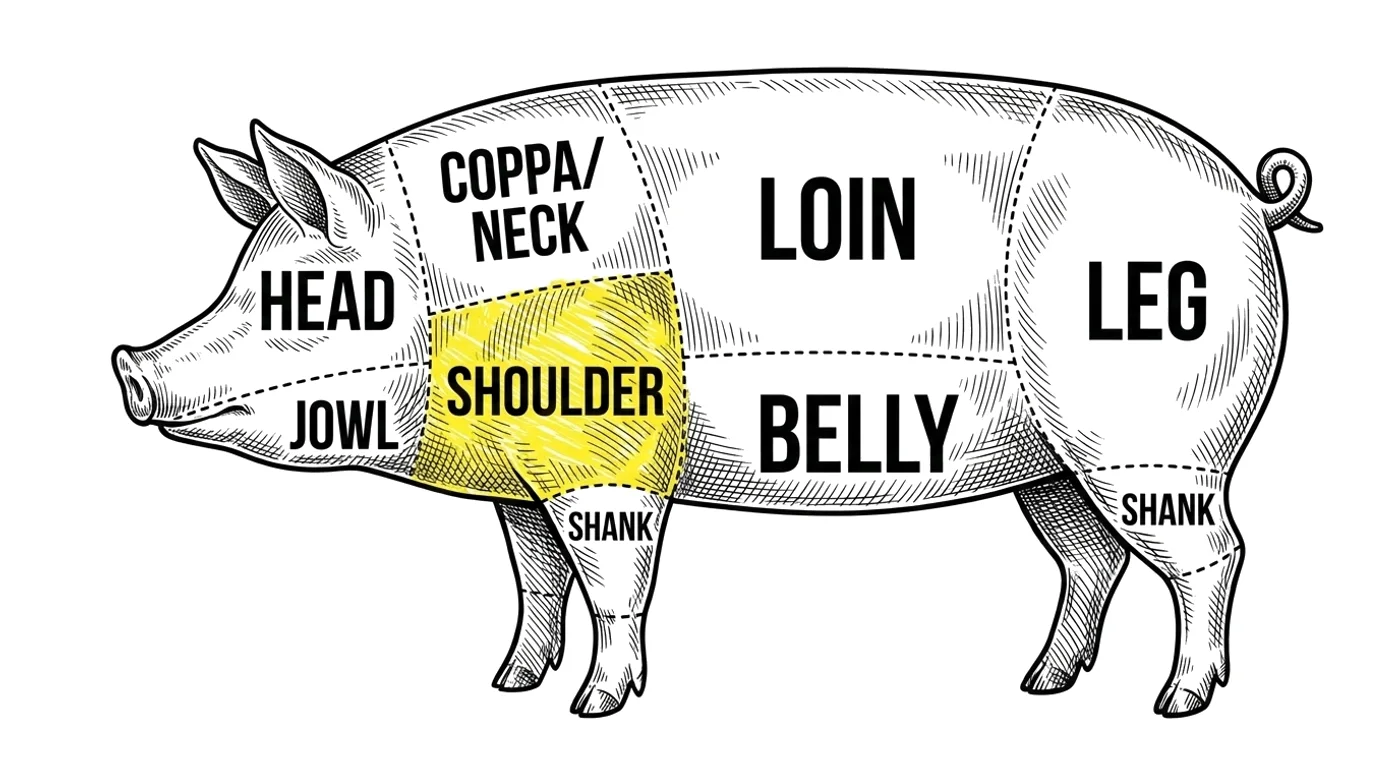
The cut
Identity and terminology
The current German meat guidelines require a careful distinction between Bayerische Bierwurst and other Bierwurst usage. Bayerische Bierwurst appears among coarse Brühwurst made from beef, pork and bacon with particles up to about pea size, while Bierwurst also appears in a separate guideline group with different analytical expectations. The formula developed here is a Bavarian-style branch. Not every sausage sold as Bierwurst is compositionally the same.
Composition and characteristics
A typical Bavarian-style formula combines lean beef for bind and colour, pork for body and firm back fat for visible pale particles. Garlic, white pepper, paprika, mustard, mace and nutmeg create a savoury, aromatic profile. The cut face is cured pink to red with a distinct but not chunky grain; the casing may carry smoke colour. Fat smearing, weak binding or a completely smooth slice would remove the coarse character expected of Bierwurst. Its seasoning and grain distinguish it from fine Fleischwurst.
Production and process
Beef and pork are cured cold, then minced separately so the maker can build a fine binding phase while preserving a coarse fat pattern. The seasoned mixture is filled into a large casing, surface-dried and smoked before cooking. Smoke is a flavour and appearance stage, not proof of lethality. The finished sausage must reach 71°C in the centre and then be cooled quickly through the bacterial growth range.
History and regional forms
Bierwurst's strongest named regional branch is Bavarian, but the official national guidelines show that the term has circulated more broadly and does not represent one immutable recipe. Large natural bladders and modern fibrous casings both occur. Some commercial products are marketed as longer-keeping sausage, but that claim depends on an applicable validated process and composition; it cannot be inferred from smoke or the traditional name.
Use, storage and related products
Bierwurst is sliced for open sandwiches, snacks and cold platters, often alongside mustard, pickles and beer. It is more uniformly coarse and more assertively spiced than Bierschinken, which is defined by abundant large lean-meat inlays. The cooked branch described here is refrigerated, not shelf stable, and should be kept cold after slicing.
Recipe and cure
This is not a finished recipe. It is a window into how this meat is traditionally cured. Before you follow any process, run it through one of our curing calculators so the salt, cure and timings are right and safe for your own batch.
Make this — the measured Curesmith version →“Make this” opens the same cure as a measured recipe, scaled to your batch.
- Meat
- Pork shoulder
- Cut
- Pork shoulder
- Salt (%)
- 1.75
- Curing salt
- Cure #1/#2 as specified
- Fermented
- No
- Smoked
- Yes
- Basis
- per 1,000 g pork shoulder
- Style
- Representative coarse-inclusion cooked Bierwurst.
Ingredients
- Pork shoulder100% · 1000 g
- Lean beef50% · 500 g
- Pork back fat30% · 300 g
- Lean pork cubes, 8 mm20% · 200 g
- Fine salt1.8% · 35 g
- Cure #1 containing 6.25% sodium nitrite0.25% · 5 g
- Black pepper0.2% · 4 g
- Mustard seed0.3% · 6 g
- Garlic0.2% · 4 g
- Ground coriander0.1% · 2 g
- Sweet paprika0.15% · 3 g
- Crushed ice10% · 200 g
Safety. Smoke does not establish shelf stability or lethality. It is fully cooked, and it is kept refrigerated.