
Blanco de Alicante
Also known as blanco alicantino, embutido blanco de Alicante
Alicante, Valencian Community, Spain
Overview
Blanco de Alicante is an uncured white cooked pork sausage associated by name with Alicante and the wider eastern Spanish blanco tradition. Its formula is direct: lean pork and fatty dewlap, seasoned with pepper, cinnamon and a trace of clove, are stuffed into relatively narrow casings and gently cooked. The pale colour is a consequence of the uncured meat system, not an undercooked centre.
Where it's from
The cut
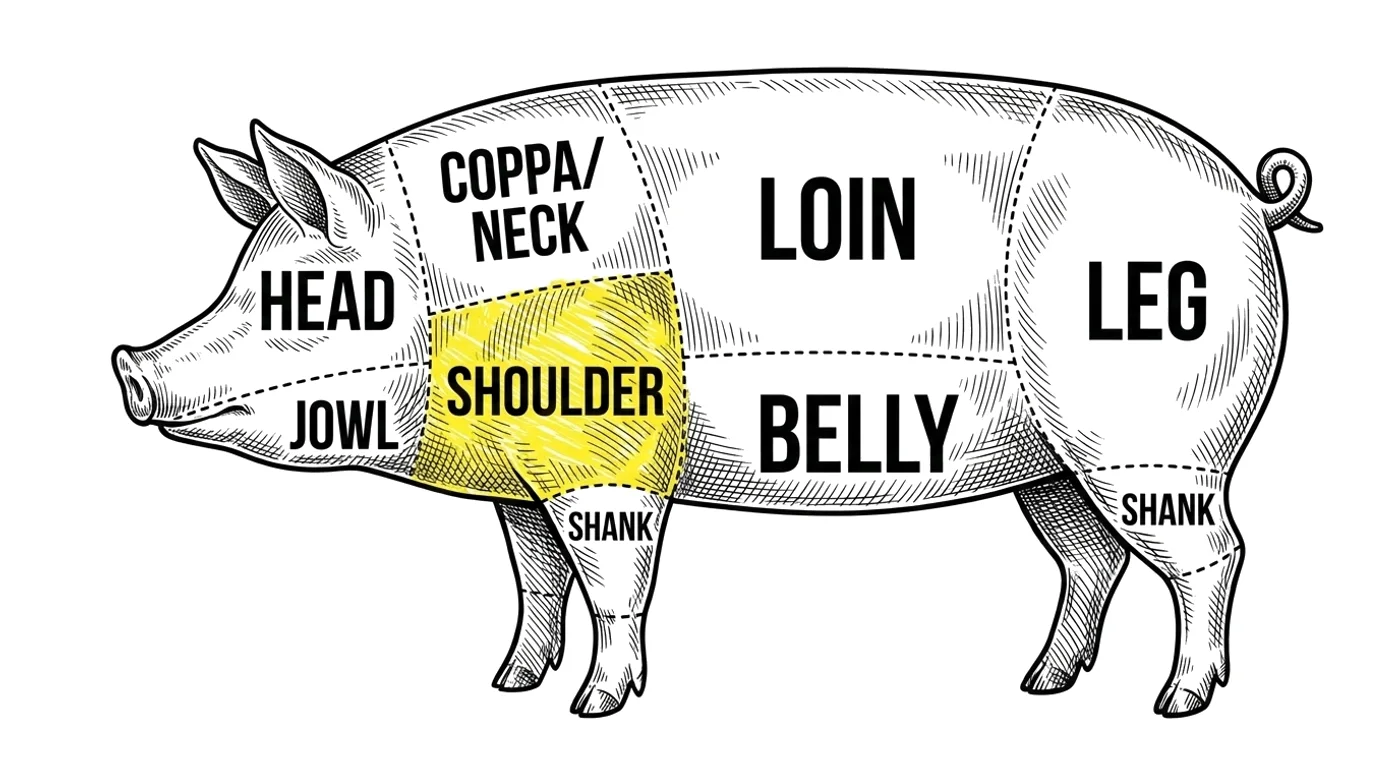
Identity and terminology
Blanco simply means white, a descriptive name used for several eastern Spanish cooked sausages. A Spanish Ministry of Agriculture culinary survey of the Valencian Community singles out blanco among the region's sausages and notes the characteristic contribution of cinnamon, especially in larger casings. The geographic qualifier de Alicante narrows this source identity, but the exact name does not appear in Spain's current official list of registered geographical indications.
Composition and characteristics
Equal portions of lean pork and dewlap create a rich but sliceable texture. Black pepper supplies bite, while cinnamon and clove give the warm aromatic profile found in several Levantine pork sausages. There is no paprika-driven red colour and no curing salt in the developed branch. The finished sausage should be ivory to light grey inside, juicy, cohesive and cleanly spiced.
Production and process
Cold pork and dewlap are minced to a medium grain and mixed until protein extraction binds the high-fat batter. The mixture is linked in pork or veal casing and poached gently so the fat remains emulsified. A measured cold-point endpoint is more reliable than a fixed half-hour, particularly when link diameter changes. Rapid cooling preserves texture and moves the cooked sausage safely into refrigerated storage.
History and regional forms
Institutional writing places blanco within the Valencian catalogue of local embutidos, but the available official material does not document a single invention date or exclusive Alicante specification. It is safer to understand Blanco de Alicante as a locally named branch of an eastern Spanish family whose seasoning and calibre vary between towns and makers. That family relationship does not erase the Alicante label used by the source formula.
Use, storage and related products
The sausage may be sliced cold, warmed gently, fried or added to rice and bean dishes. It is related to Murcian and Valencian blancos and to Balearic blanquet, but this branch lacks the cooked head meat, egg or pine nuts found in some related formulas. Its white appearance must not be used as a doneness test; the cooked product remains perishable and refrigerated.
Recipe and cure
This is not a finished recipe. It is a window into how this meat is traditionally cured. Before you follow any process, run it through one of our curing calculators so the salt, cure and timings are right and safe for your own batch.
Make this — the measured Curesmith version →“Make this” opens the same cure as a measured recipe, scaled to your batch.
- Meat
- Lean pork shoulder
- Cut
- Lean pork shoulder
- Salt (%)
- 2.1
- Curing salt
- None
- Fermented
- No
- Smoked
- No
- Maturation
- Cooked sausage 0–4°C for up to 5 days; freeze for longer storage
- Basis
- per 1,000 g lean pork shoulder
- Style
- Alicante-style uncured cooked white pork sausage
Ingredients
- Lean pork shoulder100% · 1000 g
- Skinless pork dewlap100% · 1000 g
- Fine salt2.1% · 42 g
- Ground black pepper0.2% · 4 g
- Ground cinnamon0.1% · 2 g
- Ground clove0.03% · 0.6 g
Method
- Chill pork and dewlap until firm, then grind separately through 6 mm.
- Mix pork, dewlap, salt, pepper, cinnamon and clove until cohesive without smearing.
- Stuff into 20–30 mm casing and link at 10–15 cm; remove visible air pockets.
- Poach in 78–80°C water until the cold point reaches 72°C.
- Cold-water or ice-water cool, then refrigerate.
- Refrigerate wrapped. The sausage is fully cooked; it may be served cold or reheated.
Safety. The pale centre is normal for an uncured sausage. Verify the cooking endpoint instrumentally and cool rapidly.