
Overview
Boerewors is South Africa's best-known fresh sausage and one of the foods most closely associated with the braai. It is normally sold as a long, unlinked coil in an edible casing, with a coarse, visibly minced filling rather than the smooth paste of an emulsified sausage. The name is Afrikaans. Boer can mean a farmer and also refers historically to the Dutch-speaking settler communities from which Afrikaner identity developed, while wors means sausage. Although its name and early cultural associations are Afrikaner, boerewors has long since become a national South African food made, sold and eaten across language and community boundaries.
Where it's from
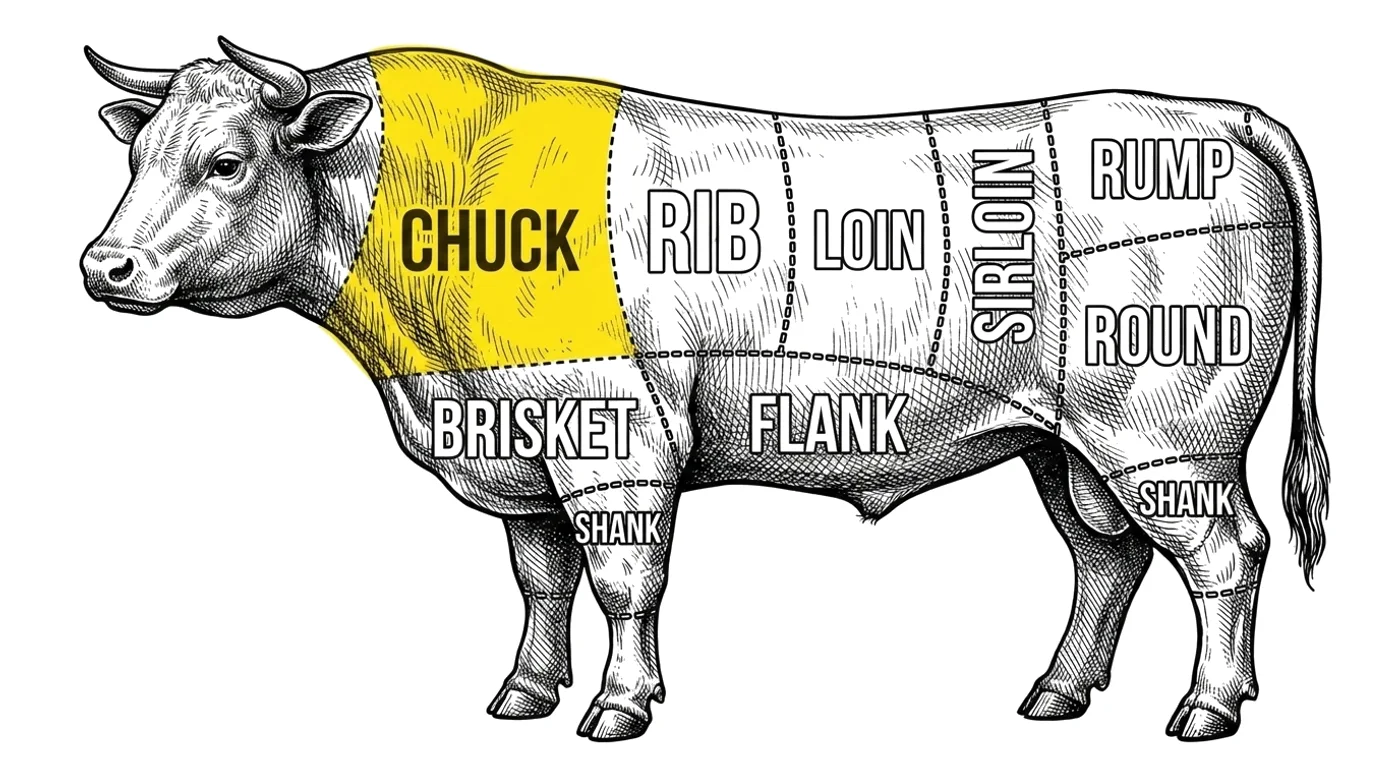
The cut
Identity and terminology
Boerewors is not simply any sausage cooked over a fire. South African law treats raw boerewors as a defined class and applies the standard whenever the word boerewors appears in a product name, alone or with another expression. The legal identity requires meat from cattle, sheep, pigs or goats, singly or in combination, in an edible casing. It excludes offal, mechanically recovered meat and added colourants, and restricts the permitted non-meat ingredients to a narrow list that includes cereal or starch, vinegar, spices, herbs, salt, approved additives and water. Products that fall outside that identity are more accurately described as wors, braaiwors, species sausage or flavoured sausage, depending on their composition.
Composition and characteristics
Traditional and butcher-made boerewors usually combines beef with pork or sheep meat and firm fat, although the legal definition allows several domestic red-meat species. Coriander is the seasoning most strongly associated with the style, commonly supported by black pepper, cloves, nutmeg or allspice and a measured acidity from vinegar. The mixture is coarsely minced and should show discrete lean and fat particles at the cut face. A good coil is plump but not overfilled, brown and caramelised after cooking, juicy without being greasy, and aromatic with toasted coriander. The continuous spiral is a practical butchers' form and has also become the product's most recognisable visual marker.
Production and process
Boerewors is made as a raw fresh sausage. Chilled meat and fat are cut or minced relatively coarsely, mixed with the seasoning system and stuffed into an edible casing, traditionally a natural casing. The sausage is commonly left in one coil rather than twisted into short links. Butcher production favours a loose, open texture that remains succulent on the braai, while industrial versions may use tighter particle control and mechanised filling. It is cooked by braaiing, grilling or pan-frying. The coil is often turned as a whole, and piercing is avoided because it releases fat and meat juices. It remains a raw, perishable product until fully cooked.
History and regional forms
The roots of boerewors lie in the food culture that developed at the Cape after Dutch settlement began in the seventeenth century. Research into early Cape cookery identifies Dutch, German and French-speaking European traditions among its principal foundations, including established habits of sausage making and spice use. These practices were adapted to local livestock, climate and domestic farming life. The later name boerewors linked the sausage to Boer farming households and, increasingly, to Afrikaner food culture. In the twentieth century it moved from farm and household production into urban butcheries, supermarkets, sporting events and public braais. Regional and family formulas differ, but coriander, vinegar, coarse texture and the coiled form remain the strongest continuities.
Use, storage and related products
Boerewors is most characteristically cooked over coals and served with pap, tomato-and-onion sauce, chakalaka, bread or salads. It is also used in a boerewors roll, where a length of grilled sausage is placed in a bread roll with onion relish or sauce. Raw boerewors must be refrigerated and cooked before eating. It is distinct from droëwors, which is a dried sausage, and from braaiwors, bangers and flavoured mixed-species sausages, which may follow less restrictive composition rules. The word boerewors on a label is a legal identity claim in South Africa, not merely a suggestion of South African flavour.
Recipe and cure
This is not a finished recipe. It is a window into how this meat is traditionally cured. Before you follow any process, run it through one of our curing calculators so the salt, cure and timings are right and safe for your own batch.
Make this — the measured Curesmith version →“Make this” opens the same cure as a measured recipe, scaled to your batch.
- Meat
- Beef chuck
- Cut
- Beef chuck
- Salt (%)
- 1.6
- Curing salt
- None
- Fermented
- No
- Smoked
- No
- Maturation
- Raw Boerewors ≤4°C for up to 2 days; freeze for longer storage
- Basis
- per 1,000 g beef chuck
- Style
- Fresh mixed-species sausage in a continuous coil; cook before eating
Ingredients
- Beef chuck100% · 1000 g
- Pork shoulder55% · 550 g
- Pork back fat15% · 150 g
- Potable water2.9% · 50 g
- Cider vinegar2.9% · 50 g
- Fine salt1.8% · 30 g
- Ground black pepper0.24% · 4 g
- Roasted ground coriander seed0.12% · 2 g
- Ground nutmeg0.06% · 1 g
- Ground cloves0.04% · 0.6 g
- Ground allspice0.06% · 1 g
Method
- Weigh the lean meats and separately weighed fats. The finished formula contains more than 90% meat ingredients and is formulated below 30% fat.
- Chill meats, fats and equipment to 0–3°C.
- Grind all meat and fat once through 8 mm.
- Dissolve salt and spices in the water and vinegar. Add to the meat and mix only until evenly distributed and lightly cohesive.
- Stuff into hog casing as a continuous coil, avoiding trapped air.
- Refrigerate for 4–12 hours at 2–4°C.
Safety. Boerewors is a raw refrigerated sausage. It requires full cooking and protection from cross-contamination. Braai colour, casing browning and firmness are not reliable evidence that the centre is safe.