
Botifarra Catalana
Also known as Butifarra catalana, Botifarra catalana trufada
Catalonia, Spain
Overview
Botifarra Catalana is a large cooked pork sausage made from carefully trimmed lean meat, sometimes softened with a modest amount of jowl or streaky bacon. Its slice is smooth and pink, its flavour mild and aromatic, and dark truffle flecks may punctuate the cut surface. The truffled form is an established variation rather than a separate sausage family.
Where it's from
The cut
Identity and terminology
The qualifier catalana separates this cooked slicing sausage from the much broader botifarra family. It is not Botifarra crua, the raw coarse sausage cooked by the consumer, and it is not the egg, blood or kettle-cooked offal forms. The Spanish spelling butifarra is common, while botifarra is the Catalan form used by the regional product inventory.
Composition and production
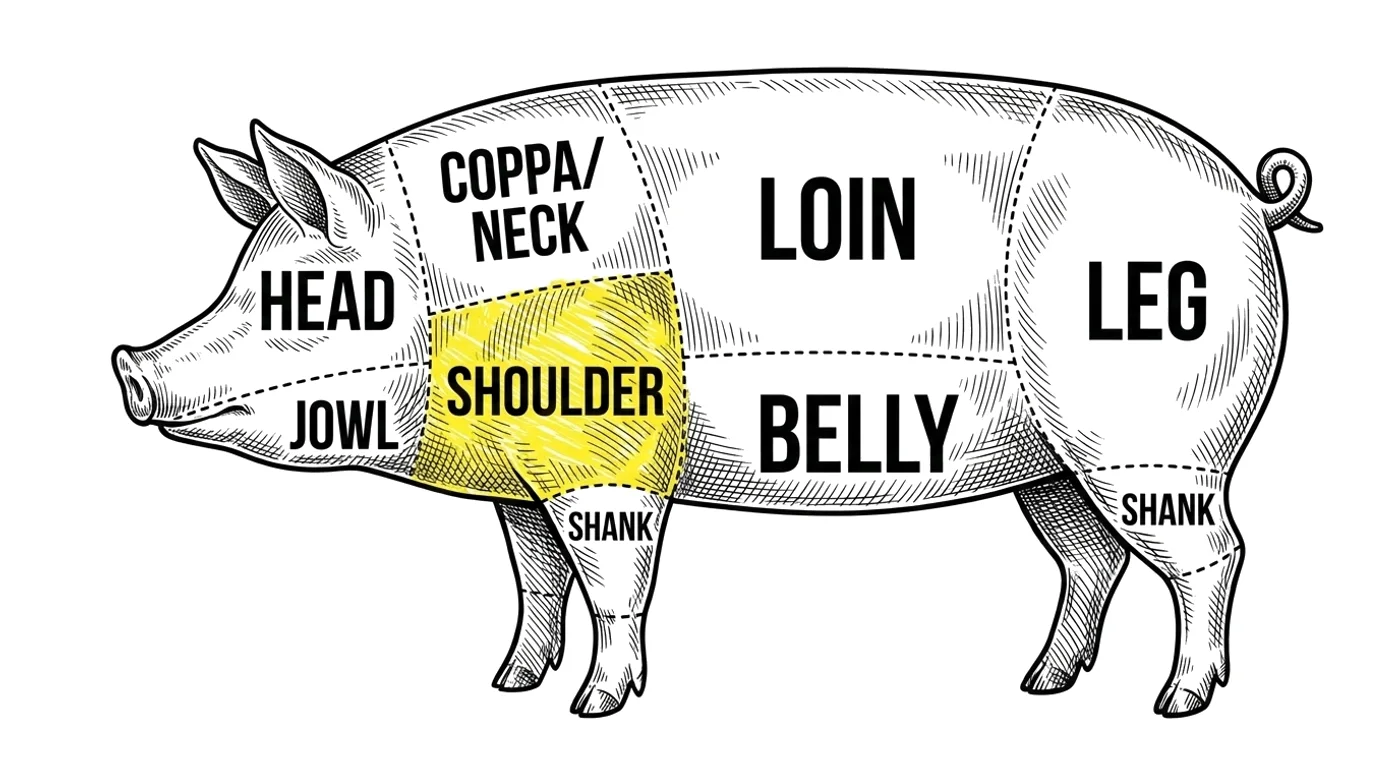
Lean leg and shoulder are trimmed closely, salted and traditionally nitrified during a refrigerated rest. The cured meat is seasoned with restrained sweet spice and may receive dry wine, green pepper or truffle. It is stuffed into a relatively broad casing, cooked in the kettle, cooled and held under refrigeration. The fine pink slice comes from meat selection, curing and gentle cooking, not from fermentation or drying.
Serving and cultural place
It is sold by the piece or sliced and is commonly eaten cold with bread rubbed with tomato. It also appears in sandwiches, mixed charcuterie plates and salads, where its mild flavour makes it more versatile than strongly smoked or fermented sausages. Vacuum packing extends refrigerated life but does not make the product shelf stable.
How to recognise it
A sound Botifarra Catalana has a broad, tidy slice, a pink lean matrix and a tender, succulent texture. Truffled versions show small, irregular dark fragments rather than a uniformly dark paste. It should not be confused with mortadella, which has a different emulsion structure and conspicuous fat inclusions, or with Botifarra blanca, whose paler filling often uses head meat.
Origins and history
The Generalitat describes Botifarra Catalana as a sausage developed and produced in Catalonia from the nobler cuts of pork. Industrial manufacture widened its distribution, but the product remains rooted in the Catalan cansaladeria. Truffle reflects both an older taste for luxurious cooked charcuterie and the importance of black truffle in inland Catalonia.
Recipe and cure
This is not a finished recipe. It is a window into how this meat is traditionally cured. Before you follow any process, run it through one of our curing calculators so the salt, cure and timings are right and safe for your own batch.
Make this — the measured Curesmith version →“Make this” opens the same cure as a measured recipe, scaled to your batch.
- Meat
- Lean pork leg and shoulder
- Cut
- Lean pork leg and shoulder
- Salt (%)
- 1.8
- Curing salt
- Cure #1 as specified in the recipe
- Fermented
- No
- Smoked
- No
- Maturation
- 0–4°C; consume within 5 days or freeze
- Basis
- per 1,000 g lean pork leg and shoulder
- Style
- Catalan cured cooked pork sausage with black truffle
Ingredients
- Lean pork leg and shoulder100% · 1000 g
- Skinless pork belly35% · 350 g
- Fine salt1.7% · 24 g
- Cure #1, 6.25% nitrite0.24% · 3.5 g
- Ground white pepper0.48% · 6.5 g
- Sugar0.48% · 6.5 g
- Ground nutmeg0.05% · 0.7 g
- Fresh black truffle, finely chopped4% · 40 g
Method
- Trim lean pork thoroughly and chill pork and belly to 0–4°C.
- Mix the complete meat-and-fat block with salt, Cure #1 and sugar; cover and cure under refrigeration for 48 hours.
- Grind lean pork through 6 mm and belly through 3 mm while both remain firm.
- Mix pork, belly, pepper, nutmeg and truffle until cohesive and evenly distributed.
- Stuff firmly into the selected casing and remove trapped air.
- Hold the stuffed sausage at 0–4°C for 8–12 hours.
Safety. This is a cured, fully cooked, high-moisture sausage. Cure must be measured on the complete meat-and-fat block, cooking verified at the cold point, and cooling and refrigeration controlled.