
Botifarra de Perol
Also known as Botifarra del perol, Botifarra perol, Botifarra de parracs
Catalonia, Spain
Overview
Botifarra de Perol is a grey, richly flavoured cooked sausage from the north-eastern Catalan pork-butchery tradition. Its filling is built from tender head meat, tongue and selected organs with skin and jowl, ingredients first cooked in the butcher's kettle. Fine grinding produces a close but still meaty texture suited both to slicing and to breaking open in a hot pan.
Where it's from
The cut
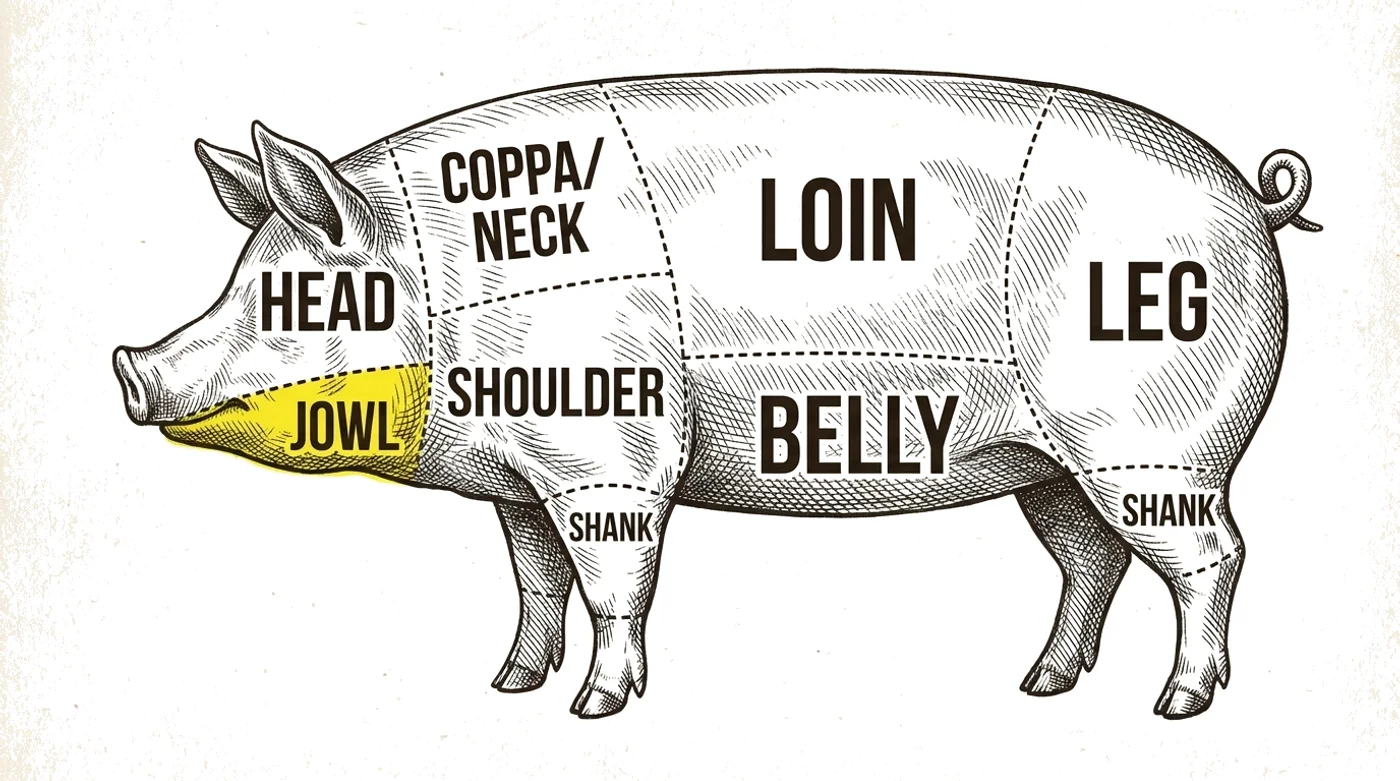
Name and regional identity
Perol is the Girona-area word for the large kettle in which sausages and their component meats were cooked. The name therefore records a method and a working vessel rather than a spice or animal breed. The Generalitat places the tradition in the Girona districts, Osona, Ripollès and Maresme, with related sausages elsewhere in Catalonia.
History and development
The sausage belongs to household and small-shop pig slaughter, when head cuts, skin and edible organs were converted quickly into cooked products. The kettle brought tougher collagen-rich pieces to tenderness and supplied the name that distinguished this sausage from raw, blood and fine lean-meat botifarres. Modern makers may favour selected head meats over the widest historical offal mixture.
Composition and production
Cheek, ear, snout, tongue and heart are typical, supported by skin and jowl for gelatin and richness. Components are cleaned, cooked until tender, chopped or finely ground, seasoned chiefly with salt and black pepper, and stuffed into narrow pork casing. A final kettle cook sets the filled sausage before immediate cooling.
Serving and cultural place
It may be sliced cold when freshly made, grilled, fried with white beans or allowed to burst and brown with cabbage, potatoes or pulses. Some cooks use a slightly dried piece to enrich stews and broad-bean dishes. Whatever the service, the sausage remains a perishable cooked product rather than a dry-cured one.
How to recognise it
Botifarra de Perol is usually tied into a short horseshoe with a grey-beige cut surface and a moist, soft grain. It is more collagenous and savoury than Botifarra Catalana, lacks the yellow cast of Botifarra d'Ou and contains no blood, which separates it from Botifarra negra. The casing may loosen when the sausage is fried and deliberately broken apart.
Recipe and cure
This is not a finished recipe. It is a window into how this meat is traditionally cured. Before you follow any process, run it through one of our curing calculators so the salt, cure and timings are right and safe for your own batch.
Make this — the measured Curesmith version →“Make this” opens the same cure as a measured recipe, scaled to your batch.
- Meat
- Pork cheek, ear and snout meat, cleaned
- Cut
- Pork cheek, ear and snout meat, cleaned
- Salt (%)
- 1.8
- Curing salt
- None
- Fermented
- No
- Smoked
- No
- Maturation
- 0–4°C; consume within 5 days or freeze
- Basis
- per 1,000 g pork cheek, ear and snout meat, cleaned
- Style
- Catalan cooked head-meat and jowl sausage
Ingredients
- Pork cheek, ear and snout meat, cleaned100% · 1000 g
- Pork tongue, peeled20% · 200 g
- Pork heart20% · 200 g
- Pork skin, scraped and cleaned20% · 200 g
- Pork jowl40% · 400 g
- Fine salt1.8% · 36 g
- Ground black pepper0.4% · 8 g
- Ground cinnamon0.05% · 1 g
- Ground nutmeg0.03% · 0.6 g
- Ground cloves0.03% · 0.6 g
Method
- Prepare only legally edible, inspected head meats and offal. Scrape skin and remove glands, bone fragments and hard tissue.
- Simmer head meats, tongue, heart, skin and jowl separately as needed until tender.
- Drain and chill the cooked components rapidly, then grind through 4.5 mm.
- Mix with salt, pepper, cinnamon, nutmeg and cloves until evenly distributed.
- Stuff into hog casing and tie as 20–30 cm horseshoes.
- Poach in 78–80°C water until the cold point reaches 72°C.
Safety. Use only inspected, legally edible head meat and offal. Clean and pre-cook components carefully, then apply a measured final cook after stuffing, cool rapidly and refrigerate.