
Botifarra Traïdora
Also known as Traïdora, Traïdura, Botifarra de freixura, Corada
Catalonia, Pyrenean counties, Spain
Where it's from
The cut
Identity
Botifarra traïdora is a raw fresh sausage of the Catalan Pyrenees made from the less prestigious but flavourful materials of household pig slaughter. The Generalitat inventory classifies it with raw botifarres, not cooked sausages. It appears as tied strings in calibres from roughly 24 to 45 mm and has a darker red-brown colour than ordinary botifarra crua.
Slaughter-day history
The sausage was prepared during the matança in Alta Ribagorça, Alt Urgell, Pallars Jussà, Pallars Sobirà and Val d'Aran. It used trimmings, kidneys, head meat and assorted freixures that needed prompt use. Its high fat content made it liable to turn rancid quickly, so it was prized for immediate cooking while the better-meat sausage was still too freshly seasoned to have developed much flavour.
Composition
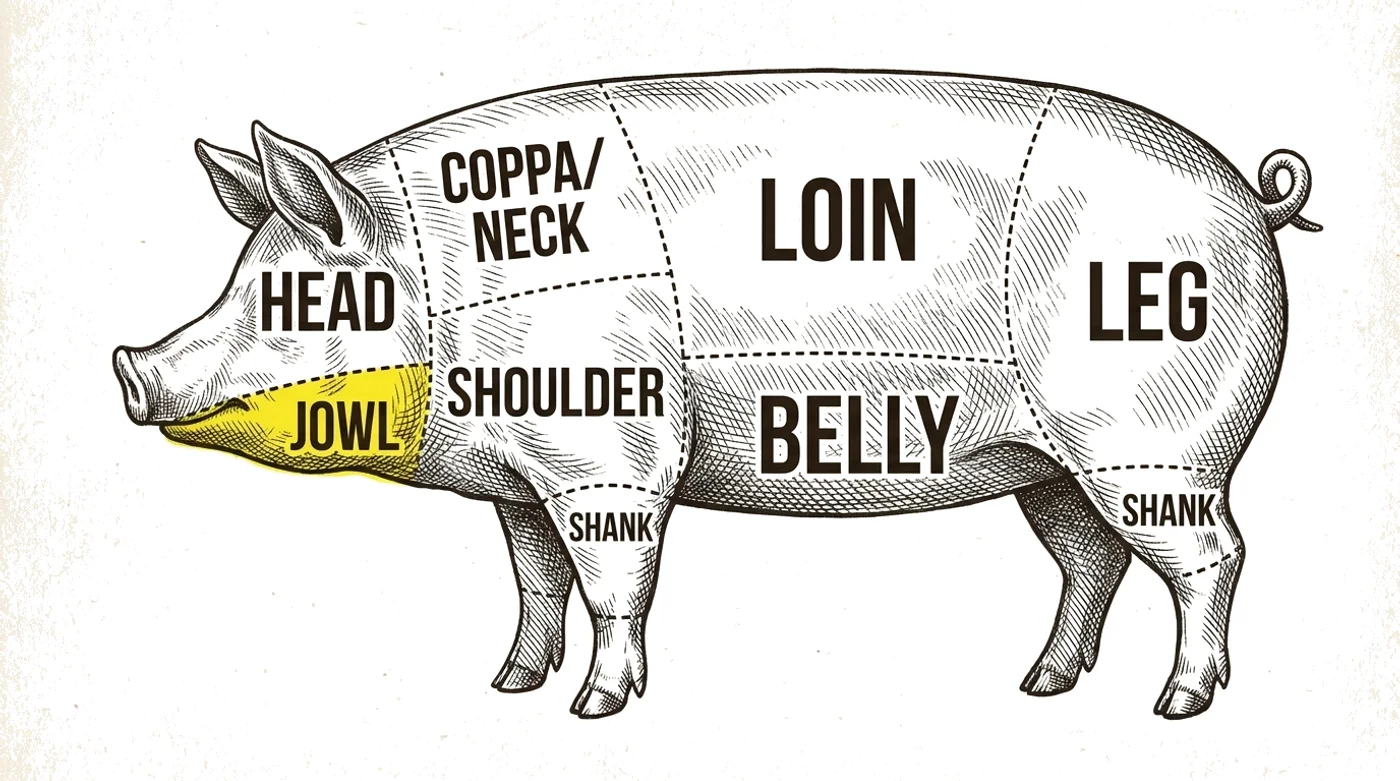
The documented core is pork trimmings, kidney, head meat, other slaughter offal and fat, seasoned simply with salt and pepper. Exact household mixtures varied with the carcass. The Curesmith branch uses fully deboned head and cheek meat, shoulder trimmings, kidney, heart, jowl and back fat, avoiding lung where availability or legal sale is restricted.
Production
All components are cut, minced and mixed raw, then filled into small hog casing and tied by hand in a continuous string. The official identity does not require flour, stock or a preliminary cook. Because the sausage is raw and offal-rich, strict chilling, inspected material and complete cooking before service are central controls.
Consumption
Fresh traïdora is grilled or pan-fried and may also enrich broths and escudelles. Historically, surplus could be dried or preserved in fat, but those are separate preservation branches requiring validated salt, drying and storage controls. The recipe here treats it strictly as a refrigerated raw fresh sausage.
Source conflict and boundaries
The Meat & Sausages page describes a cooked flour-bound offal sausage, but that construction conflicts with the Generalitat's raw-product record and is therefore retained only as attributable source evidence. Traïdora contains no blood and is distinct from botifarra negra; its offal-rich, highly perishable composition also separates it from ordinary fresh botifarra made primarily from good lean pork.
Recipe and cure
This is not a finished recipe. It is a window into how this meat is traditionally cured. Before you follow any process, run it through one of our curing calculators so the salt, cure and timings are right and safe for your own batch.
Make this — the measured Curesmith version →“Make this” opens the same cure as a measured recipe, scaled to your batch.
- Meat
- Pork head and cheek meat, fully deboned
- Cut
- Pork head and cheek meat, fully deboned
- Salt (%)
- 1.8
- Curing salt
- None
- Fermented
- No
- Smoked
- No
- Maturation
- Raw: refrigerate at 0–4°C for no more than 2 days, or freeze
- Basis
- per 1,000 g pork head and cheek meat, fully deboned
- Style
- Catalan raw fresh pork-offal sausage for cooking
Ingredients
- Pork head and cheek meat, fully deboned100% · 1000 g
- Pork shoulder trimmings65% · 650 g
- Pork kidney35% · 350 g
- Pork heart35% · 350 g
- Pork jowl and back fat100% · 1000 g
- Fine salt1.8% · 60 g
- Black pepper0.2% · 6.5 g
Method
- Trim, dice and chill all inspected pork and fat to 0–2°C.
- Grind chilled head meat, shoulder, kidney, heart and fat through 6 mm.
- Mix all components with salt and pepper until evenly distributed and lightly tacky.
- Stuff into natural hog casing, 24–45 mm. Hand-tie short portions in a continuous string.
- Grill, pan-fry or simmer gently until the centre of every link reaches at least 71°C; serve immediately.
- Treat as raw fresh sausage: refrigerate at 0–4°C and cook within 2 days, or freeze promptly.
Safety. Use inspected pork offal, hold at 0–4°C, cook to at least 71°C and do not treat the fresh branch as cured, dried or ready to eat.