
Cajun Boudin
Also known as Louisiana boudin, Cajun boudin blanc, Boudin - Cajun
Louisiana, United States
Overview
Cajun boudin is a cooked pork, liver and rice sausage of south-west Louisiana. It is soft, highly seasoned and commonly eaten hot as a snack, squeezed from the casing, or formed into breaded boudin balls.
Where it's from
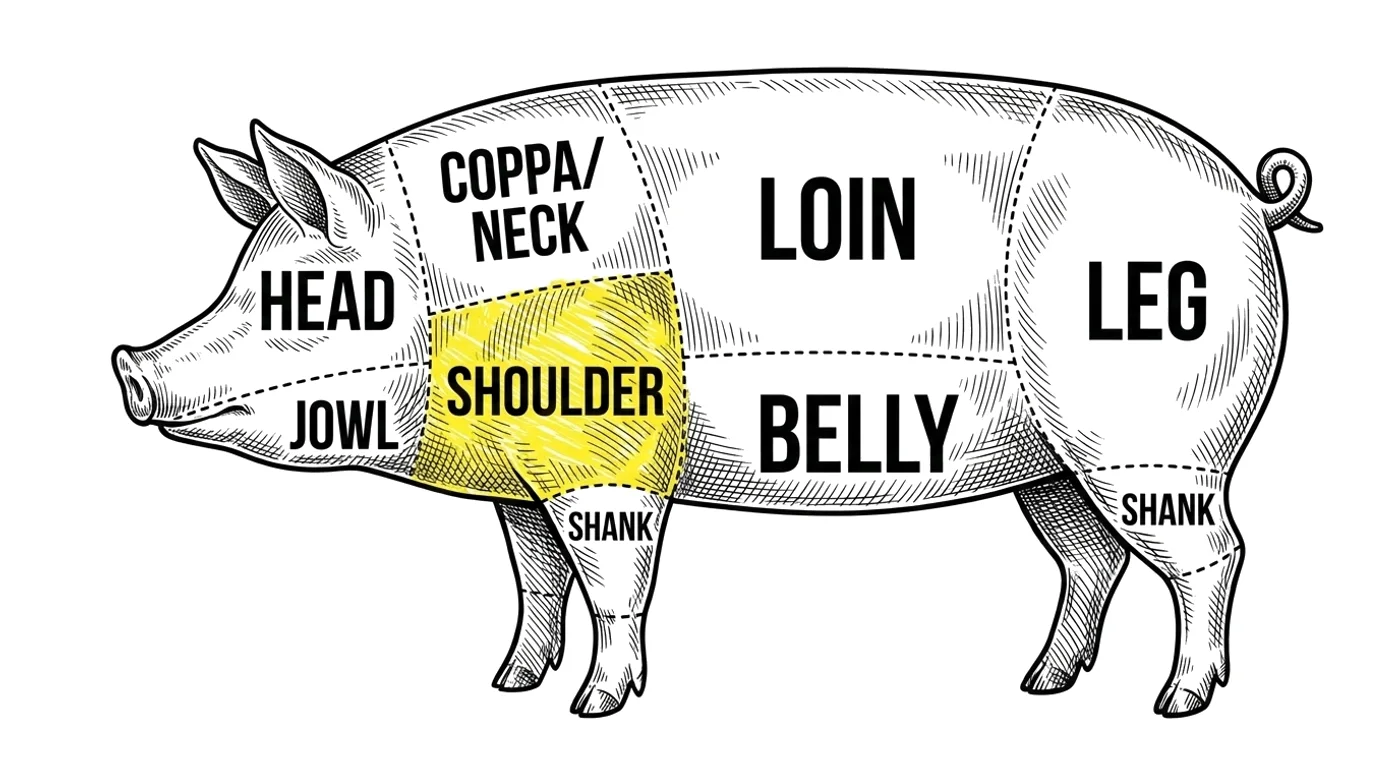
The cut
Identity and terminology
The unqualified Louisiana word boudin usually means boudin blanc, even though it is not the refined white sausage of France. Cajun boudin combines cooked pork, liver, rice, green onion and seasoning. Boudin rouge, a blood-containing form, is historically important but legally and commercially less common.
Composition and characteristics
The filling is moist and spoonable rather than sliceable. Rice is a structural ingredient, pork liver gives depth and slight bitterness, and green onion, parsley, cayenne and black pepper provide the characteristic Louisiana profile.
Production and process
Pork and liver are cooked, usually in a seasoned broth, then ground and mixed with cooked rice and fresh aromatics. The mixture is stuffed into casing while warm or chilled for later reheating. It is a cooked product but remains highly perishable.
History and regional forms
Boudin is closely linked to the Cajun boucherie, the communal hog slaughter in which neighbours divided meat and transformed perishable parts into sausage, cracklings and other preparations. Rice, established as a Louisiana staple, became the defining extender. Modern boudin developed a strong commercial corridor around Lafayette, Scott and the Acadiana parishes.
Use, storage and related products
It is sold hot at meat markets, fuel stations and specialist shops, eaten from the casing, served with crackers, or made into boudin balls. It differs from French boudin blanc, boudin noir and Creole blood sausage. Refrigeration is essential despite its cooked status.
Recipe and cure
This is not a finished recipe. It is a window into how this meat is traditionally cured. Before you follow any process, run it through one of our curing calculators so the salt, cure and timings are right and safe for your own batch.
Make this — the measured Curesmith version →“Make this” opens the same cure as a measured recipe, scaled to your batch.
- Meat
- Pork shoulder / Boston butt
- Cut
- Pork shoulder / Boston butt
- Salt (%)
- 1.8
- Curing salt
- None
- Fermented
- No
- Smoked
- No
- Maturation
- ≤4°C for up to 4 days; freeze for longer storage
- Basis
- per 1,000 g pork shoulder / boston butt
- Style
- Fully cooked pork, liver and rice sausage
Ingredients
- Pork shoulder / Boston butt100% · 1000 g
- Pork liver45% · 450 g
- Dry long-grain white rice14.2% · 214.5 g
- Fresh onion, chopped5.7% · 85.5 g
- Celery, chopped5.7% · 57 g
- Green onions, finely chopped2.4% · 35.5 g
- Fresh parsley, finely chopped0.76% · 11.5 g
- Fine salt1.7% · 25.5 g
- Cracked black pepper0.57% · 8.5 g
- Dried thyme0.19% · 3 g
- Cayenne pepper0.19% · 3 g
- Bay leaf0.02% · 0.3 g
- Reserved cooking stock37.9% · 571.5 g
- Potable poaching water90% · 1357 g
Method
- Combine pork, liver, onion, celery, bay leaf and the 950 g process water. Bring to a gentle simmer and cook until pork and liver reach at least 71°C and are tender.
- Remove pork and liver. Strain the liquid and weigh at least 400 g clear cooking stock.
- Cook the 150 g dry rice in 300 g reserved stock until very tender and all liquid is absorbed.
- Grind the cooked pork and liver through 6 mm.
- Combine ground meat, cooked rice, green onions, parsley, salt, pepper, thyme and cayenne. Add exactly 100 g reserved stock and mix until cohesive.
- Stuff gently into hog casings and form long links.
Safety. Cooked boudin is not shelf stable. It must be kept cold or hot-held correctly and reheated safely.