
Boudin Blanc de Liège
Also known as Liège white pudding, Boudin liégeois blanc
Province of Liège, Belgium
Overview
Boudin Blanc de Liège is a Belgian white cooked pork sausage whose dominant aromatic signature is dried marjoram. The cut surface shows a visible meat grain and fragments of whole leaf, while the aroma of marjoram remains clear rather than being masked by the other ingredients. It is traditionally eaten cold in slices.
Where it's from
The cut
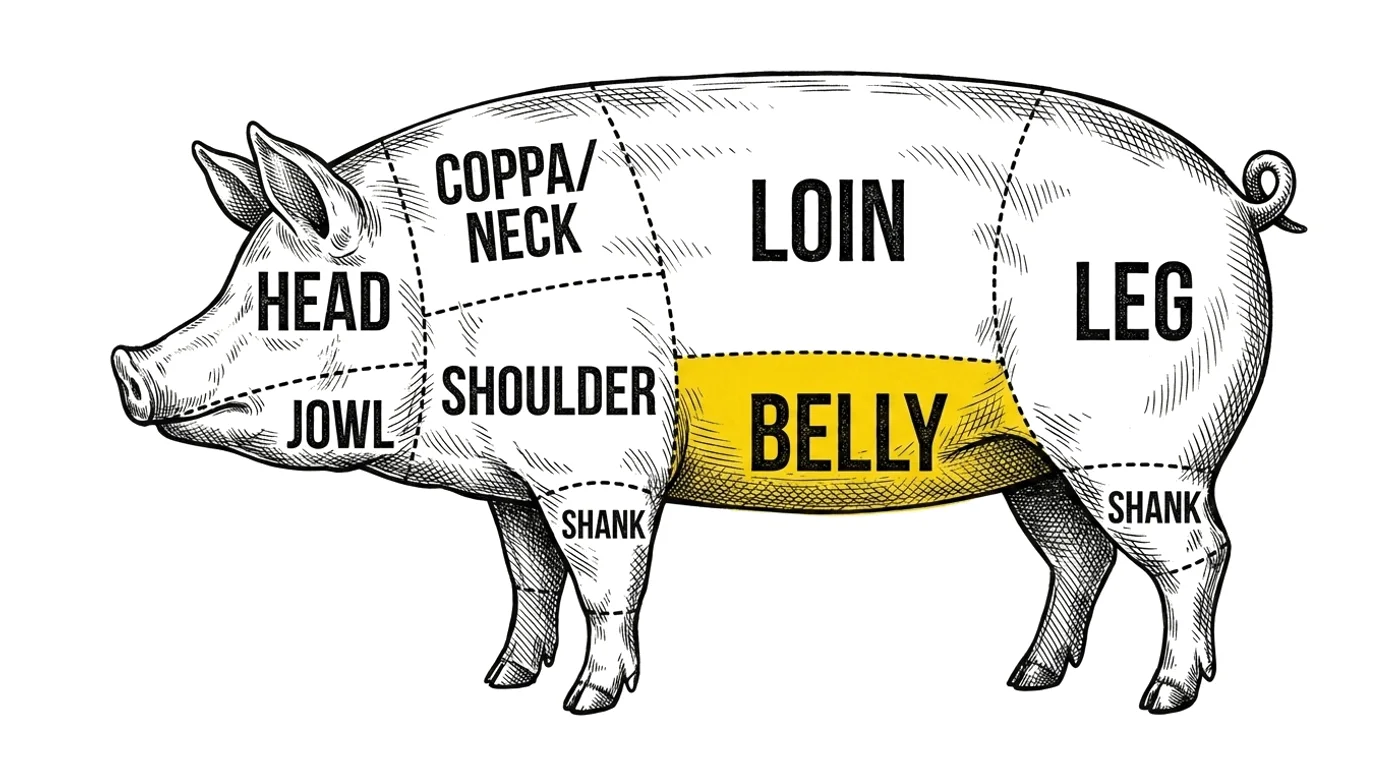
Protected identity
The name entered the Union register as a protected geographical indication in 2025. Preparation of the mixture, casing preparation, stuffing, cooking and cooling must take place in the Province of Liège. The protection rests on the product's reputation, the butchers' transmitted skill and the particular way high-quality marjoram is handled and incorporated.
Marjoram and regional character
Marjoram has long been part of Liège cooking and appears in local meat, crayfish and veal preparations. For this sausage, Origanum majorana is harvested before flowering, dried carefully away from direct sun, stored dry and dark, and stripped so whole leaves rather than powder enter the mixture. This preserves both visible fragments and the dominant aroma.
Composition and production
The sausage uses lean pork and pork fat from specified cuts, with no other edible pig parts apart from the natural casing. Whole dried marjoram leaves are mandatory, and other ingredients come from a controlled positive list. The mixture is stuffed into natural pork casing, steamed or cooked in broth, then cooled immediately by cold-water immersion or showering.
History and service
Documents from the early twentieth century already identify marjoram as the flavour that distinguishes Liège white sausage, while local butchers trace the practical knowledge further back through apprenticeship. Competitions and record-length sausages strengthened its public reputation. Cold sliced service, sometimes in the Liège charcuterie assortment called a drèssêye, remains characteristic.
How to recognise it
A whole sausage is cylindrical and closed at both ends. The interior has visible meat grain and scattered marjoram fragments. The herb should be apparent both on the nose and palate. A smooth anonymous white emulsion, powdered herb with no visible leaf, or a formula built from offal does not match the protected description.
Recipe and cure
This is not a finished recipe. It is a window into how this meat is traditionally cured. Before you follow any process, run it through one of our curing calculators so the salt, cure and timings are right and safe for your own batch.
Make this — the measured Curesmith version →“Make this” opens the same cure as a measured recipe, scaled to your batch.
- Meat
- Pork belly
- Cut
- Pork belly
- Salt (%)
- 3.3
- Curing salt
- None
- Fermented
- No
- Smoked
- No
- Maturation
- 0–4°C; consume within 5 days or freeze
- Basis
- per 1,000 g pork belly
- Style
- Belgian marjoram-scented white cooked pork sausage
Ingredients
- Lean pork shoulder50% · 500 g
- Pork belly100% · 1000 g
- Fresh white bread crumb66.7% · 1000 g
- Onion, finely diced44.4% · 666.5 g
- Pasteurised cream6.7% · 100 g
- Pasteurised whole milk6.7% · 100 g
- Whole hen egg, beaten22.2% · 333.5 g
- Neutral oil or lard for onion3.3% · 50 g
- Fine salt3.3% · 50 g
- Ground white pepper0.45% · 6.5 g
- Ground nutmeg0.22% · 3.5 g
- Ground cinnamon0.11% · 1.5 g
- Ground cloves0.07% · 1 g
- Whole dried marjoram leaves0.67% · 10 g
Method
- Crumble bread and moisten with milk and cream.
- Cook onion gently in the measured oil or lard until translucent; cool to 4°C or below.
- Chill pork and belly until firm and grind through 6 mm.
- Mix meat, belly, panade, onion, egg, salt and spices. Fold in whole dried marjoram leaves so fragments remain visible.
- Stuff into natural pork casing and close both ends.
- Poach or steam until the cold point reaches 72°C.
Safety. Protected production has its own specification and certification. A home branch made outside the Province of Liège must not be sold as PGI. Cook to a measured endpoint, cool immediately in cold water and refrigerate.