
Austrian Bratwurst
Also known as rohe Bratwurst, Austrian raw bratwurst, Bratwurst - Austrian
Austria
Overview
Austrian raw Bratwurst is a fresh pork or veal sausage defined in the Austrian Food Book as a raw Bratwurst branch. It is sold uncooked and is distinct from Austria's many scalded sausages and from German regional Bratwurst specifications.
Where it's from
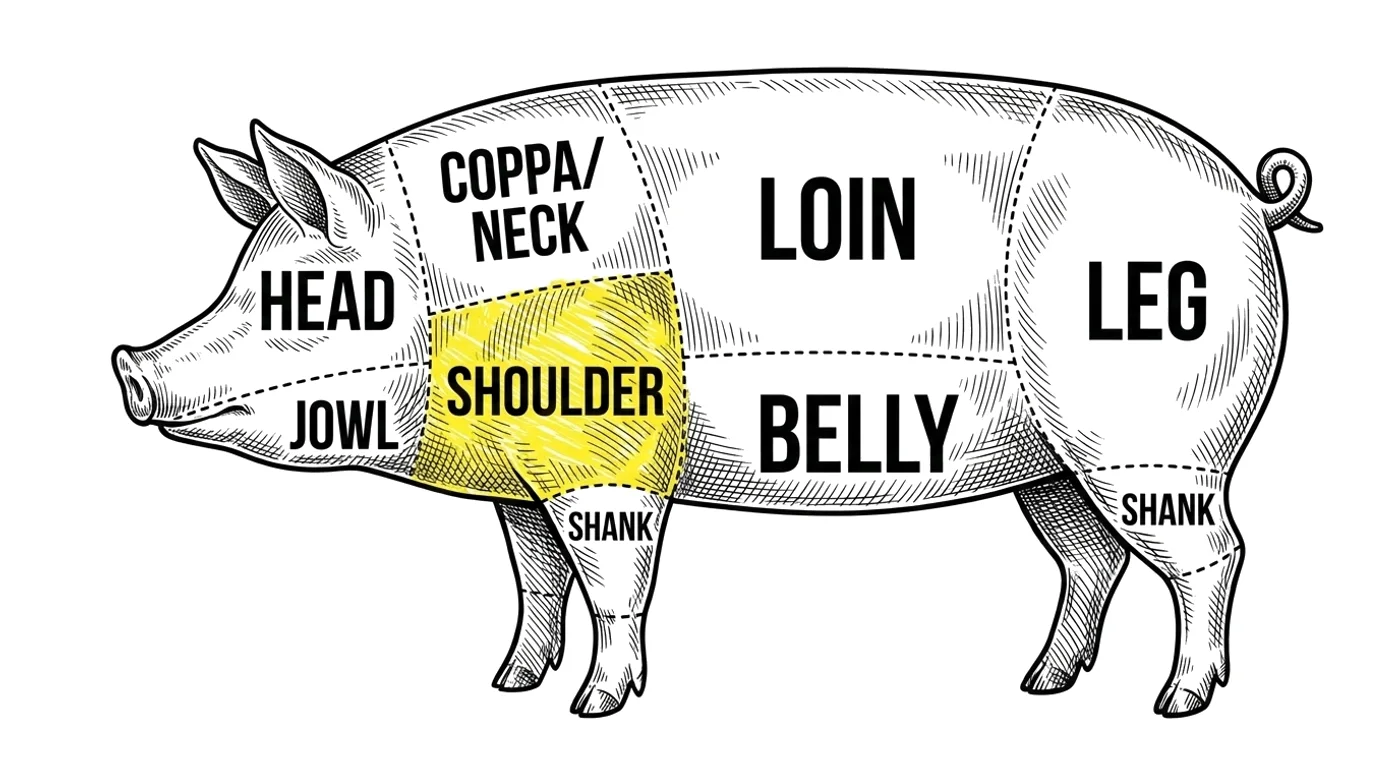
The cut
Identity and terminology
The Austrian designation rohe Bratwurst means raw frying sausage. The national guidance allows pork or veal with bacon and seasoning, using ordinary salt or nitrite curing salt. It is an Austrian bratwurst rather than a German standard.
Composition and characteristics
The filling is generally fine-to-medium, pale when made with ordinary salt and pinker if curing salt is used. Pork, veal and bacon provide a rich but relatively mild base, commonly seasoned with pepper, marjoram, nutmeg, mace or garlic.
Production and process
Meat and bacon are chilled, minced, seasoned and stuffed into edible casing. It is not scalded during manufacture, so the consumer must cook it completely. Modern use of curing salt affects colour but does not make the raw sausage ready to eat.
History and regional forms
Austrian sausage terminology developed through the codification of established butcher practice in the Österreichisches Lebensmittelbuch. Regional butchers produce their own Bratwurst styles, but the raw branch is a recognised national category rather than a protected town product.
Use, storage and related products
It is fried or grilled and served with mustard, bread, potatoes or sauerkraut. It should be separated from Austrian Augsburger, Käsekrainer and cooked Bratwurst forms.
Recipe and cure
This is not a finished recipe. It is a window into how this meat is traditionally cured. Before you follow any process, run it through one of our curing calculators so the salt, cure and timings are right and safe for your own batch.
Make this — the measured Curesmith version →“Make this” opens the same cure as a measured recipe, scaled to your batch.
- Meat
- Pork shoulder
- Cut
- Pork shoulder
- Salt (%)
- 1.8
- Curing salt
- None
- Fermented
- No
- Smoked
- No
- Maturation
- ≤4°C and use within 24 hours; otherwise freeze
- Basis
- per 1,000 g pork shoulder
- Style
- Fresh Austrian-style pork-and-veal Bratwurst; cook before eating
Ingredients
- Pork shoulder100% · 1000 g
- Pork back fat45% · 450 g
- Veal shoulder25% · 250 g
- Ice-cold water6.4% · 109 g
- Fine salt1.8% · 31 g
- Ground black pepper0.21% · 3.5 g
- Ground marjoram0.05% · 0.9 g
- Ground caraway0.05% · 0.9 g
Method
- Chill pork, veal, fat, water and equipment to 0–3°C.
- Grind pork shoulder, veal shoulder and back fat together through 5 mm.
- Add salt, pepper, marjoram, caraway and measured water. Mix until evenly distributed and lightly tacky.
- Stuff into 36 mm hog casings and form 15 cm links.
- Refrigerate at 2–4°C and use within 24 hours, or freeze promptly.
- Fry, grill or poach until the cold point reaches 71°C.
Safety. The word Bratwurst does not imply pre-cooking. This Austrian raw branch requires refrigeration and full cooking.