
Overview
German Bratwurst is not one sausage but a large national family of sausages intended for frying or grilling. The family includes fresh, scalded, fine, coarse, smoked and strongly regional forms such as Nürnberger, Thüringer and Fränkische Bratwurst.
Where it's from
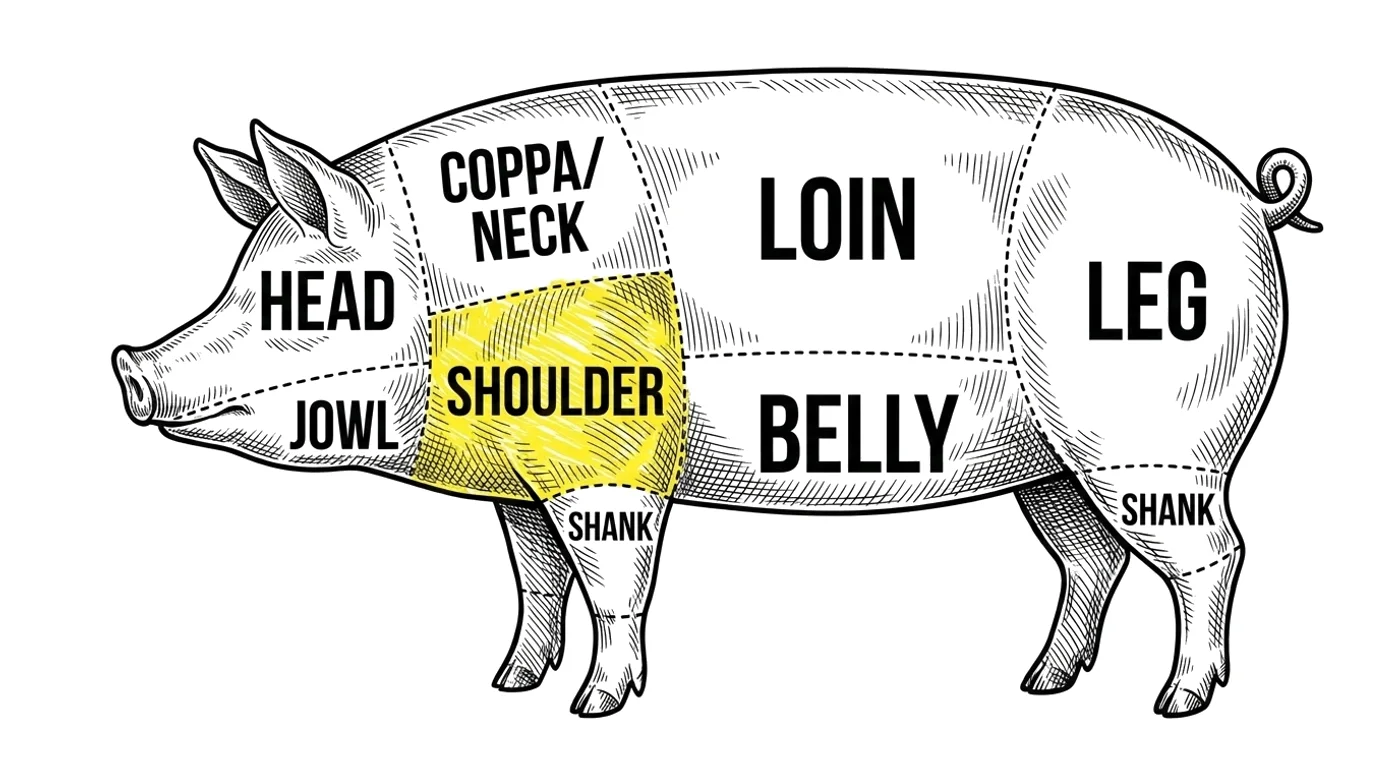
The cut
Identity and terminology
Bratwurst combines Wurst, sausage, with Brät, the seasoned sausage mixture used in German butchery. The name therefore refers primarily to method and use rather than one geographical origin. A generic German Bratwurst should not absorb regionally protected or conventionally distinct varieties.
Composition and characteristics
Depending on the branch, the filling may use pork alone or pork with veal or beef. Marjoram, pepper, nutmeg, mace, caraway, lemon and garlic occur in different regional profiles. Texture ranges from fine emulsified paste to visibly coarse mince.
Production and process
Fresh versions are minced, mixed and stuffed for direct cooking. Scalded versions are heated during manufacture and later browned for service. German food guidelines distinguish raw and scalded sausage categories and set customary composition expectations.
History and regional forms
Bratwurst is documented in German-speaking Europe for centuries and developed through urban butchers' guilds, regional livestock patterns and local spice traditions. Several towns turned their particular format into a civic emblem, which is why size, casing and seasoning can change dramatically across Germany.
Use, storage and related products
Bratwurst is grilled or pan-fried and served with bread, mustard, sauerkraut or potato dishes. The generic entry should function as a family article linking to specific regional children rather than pretending to be the sole authentic recipe.
Variations
Named formulas within this product rather than separate ones. Quantities are per 1000 g of the meat block.
Münchener Rostbratwurst - Fine Veal and Pork Branch
- Veal shoulder, sinew removed500 g
- Pork shoulder400 g
- Firm pork back fat100 g
- Fine salt18 g
- Ground white pepper2 g
- Ground mace0.5 g
- Ground cardamom0.3 g
- Fresh lemon zest4 g
- Crushed ice60 g
Rostbratwurst - Coarse Pork, Pre-Scalded Grill Branch
- Skinless pork belly or medium-fat pork shoulder, about 30% visible fat1000 g
- Fine salt18 g
- Ground black pepper2 g
- Ground nutmeg1 g
- Ground ginger0.5 g
- Ground cardamom0.5 g
- Ground cayenne0.3 g
- Finely grated unwaxed lemon zest1 g
Recipe and cure
This is not a finished recipe. It is a window into how this meat is traditionally cured. Before you follow any process, run it through one of our curing calculators so the salt, cure and timings are right and safe for your own batch.
Make this — the measured Curesmith version →“Make this” opens the same cure as a measured recipe, scaled to your batch.
- Meat
- Pork shoulder
- Cut
- Pork shoulder
- Salt (%)
- 1.8
- Curing salt
- None
- Fermented
- No
- Smoked
- No
- Maturation
- Raw sausage ≤4°C for up to 2 days; freeze for longer storage
- Basis
- per 1,000 g pork shoulder
- Style
- Fresh pork-and-veal Bratwurst; cook before eating
Ingredients
- Pork shoulder100% · 1000 g
- Skinless pork belly25% · 250 g
- Veal shoulder55% · 550 g
- Fine salt1.8% · 32.5 g
- Ground white pepper0.31% · 5.5 g
- Dried marjoram0.1% · 2 g
- Ground caraway0.1% · 2 g
- Ground nutmeg0.1% · 2 g
- Ground ginger0.05% · 0.9 g
- Egg white6.1% · 109 g
- Ice-cold water10.1% · 182 g
Method
- Chill meats, water and equipment to 0–3°C.
- Grind shoulder, belly and veal together through 3 mm.
- Whisk the egg white lightly with the measured water.
- Add salt and spices to the meat, then add the egg-water mixture. Mix until uniformly sticky and bound.
- Stuff into hog casing and form 10 cm links.
- Refrigerate for 4–12 hours at 2–4°C.
Safety. Fresh Bratwurst is raw, while some scalded forms are pre-cooked. The product status must be stated explicitly.