
Brazilian Linguiça
Also known as linguiça brasileira, Brazilian fresh linguiça
Brazil
Overview
Linguiça is Brazil's everyday pork sausage: coarse ground, heavily seasoned with garlic and paprika, filled into a hog casing and usually smoked. It is the sausage on the churrasco grill, the one sliced into feijoada, and the one sold in coils in every market. The name covers a family rather than a single formula, and the version cured with nitrite and hot smoked is the one most people picture, deep brick red and firm enough to slice.
Where it's from
The cut
Identity and terminology
Linguiça comes from the Portuguese for tongue, língua, describing the long slim shape rather than the contents. The word travelled from Portugal with Portuguese settlers and then took on a life of its own, so Brazilian linguiça and Portuguese linguiça are related but not the same thing. Within Brazil the important distinction is between the fresh types, sold raw and grilled the same day, and the cured and smoked types that keep. Linguiça calabresa is the best known of the smoked kind, and despite the name it is a Brazilian product rather than an import from Calabria.
Composition and characteristics
The meat is pork shoulder, ground coarsely enough that the lean and the fat stay visible on the cut face. Paprika does most of the colouring work, garlic most of the smell, and black pepper and a little cayenne carry the heat, which in most Brazilian versions is warm rather than fierce. A splash of dry red wine is common and helps the seasoning carry. The texture should be firm and slightly springy, never pasty: a smeared mix means the meat and fat were allowed to warm during grinding.
Production and process
The pork is cut, mixed with salt and curing salt and held cold overnight so the cure distributes before grinding. It is then ground, seasoned, mixed until the mass turns tacky, and filled firmly into hog casing in long links. The surface is dried until it is tacky to the touch, which is what lets smoke deposit evenly, and the sausage is then hot smoked until it takes colour. That smoking step is a flavour and colour step, not a cook. The centre does not reach a killing temperature, so the sausage comes out of the chamber raw and is cooked before it is eaten.
History and regional forms
Portuguese colonists brought both the word and the method, and the sausage adapted to what Brazil grew: more paprika, more garlic, and a heavier hand with smoke in the south where wood is plentiful. Regional forms multiplied. Linguiça toscana is fresh and coarse and belongs on the grill. Linguiça calabresa is cured and smoked and belongs in the pot. Linguiça portuguesa keeps closer to the older, drier Portuguese style. The names are not protected, so a label tells you the tradition being aimed at rather than a specification being met.
Use, storage and related products
Grilled whole over charcoal and served with farofa, sliced into feijoada where it gives the pot its smoke, or fried and folded into rice and beans. Because the smoked version is not cooked through in the chamber, treat it as a raw sausage: refrigerate it, cook it to 71°C at the centre, and do not leave it at room temperature on the strength of its colour. Its nearest relatives are the Portuguese linguiça it descends from, chouriço, and the Spanish chorizo family, all of them built on pork, paprika and garlic but each taking the mixture somewhere different.
Variations
Named formulas within this product rather than separate ones. Quantities are per 1000 g of the meat block.
Brazilian Linguiça - Paprika, Wine and Smoked Branch
- Pork shoulder, approximately 75% lean1000 g
- Fine salt18 g
- Cure #1, 6.25% sodium nitrite2.5 g
- Ground black pepper2 g
- Sweet paprika6 g
- Dried oregano, rubbed2 g
- Fresh garlic, minced10 g
- Dry red wine15 g
- Ground cayenne1 g
Recipe and cure
This is not a finished recipe. It is a window into how this meat is traditionally cured. Before you follow any process, run it through one of our curing calculators so the salt, cure and timings are right and safe for your own batch.
Make this — the measured Curesmith version →“Make this” opens the same cure as a measured recipe, scaled to your batch.
- Meat
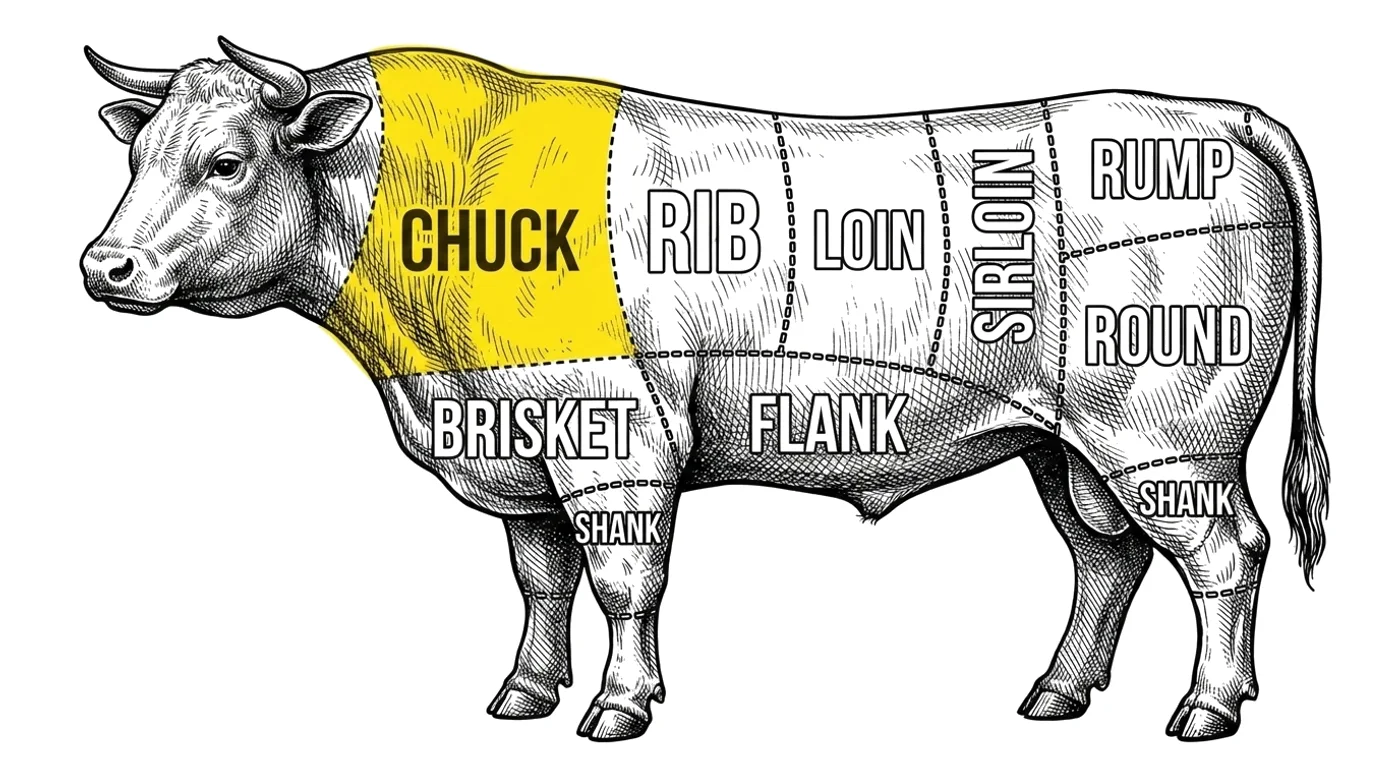
- Beef chuck
- Cut
- Beef chuck
- Salt (%)
- 1.8
- Curing salt
- None
- Fermented
- No
- Smoked
- No
- Maturation
- Raw sausage ≤4°C for up to 2 days; freeze for longer storage
- Basis
- per 1,000 g beef chuck
- Style
- Fresh beef-and-pork coil sausage
Ingredients
- Beef chuck100% · 1000 g
- Pork shoulder40% · 400 g
- Skinless pork belly10% · 100 g
- Pork back fat15% · 150 g
- Fine salt1.8% · 30 g
- Ground black pepper0.2% · 3.5 g
- Fresh garlic, crushed0.7% · 11.5 g
- Fresh parsley, finely chopped0.4% · 6.5 g
- Scallion, finely sliced1% · 10 g
- Ice-cold water3% · 50 g
Method
- Chill all meats, water and equipment to 0–3°C.
- Grind pork and fat through 10 mm; grind beef through 6 mm.
- Mix beef and pork shoulder with salt and water until tacky.
- Fold in belly, back fat, pepper, garlic, parsley and scallion.
- Stuff into 36 mm hog casing and form one continuous coil.
- Refrigerate 4–12 hours at 2–4°C.
Safety. Fresh linguiça is raw and perishable. Do not infer readiness from smoke or red colour.