
Bread and Butter Sausage
Also known as Bread-and-Butter Sausage
England, United Kingdom
Overview
Bread and Butter Sausage is an archival English-labelled formula for a slim cured, smoked and cooked sausage made from veal, lean pork and diced belly. Contrary to its name, the recorded composition contains neither bread nor butter. A fine meat matrix holds small pale cubes of belly, giving a pink, lightly speckled cut face.
Where it's from
The cut
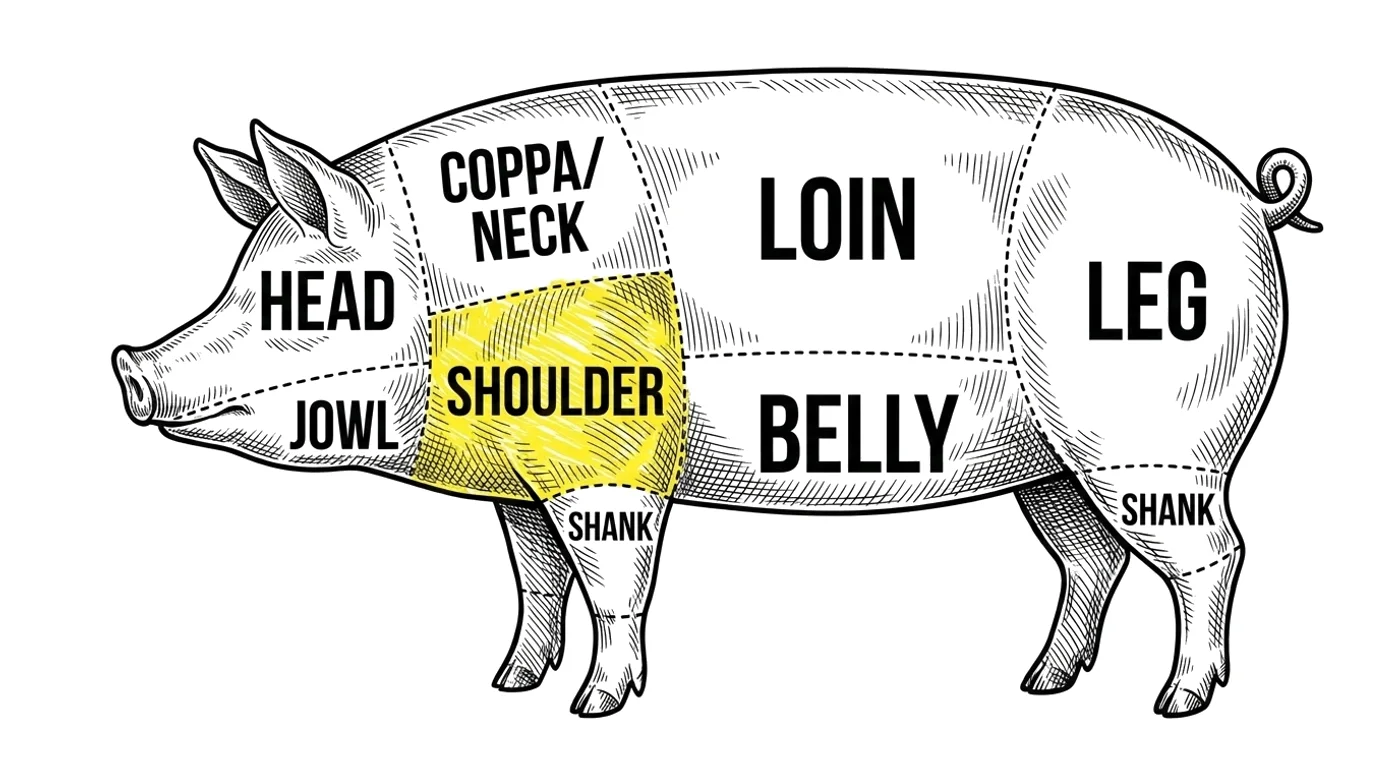
Identity and terminology
The origin of the title is unresolved. It does not describe the ingredients, and no protected British name or current reserved description for the exact product was located. The Atlas retains the source title but labels the identity archival. It should not be confused with bread sausage, British fresh bangers containing rusk, or a butter-flavoured sausage.
Composition and characteristics
Veal makes up half of the meat block and gives the sausage a pale, delicate base. Lean pork contributes bind, while belly is cut into small cubes and briefly blanched before mixing. Black pepper is the main seasoning, with restrained clove and ginger. The narrow sheep casing and light smoke make the finished link closer in form to a fine cooked sausage than to a coarse British breakfast sausage.
Production and process
Veal and lean pork are minced finely and mixed with salt, nitrite cure, spice and chilled water until tacky. Belly cubes are blanched, cooled and folded through without smearing. After a refrigerated curing rest, the filling is stuffed into narrow sheep casings, surface-dried, lightly smoked, cooked through and chilled rapidly.
Documentary status
No reliable date, inventor, town of origin or continuous English trade tradition for this exact name was located. Current British protected-name records do not list it, and general meat-product rules govern any modern sale rather than a product-specific specification. The evidence therefore supports an attributable historical-style formula, not a claim that the name is a recognised regional classic.
Use, storage and related products
The sausage is fully cooked but remains refrigerated. It can be warmed gently like a frankfurter or served chilled once properly cooked and cooled. Its visible belly inclusion separates it from a uniform frankfurter emulsion, while the absence of cereal separates it from many British fresh sausages. Smoke and nitrite do not make it shelf-stable.
Recipe and cure
This is not a finished recipe. It is a window into how this meat is traditionally cured. Before you follow any process, run it through one of our curing calculators so the salt, cure and timings are right and safe for your own batch.
Make this — the measured Curesmith version →“Make this” opens the same cure as a measured recipe, scaled to your batch.
- Meat
- Trimmed veal shoulder
- Cut
- Trimmed veal shoulder
- Salt (%)
- 1.8
- Curing salt
- Cure #1 as specified in the recipe
- Fermented
- No
- Smoked
- Yes
- Maturation
- Refrigerate at 0–4°C; use within 4 days or freeze promptly
- Basis
- per 1,000 g trimmed veal shoulder
- Style
- English-labelled cured smoked cooked veal and pork link
Ingredients
- Trimmed veal shoulder100% · 1000 g
- Trimmed pork shoulder80% · 800 g
- Skinless pork belly20% · 200 g
- Fine salt1.8% · 36 g
- Cure #1, 6.25% sodium nitrite0.25% · 5 g
- Black pepper0.3% · 6 g
- Ground cloves0.05% · 1 g
- Ground ginger0.03% · 0.6 g
- Ice water3% · 60 g
Method
- Cut chilled pork belly into 6 mm cubes. Blanch in 75–80°C water for 10 minutes, drain and chill below 4°C.
- Mince veal shoulder and pork shoulder through 3 mm.
- Dissolve salt and Cure #1 in ice water. Mix into minced meat with spices until sticky, then fold in chilled belly cubes.
- Cover and refrigerate the mixture for 8–12 hours at 3–5°C.
- Stuff into 24–26 mm sheep casings, link, and dry the casing surface under refrigeration.
- Apply warm smoke with chamber temperature near 60°C until the desired light colour is reached, about 45 minutes.
Safety. Use measured Cure #1, maintain a cold bind, smoke only after surface drying, cook to the cold-point endpoint, cool rapidly and refrigerate.