
Overview
Breakfast sausage is a fresh raw sausage commonly served at breakfast. It is sold as links, patties, bulk seasoned meat or frozen portions and must be cooked before eating. Pork is common, but other species and mixed formulations occur.
Where it's from
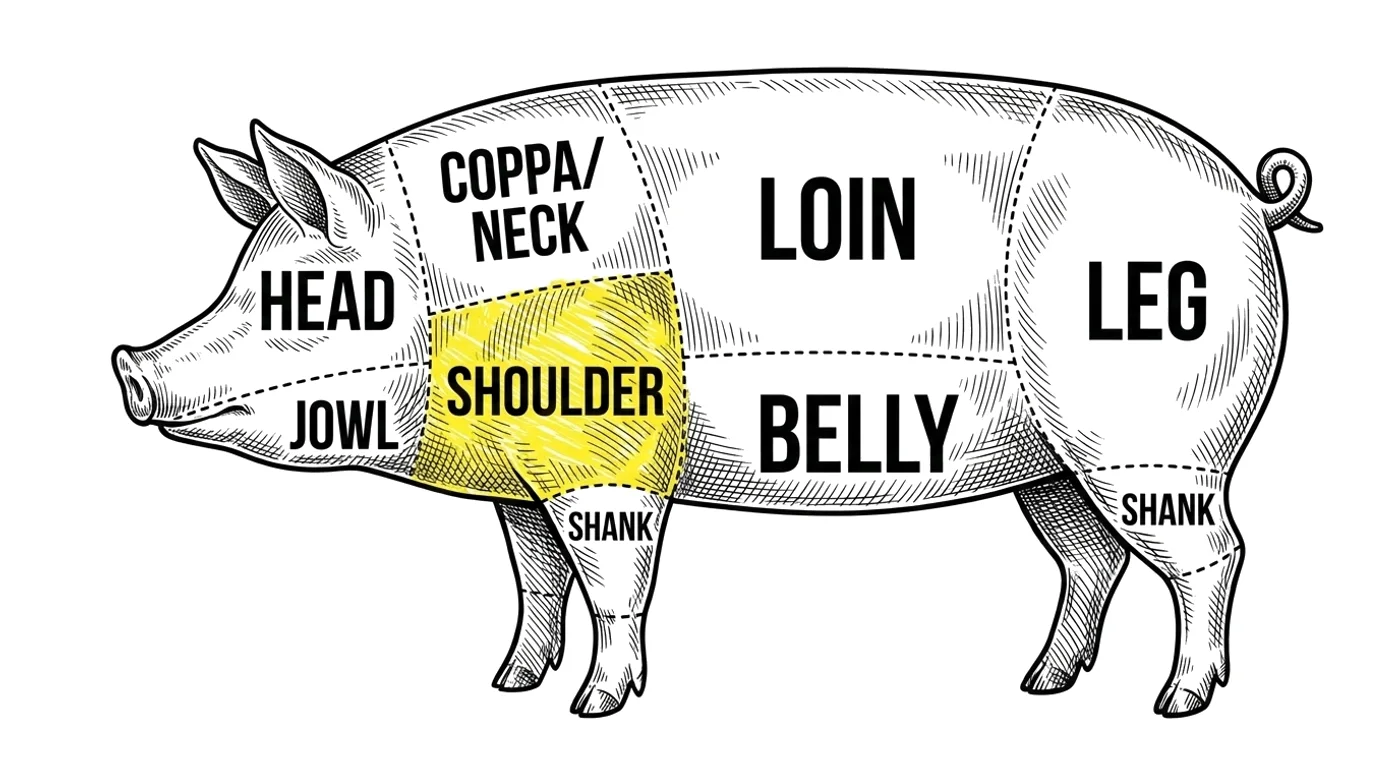
The cut
Identity and terminology
United States standards define Breakfast Sausage as a fresh or frozen meat product with permitted seasonings, byproducts and declared binders or extenders. The finished product has regulated fat and added-water limits. The term is based on customary use rather than a protected regional recipe. It should not be confused with pre-cooked breakfast links unless the cooked status is stated.
Composition and characteristics
Typical formulations use pork shoulder or trimmings with sufficient fat for juiciness, salt and seasonings such as black pepper, sage, thyme, marjoram, ginger, nutmeg or chilli. Regional styles may be sweet, peppery or strongly herbal. Particle size ranges from fine to medium, and the raw mixture should remain cold and cohesive without becoming emulsified. The federal identity permits declared binders or extenders, but artisan and household versions are often simple meat, fat, salt and spice mixtures. Fat level affects juiciness and shrinkage; excessive fat creates greasy cooking loss, while very lean mixtures can be dry and crumbly.
Production and process
Chilled meat and fat are ground, mixed with salt and seasoning and formed as links, patties or bulk sausage. Because it is a fresh product, there is no curing or maturation step. It is packaged promptly and held refrigerated or frozen. The consumer or food business cooks it until the centre reaches 71°C.
History and regional forms
Fresh seasoned sausage has long been part of farm and household butchery. In the United States it became closely linked with breakfast service, biscuits, gravy and diner meals. Distinct regional spice profiles developed, but no single combination defines the whole family. The family also includes country-style bulk sausage, small links and formed patties. Maple, chilli, sage-forward and pepper-forward styles are variations rather than separate universal identities unless a regional or commercial standard supports them.
Use, storage and related products
Breakfast sausage is pan-fried, grilled, baked or crumbled into gravy, casseroles and egg dishes. Raw product must remain cold and separated from ready-to-eat food. Related products include other Fresh Sausage families, Chipolata and cooked breakfast links, which require separate labelling and process descriptions.
Recipe and cure
This is not a finished recipe. It is a window into how this meat is traditionally cured. Before you follow any process, run it through one of our curing calculators so the salt, cure and timings are right and safe for your own batch.
Make this — the measured Curesmith version →“Make this” opens the same cure as a measured recipe, scaled to your batch.
- Meat
- Pork shoulder
- Cut
- Pork shoulder
- Curing salt
- None
- Fermented
- No
- Smoked
- No
- Basis
- per 1,000 g pork shoulder
- Style
- Fresh refrigerated sausage; cook before eating.
Ingredients
- Pork shoulder100% · 1000 g
- Fine salt1.8% · 18 g
- Black pepper0.2% · 2 g
- Dried sage0.2% · 2 g
- Ground nutmeg0.05% · 0.5 g
- Ground ginger0.05% · 0.5 g
- Dried thyme0.1% · 1 g
- Cayenne pepper0.05% · 0.5 g
- Ice-cold water10% · 100 g
Safety. Breakfast sausage is raw and must be kept refrigerated or frozen and cooked thoroughly before eating. It is not cured, fermented or shelf-stable unless a separately named and validated product says otherwise. Cross-contamination must be controlled during handling.