
Breinwurst
Also known as White Breinwurst, Weiße Breinwurst
Styria and Burgenland, Austria
Overview
Breinwurst is an Austrian cooked sausage of pig-head meat, pork skin and cooked grain, especially buckwheat or millet. It belongs particularly to Styria and Burgenland. The sausage is poached after stuffing, then commonly fried in hot fat so the casing browns and the grain-rich filling becomes crisp at the edges.
Where it's from
The cut
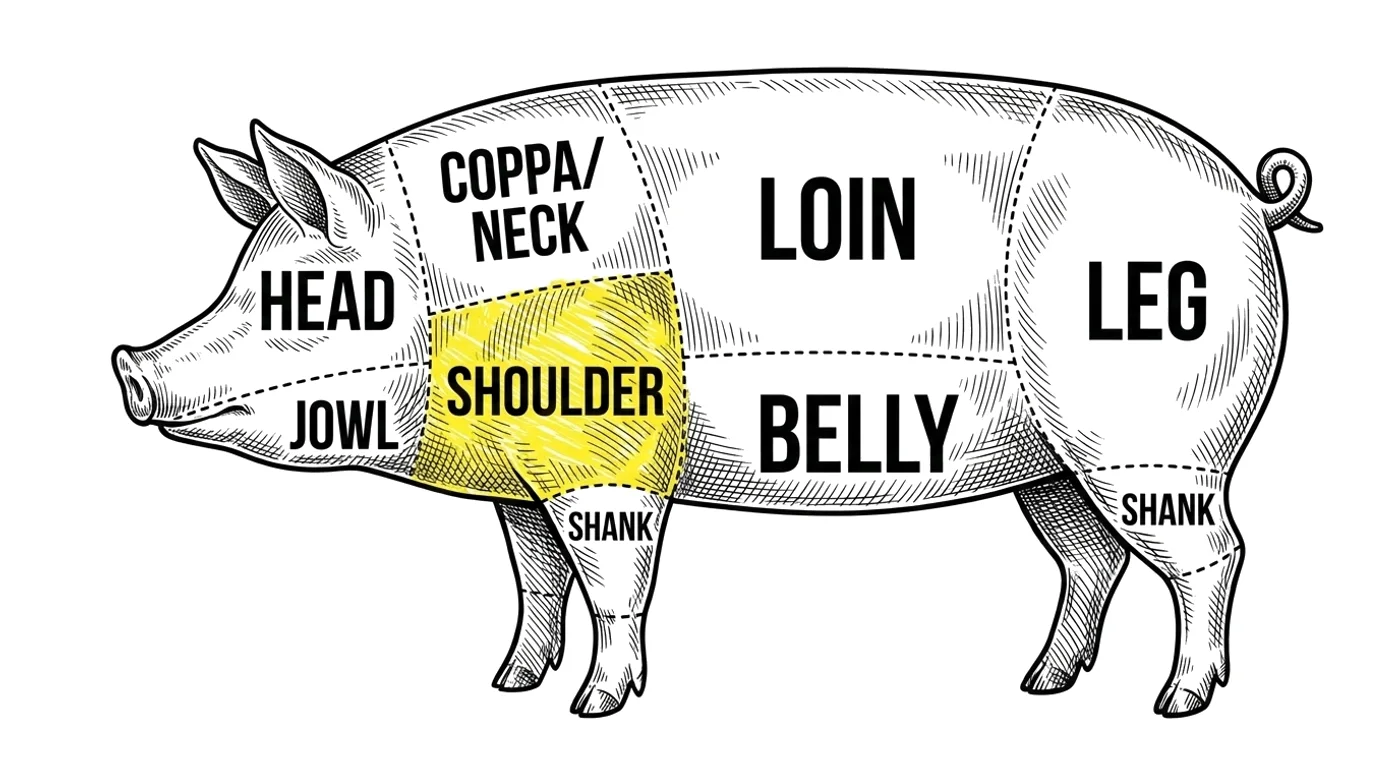
Identity and terminology
Brein names both hulled grain and the porridge made from it. It is not the German or English word brain and Breinwurst is not a brain sausage. Austrian practice distinguishes white Breinwurst without blood from black Breinwurst with blood. The source record and Curesmith branch represent the white form.
Composition and characteristics
Pig-head meat provides soft muscle and fat, while cooked skin supplies collagen. Cooked buckwheat or millet remains visible in the cut face and gives the filling its distinctive granular body. Onion, white pepper, allspice, basil and thyme create a warm savoury profile. The casing can be fragile because the cooked grain expands and the skin sets firmly on cooling.
Production and process
The head meat and skins are simmered until tender and deboned while warm. Grain is cooked separately, traditionally in the resulting pork stock. The meat and skin are minced, mixed with grain, fried onion and seasoning, then filled into hog casings and poached. The mass should remain granular, not be reduced to an emulsion.
History and regional practice
Austria's federal Traditional Foods register records Breinwurst as register number 211 and cites a version described by Katharina Prato in 1869. It also notes millet and rice sausages in a 1925 butchers' handbook, white and black forms in Burgenland, and former service at weddings. In rural Styria the sausages were also given to neighbours and relatives after a household pig slaughter.
Use, storage and related forms
The characteristic service is fried Breinwurst with sauerkraut and roasted potatoes. Closely related regional ideas include dumpling-shaped mixtures wrapped in caul fat and Slovenian grain sausages such as Jagláča or Masteníca. Breinwurst remains a cooked refrigerated product and should be reheated carefully because the casing readily splits.
Recipe and cure
This is not a finished recipe. It is a window into how this meat is traditionally cured. Before you follow any process, run it through one of our curing calculators so the salt, cure and timings are right and safe for your own batch.
Make this — the measured Curesmith version →“Make this” opens the same cure as a measured recipe, scaled to your batch.
- Meat
- Cooked deboned pork-head meat
- Cut
- Cooked deboned pork-head meat
- Salt (%)
- 2.3
- Curing salt
- None
- Fermented
- No
- Smoked
- No
- Maturation
- Refrigerate at 0–4°C; use within 3 days or freeze promptly
- Basis
- per 1,000 g cooked deboned pork-head meat
- Style
- Austrian cooked pig-head, skin and buckwheat sausage
Ingredients
- Cooked deboned pork-head meat100% · 1000 g
- Cooked pork skin35% · 350 g
- Cooked buckwheat groats24.4% · 333.5 g
- Finely diced onion7.3% · 100 g
- Rendered pork lard1.7% · 16.5 g
- Fine salt2.2% · 30 g
- White pepper0.24% · 3.5 g
- Ground allspice0.12% · 1.5 g
- Rubbed basil0.1% · 0.8 g
- Rubbed thyme0.06% · 0.8 g
Method
- Simmer cleaned pork-head meat and skin in a small volume of water until the meat separates readily and the skin is tender.
- Cook dry buckwheat groats in twice their weight of strained pork stock until tender. Cool and weigh 200 g cooked grain.
- Sweat onion slowly in measured lard until translucent and lightly golden.
- Mince the cooked pork-head meat and skin through 5 mm. Fold in buckwheat, onion, salt and herbs until evenly distributed.
- Stuff into 36 mm natural hog casings and link at about 15 cm.
- Poach in 78–80°C water until the cold point reaches 72°C.
Safety. Cooked head meat and grain support rapid bacterial growth if cooling is slow. Debone meticulously, verify the final poach, cool rapidly and keep refrigerated.