
Bresaola della Valtellina
breh-zah-OH-lah
Valtellina (Sondrio), Lombardy, Italy
Lean, clean and lightly spiced, with a soft, faintly sweet finish.
Overview
Bresaola della Valtellina is a lean cured beef speciality produced in the province of Sondrio. Selected hindquarter muscles are trimmed, seasoned and slowly dried until the meat becomes dark red, tender and delicately aromatic. Its identity is not heavy smoke or strong spice, but the clean concentration of beef in the dry Alpine air.
Where it's from
Climate. The high Valtellina valley in Sondrio, with cool, dry Alpine air.
Altitude. Alpine valley
The cut
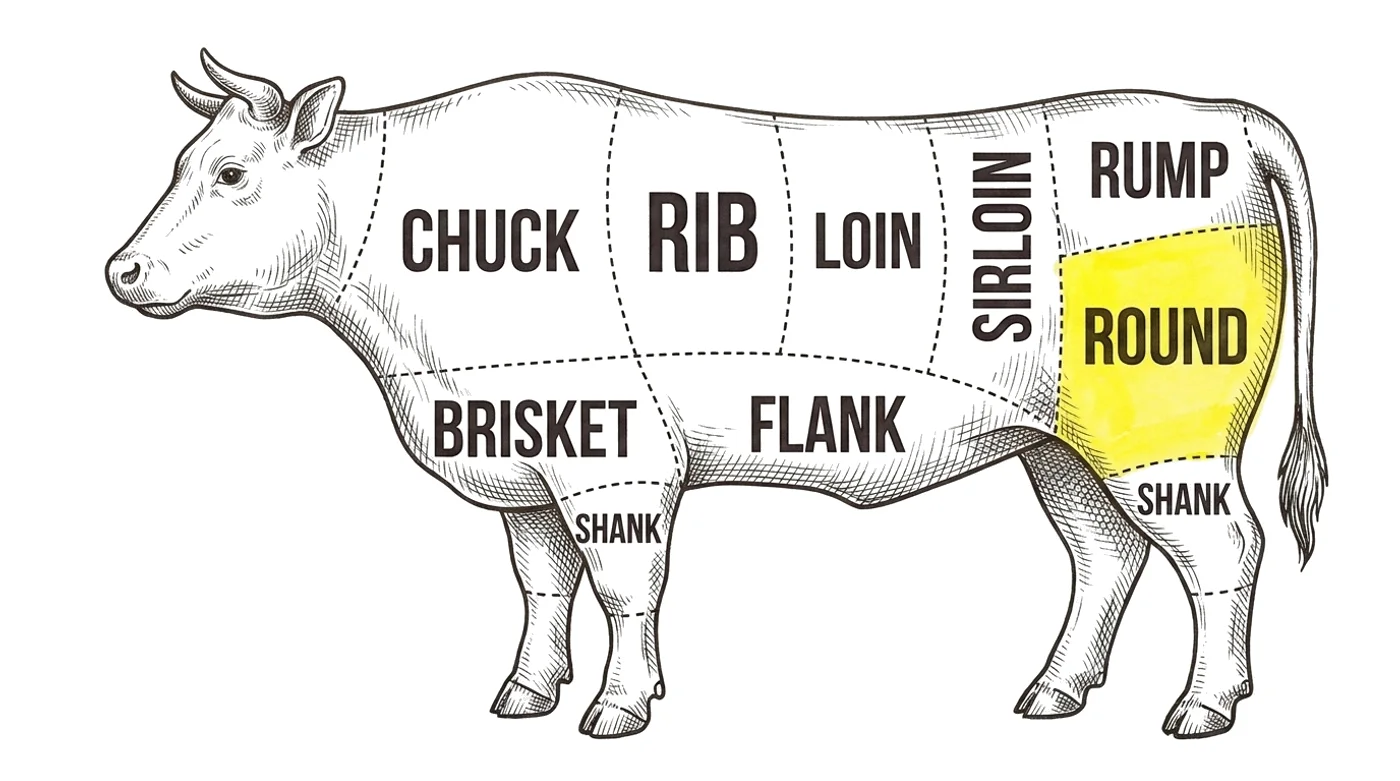
How to recognise it
The whole piece is cylindrical or slightly irregular according to the muscle used. The slice is uniform dark red, often with only the finest threads of fat. It should be tender, compact and easy to chew rather than leathery. Pepper, juniper, wine and cured-beef aromas remain subtle. Grey edges, a hard shell, internal cavities, sourness or a metallic raw smell are faults.
- Shape and size
- Cylindrical, deep-coloured, sliced into thin discs
- Lean colour
- Uniform dark red to purple
- Fat and marbling
- Very lean, little to no fat
- Casing
- Natural casing during ageing
- Surface bloom
- None
Origins and history
Valtellina is a narrow Alpine valley historically linked with livestock, transalpine trade and the need to preserve meat through winter. Salting and air drying made valuable beef portable and allowed households to use large muscles without immediate cooking. Written evidence of bresaola becomes clearer from the fifteenth century, although domestic production remained local for much longer. The name's origin is uncertain. Explanations connect it with brasa, embers used to dry curing rooms, or with dialect terms for strongly salted meat, but no single etymology is proven. During the late nineteenth century, specialist butchers and improved transport took bresaola beyond the valley. The protection consortium was established in 1998 after PGI recognition had formalised Sondrio's role as the place of transformation.
Name. From the dialect brasa, linked to salting and the salting process.
- Production today
- Consortium producers in the province of Sondrio.
- Protection
- IGP; only beef processed in Valtellina qualifies.
- Tradition vs modern
- Traditionally air-dried in the valley; modern makers use air-conditioned rooms to hold the conditions.
- Seasonality
- Made year-round.
Compare with. Cecina de León
Serving and cultural significance
Slice bresaola thinly and dress it at the last moment with olive oil and lemon, or serve it with rocket, shaved Grana or local Bitto cheese. It also works in sandwiches and salads. Heavy vinegar, smoke or thick sauce should not obscure the clean beef flavour.
Recipe and cure
This is not a finished recipe. It is a window into how this meat is traditionally cured. Before you follow any process, please run it through one of our curing calculators, so the salt, cure and timings are right and safe for your own batch.
Curesmith home adaptation — not designation-compliant
Make this — the measured Curesmith version →The cure below is the traditional reference. “Make this” opens the measured Curesmith home recipe, scaled to your batch.
Traditional or protected production
PGI Bresaola della Valtellina may use several specified beef hindquarter muscles, including punta d'anca and magatello. The meat is trimmed, dry salted with permitted seasoning and technological ingredients, rested, cased and dried. The entire transformation takes place in the province of Sondrio, although the cattle need not be raised there. The protected process focuses on clean trimming, even curing and gentle drying.
- Meat
- beef
- Cut
- lean top of the haunch (punta d'anca)
- Salt (%)
- 3
- Curing salt
- Traditionally salt with a little saltpetre; modern makers use Cure #2
- Other agents
- salt with juniper and cinnamon
- Fermented
- No
- Smoked
- No
- Target aW or weight loss
- 30 to 40% weight loss
- Temperature (°C)
- 12 to 15
- Humidity (%)
- 70 to 75
- Maturation
- 4 to 8 weeks
- Basis
- percentage of green meat weight
- Style
- Traditional dry salting, spiced
Ingredients
- sea salt3% · 30 g/kg
- black pepper0.3% · 3 g/kg
- juniper0.3% · 3 g/kg
- cinnamon0.1% · 1 g/kg
- bay0.05% · 0.5 g/kg
- garlic0.2% · 2 g/kg
- dry red wine3% · 30 g/kg
Method
- Trim the lean beef muscle clean of fat and silverskin.
- Rub in the salt and spices and add the wine, turning daily for ten to fifteen days.
- Case and dry.
- Dry to the target weight loss.
Notes
- The official protected specification controls the named product. Any Curesmith EQ, starter-culture, curing-salt or home-scale adaptation is a separate method and must not be presented as designation-compliant.
- A more efficient way of curing this product is using the EQ Method. No more than 2.5% salt to meat weight is required. To follow the EQ method, please use our whole-muscle EQ curing calculator to work out proper ratios and curing times.
Safety. Lean beef dries fast at the surface, so control humidity to avoid case hardening. Verify before serving.
In the Codex
What this product teaches, and where to read more.
Temple. Pillar, Meat Quality