
Brunswick Sausage
Also known as Brunswick Sausage-English, English Brunswick Sausage, Brunswick Sausage, English Style
England, United Kingdom
Overview
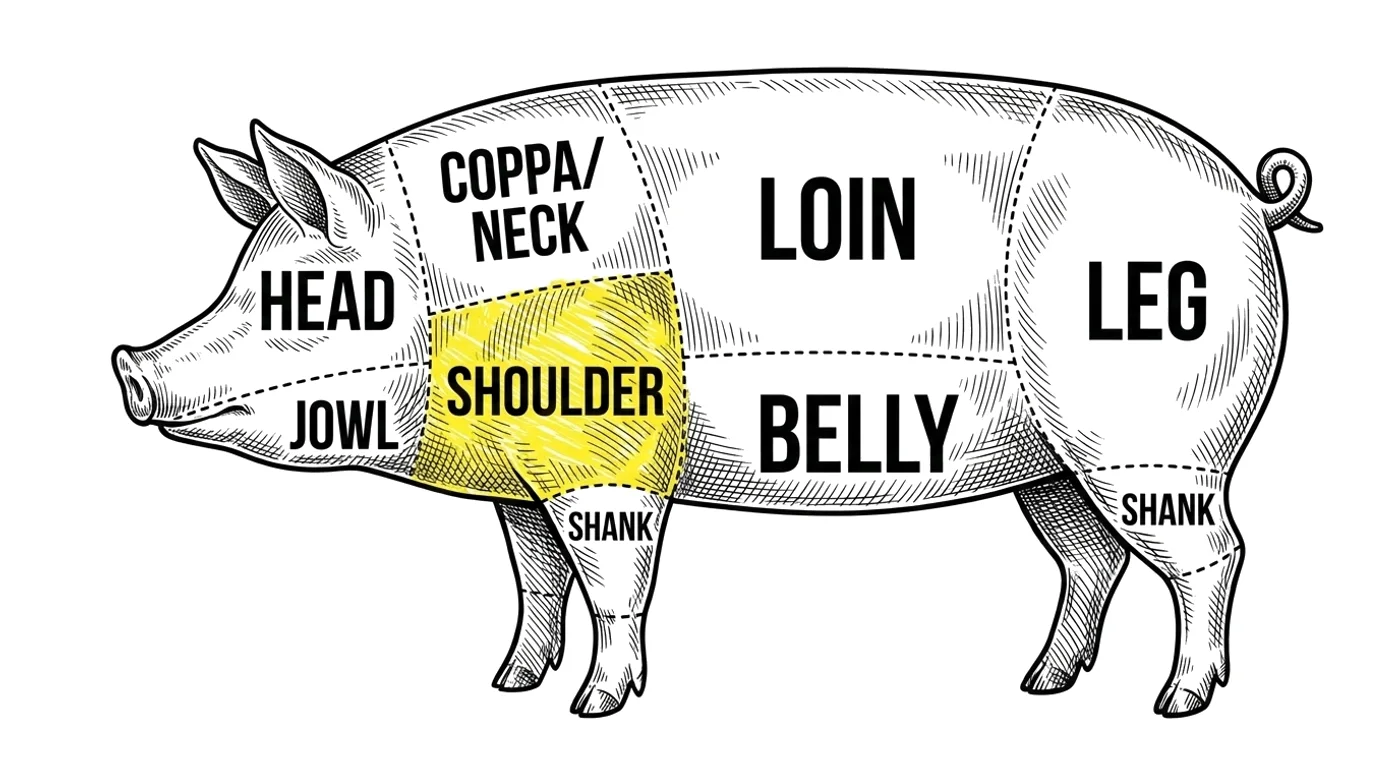
Brunswick Sausage, English Style is an archival pork-and-beef sausage that is cured, warm-smoked, cooked and refrigerated. Pork shoulder, fatty pork and belly remain moderately coarse, while beef is minced more finely to build the bind. The cut face is pink-red with pale fat distributed through a firm but not emulsified matrix.
Where it's from
The cut
Identity and name boundary
Brunswick is the English name for Braunschweig, but the sausage name has diverged sharply between countries. The English-style formula contains no liver. It is therefore not the United States product legally defined as Braunschweiger, which must contain at least 30 per cent liver, and it is not German Braunschweiger Mettwurst, which the German food guidelines place among finely comminuted raw spreadable sausages.
Composition and characteristics
The meat block combines lean pork, fatty pork, lean beef and belly. Beef is minced finely and mixed first with the curing brine to form a strong protein matrix; the pork components are coarser and give a more open bite. White pepper is the only recorded spice, so the defining sensory features are cured meat, mild smoke and the contrast between beef bind and pork fat.
Production and process
The species and particle sizes are prepared separately. Salt and nitrite cure are dissolved in ice water and worked into beef before lean pork and the fatty pork components are added. A refrigerated rest develops cure colour and bind. The sausage is then stuffed into hog casings, dried, smoked, poached until the centre reaches 71°C and cooled promptly.
History and legal divergence
The documentary route by which the Brunswick name reached this English formula has not been established, so a direct origin in Braunschweig should not be asserted. What can be shown is that modern official definitions disagree: German guidance associates Braunschweiger with Mettwurst, while United States law treats it as liver sausage. No protected British geographical name was located for the English-style product.
Use, storage and related products
The sausage can be served warm as a link or chilled and sliced. It remains a cooked refrigerated product, despite curing and smoking. The English qualifier is essential in catalogues and recipe systems because an unqualified Braunschweiger label may imply raw Mettwurst in Germany or liver sausage in North America.
Recipe and cure
This is not a finished recipe. It is a window into how this meat is traditionally cured. Before you follow any process, run it through one of our curing calculators so the salt, cure and timings are right and safe for your own batch.
Make this — the measured Curesmith version →“Make this” opens the same cure as a measured recipe, scaled to your batch.
- Meat
- Trimmed pork shoulder
- Cut
- Trimmed pork shoulder
- Salt (%)
- 1.8
- Curing salt
- Cure #1 as specified in the recipe
- Fermented
- No
- Smoked
- Yes
- Maturation
- Refrigerate at 0–4°C; use within 4 days or freeze promptly
- Basis
- per 1,000 g trimmed pork shoulder
- Style
- English-labelled cured smoked cooked pork and beef sausage
Ingredients
- Trimmed pork shoulder100% · 1000 g
- Fatty pork shoulder trimmings35% · 350 g
- Lean beef chuck55% · 550 g
- Skinless pork belly35% · 350 g
- Fine salt1.8% · 40 g
- Cure #1, 6.25% sodium nitrite0.25% · 5.5 g
- White pepper0.1% · 2 g
- Ice water5.9% · 133.5 g
Method
- Chill beef and pork to 0–2°C. Mince beef through 3 mm and each pork component through 6 mm.
- Dissolve salt, Cure #1 and white pepper in ice water. Mix first with beef until tacky, add lean pork, then fold in fatty pork and belly.
- Cover and refrigerate for 8–12 hours at 3–5°C.
- Stuff into 32–36 mm natural hog casings. Dry the casing surface under refrigeration.
- Apply warm smoke with the chamber near 60°C for about 60 minutes.
- Poach in 78–80°C water until the cold point reaches 72°C.
Safety. Keep the meat cold during staged mixing, use measured Cure #1, replace room-temperature hanging with refrigerated curing, verify the cook, cool rapidly and refrigerate.