
Budapesti téliszalámi
Also known as Budapesti téliszalámi, Budapest Salami, Budapest salami, Budapest winter salami
Budapest, Hungary
Overview
Budapest Salami is a large cylindrical salami under a dense white-grey mould coat, with a brownish-red slice, small white fat particles and gentle smoke. it should be mild and mature rather than sharply sour.
Where it's from
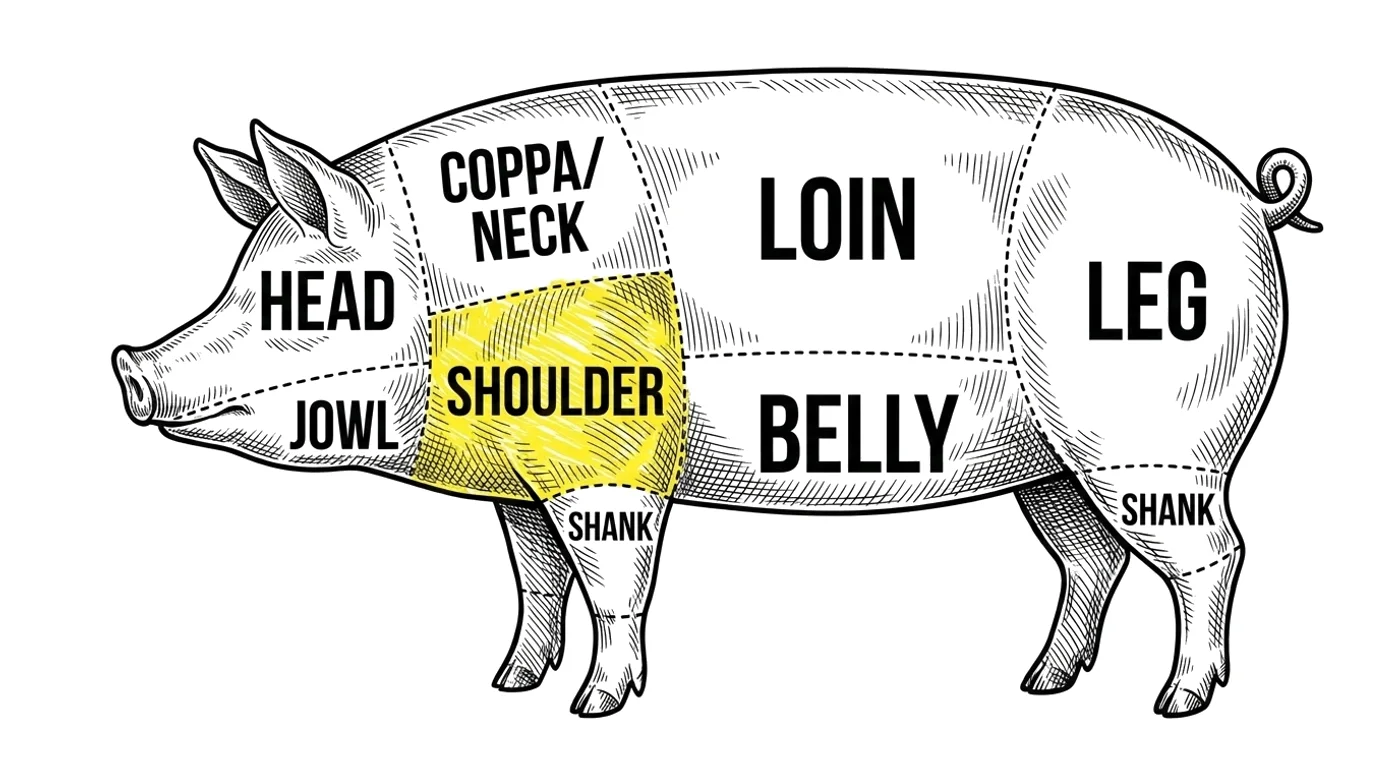
The cut
How to recognise it
A large cylindrical salami under a dense white-grey mould coat, with a brownish-red slice, small white fat particles and gentle smoke. It should be mild and mature rather than sharply sour. Grease smear, hollow pockets, case hardening, a wet centre, rancidity or uncontrolled dark mould is a production fault.
Origins and history
Budapest winter salami grew from the rapid industrialisation of Hungarian meat processing in the late nineteenth century. Ármin Herz established his Budapest salami factory in 1888, adapting Italian-style long maturation to Hungarian pork, smoke and seasoning. The cool season and large riverside buildings supported slow drying and the development of the familiar pale noble mould. The product won major awards at the 1896 Budapest Millennium Exhibition and the 1900 Paris exhibition, helping turn the Herz name into an export symbol. Nationalisation changed the company structure after the Second World War, but the Budapest winter-salami tradition survived. European PGI registration in 2009 protects both Budapesti szalámi and Budapesti téliszalámi and links production with Budapest rather than with generic Hungarian salami.
Serving and cultural significance
Remove the casing and noble mould, slice the salami thinly and serve it with bread, pickled peppers, mild cheese or Hungarian wine. Its restrained smoke and long maturation need little garnish. Cover the cut face after service so the outer ring does not harden.
Recipe and cure
This is not a finished recipe. It is a window into how this meat is traditionally cured. Before you follow any process, run it through one of our curing calculators so the salt, cure and timings are right and safe for your own batch.
Curesmith home adaptation — not designation-compliant
Make this — the measured Curesmith version →The cure below is the traditional reference. “Make this” opens the measured Curesmith home recipe, scaled to your batch.
Traditional or protected production
Budapesti téliszalámi PGI is made from pork meat and firm pork fat, seasoned principally with pepper, paprika and allspice, cold smoked and matured under a natural noble-mould covering. The registered process lasts at least 90 days. The protected mould development does not use an added starter culture.
- Meat
- pork (traditionally Mangalitza and Italian heavy-pig crossbreds)
- Cut
- minced
- Salt (%)
- 2.2 to 2.5%
- Curing salt
- Cure #1
- Other agents
- dextrose; white pepper
- Fermented
- No
- Starter or mould
- house/noble surface mould (Penicillium); the traditional Szeged method uses no mould starter
- Smoked
- beech cold-smoke, around 12 C, for 12 to 14 days
- Target aW or weight loss
- slow, long drying to heavy weight loss
- Temperature (°C)
- cold smoke ~12; ripen and dry cool
- Humidity (%)
- 72 to 75
- Maturation
- weeks
- Basis
- percentage of meat weight
- Style
- minced, stuffed, lightly cold-smoked, mould-ripened and slowly dried
Ingredients
- pork
- salt
- dextrose
- white pepper
- Cure #1
Notes
- The official protected specification controls the named product. Any Curesmith EQ, starter-culture, curing-salt or home-scale adaptation is a separate method and must not be presented as designation-compliant.
- Nitrite at 156 ppm ingoing.
- Not an acid ferment: it ripens at a high pH (Szegedi sits above pH 5.6), relying on salt, a noble mould cover and slow drying.
- Beech cold-smoke at about 12 C for 12 to 14 days, then long cool drying.
- Convert any volume spice measures to weight as a percentage of the meat.
Safety. A mould-ripened, slowly dried salami rather than a tangy ferment; safety rests on salt, the noble mould cover and thorough drying. The high pH means drying must be slow and even.
In the Codex
What this product teaches, and where to read more.
Temple. Pillar, Mould Control