
Bulagna de l'Île de Beauté
Corsica (regional), Corsica, France
Herb-scented cured fat, melting and rich, the Corsican counterpart to lardo.
Overview
Bulagna de l'Île de Beauté is the protected Corsican jowl cure registered in 2023. The triangular fatty cheek is salted, peppered and matured, producing a rich piece used much like guanciale or lardons in island cooking.
Where it's from
Climate. Corsica, cool mountain cellars.
Altitude. Corsican hills
The cut
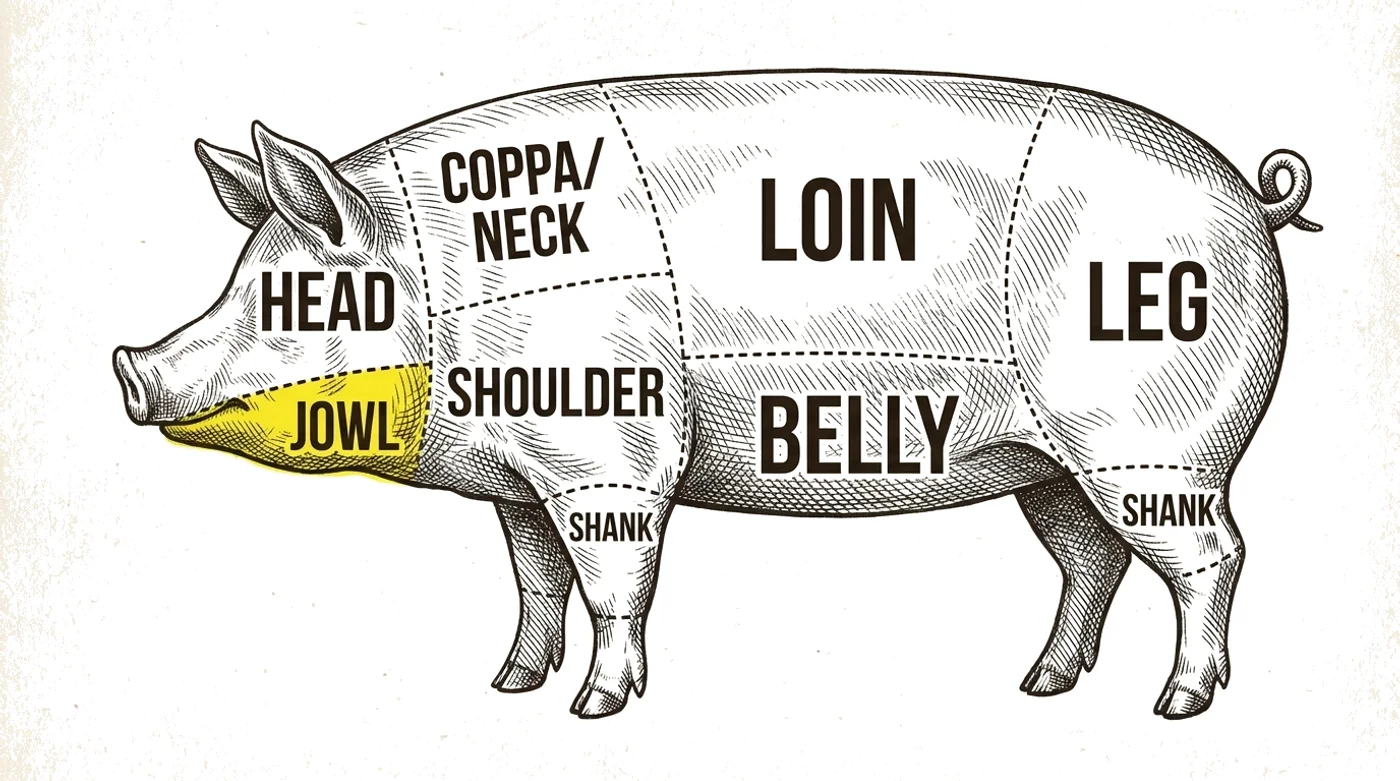
How to recognise it
The whole jowl is triangular or irregular, with broad white fat around darker cheek muscle and a peppered dry surface. Fat should be sweet and pliable. Yellow rancidity, sourness, sticky areas or grey lean pockets are defective.
- Shape and size
- Slabs of cured back fat
- Lean colour
- n/a (fat)
- Fat and marbling
- Creamy white
- Casing
- None (whole jowl)
- Surface bloom
- None
Origins and history
The pig's jowl combines soft fat with intensely flavoured cheek muscle, making it too valuable to discard and well suited to winter salting. Corsican households hung the triangular pieces beside belly and loin, then sliced them into eggs, soups, beans and vegetables. The name remained local while guanciale became better known internationally. Tourism and generic Corsican branding increased the need for formal recognition. The Île de Beauté producer group created a protected chain for traditional island charcuterie made under broader raw-material rules than the older Nustrale AOPs. Bulagna was registered as a PGI on 26 July 2023 together with Pancetta, Figatelli and Saucisson sec.
Name. Bulagna, the Corsican name for the cured back fat.
- Production today
- Corsican producers.
- Protection
- IGP (Ile de Beaute).
- Tradition vs modern
- Salt-and-herb curing in cool cellars.
- Seasonality
- Winter slaughter.
Compare with. Lardo di Colonnata, Vallée d'Aoste Lard d'Arnad
Serving and cultural significance
Cut into lardons and fry with eggs, beans, chestnuts, cabbage or potatoes. Thin slices can be crisped for bread and salads. Render slowly so the fat stays sweet. The rendered fat is valuable for cooking greens or potatoes, but it should smell fresh and sweet before it is reused in the dish.
Recipe and cure
This is not a finished recipe. It is a window into how this meat is traditionally cured. Before you follow any process, please run it through one of our curing calculators, so the salt, cure and timings are right and safe for your own batch.
Curesmith home adaptation — not designation-compliant
Make this — the measured Curesmith version →The cure below is the traditional reference. “Make this” opens the measured Curesmith home recipe, scaled to your batch.
Traditional or protected production
The PGI controls Corsican sourcing and production, salting, seasoning, possible smoke and maturation. It is legally distinct from generic guanciale and from the island's breed-specific AOP products.
Coarse sea salt (packed), with herbs; no fixed percentage.
- Meat
- pork
- Cut
- jowl (throat), rind on one face
- Salt (%)
- packed in salt, traditional (no fixed %)
- Curing salt
- Sea salt (packed) and herbs
- Fermented
- No
- Smoked
- Yes
- Target aW or weight loss
- minimal loss (cured fat)
- Temperature (°C)
- cool cellar
- Humidity (%)
- high
- Maturation
- a few months
- Basis
- percentage of green meat weight
- Style
- Traditional dry salting, herbed
Method
- Layer back fat with coarse salt and herbs.
- Cure in the cool cellar.
- Turn and top up as needed.
- Rest a few months before use.
Notes
- The official protected specification controls the named product. Any Curesmith EQ, starter-culture, curing-salt or home-scale adaptation is a separate method and must not be presented as designation-compliant.
- A more efficient way of curing this product is using the EQ Method. No more than 2.5% salt to meat weight is required. To follow the EQ method, please use our whole-muscle EQ curing calculator to work out proper ratios and curing times.
In the Codex
What this product teaches, and where to read more.
Temple. Foundation, Time