
Burgenländisches Hauswürstel
Also known as Burgenland house sausage, Hauswürstel, Burgenland style
Burgenland, Austria
Where it's from
The cut
Identity
Burgenländisches Hauswürstel is a Burgenland-style house sausage built from coarsely ground pork, beef and pork belly. Hauswürstel literally identifies a sausage of household or house manufacture rather than one universal national formula. The qualifier Burgenländisches is therefore essential: it locates this cooked, smoked branch in Austria's eastern state and separates it from differently made house sausages elsewhere.
Regional setting
Burgenland lies along Austria's eastern border and has a food culture shaped by Central European farm slaughter, paprika-country cooking and practical preservation. A house sausage made use of shoulder, beef and belly in a form that could be smoked, cooked and served without lengthy maturation. The source distinguishes this hot-smoked, poached version from Hauswürstel Roh, which is cold-smoked and dried.
Composition and flavour
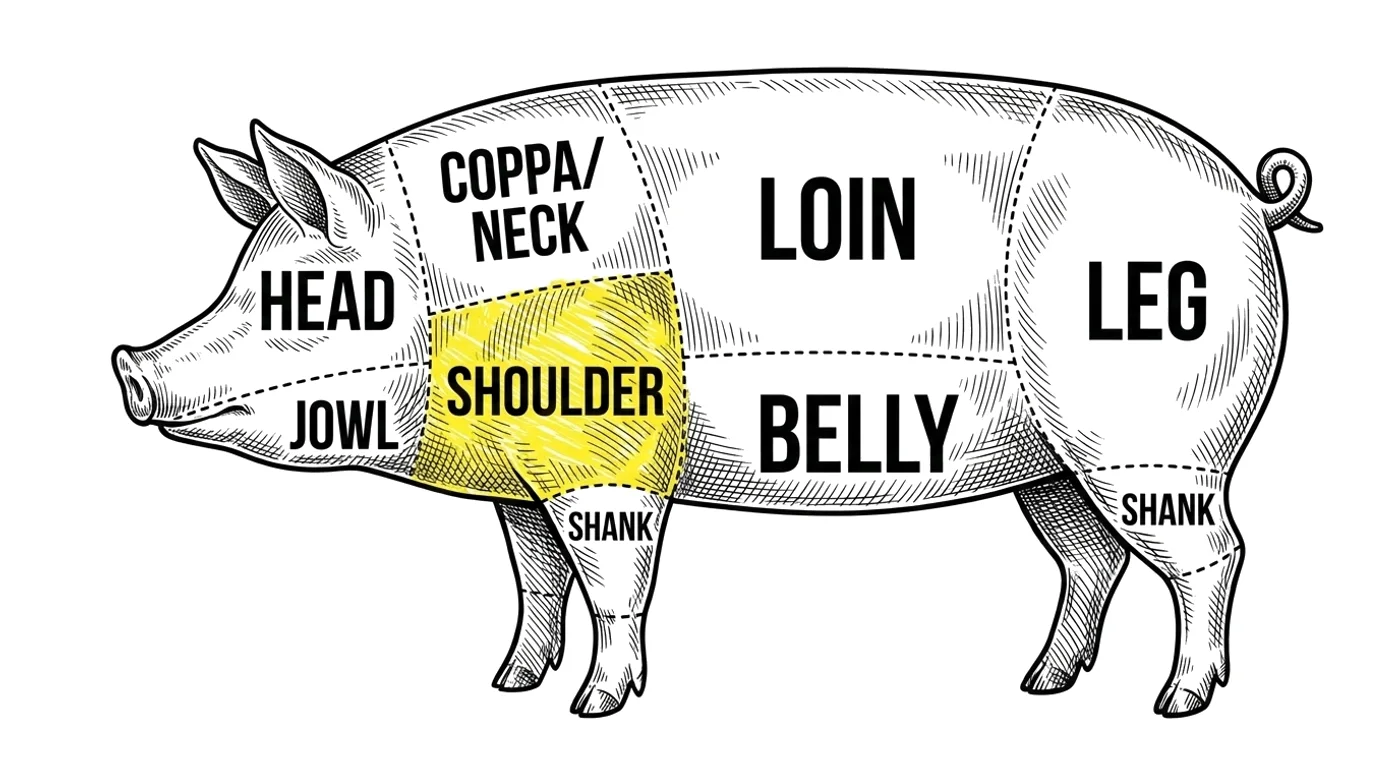
The meat block combines pork shoulder for body, beef for a firm protein bind and belly for succulence. Garlic, black pepper, caraway and allspice provide the recognisable seasoning. An 8 mm grind gives a rustic, even grain: it should be coarser than a frankfurter but sufficiently extracted to slice without crumbling.
Production
Beef is first mixed with salt, curing salt and cold water to develop a tacky bind. Pork, garlic and spices follow, with belly added last to protect the fat definition. The mixture is stuffed into broad hog casings, rested under refrigeration, dried, hot-smoked and poached until the centre reaches 71°C before rapid cooling.
Eating and service
The cooked sausage is served hot with bread and mustard or with boiled potatoes and vegetables. Reheating should be gentle because hard boiling can split the casing and drive out fat. Its garlic-caraway profile makes it more assertive than a mild white sausage but less paprika-led than Burenwurst.
Boundaries
The cooked branch must not be presented as Hauswürstel Roh: the latter relies on cold smoking and drying and needs a separate validated fermentation or drying process. Burgenländisches Hauswürstel is also not Burenwurst, whose Vienna register identity, starch-bearing composition and coarse batter architecture are independently defined.
Recipe and cure
This is not a finished recipe. It is a window into how this meat is traditionally cured. Before you follow any process, run it through one of our curing calculators so the salt, cure and timings are right and safe for your own batch.
Make this — the measured Curesmith version →“Make this” opens the same cure as a measured recipe, scaled to your batch.
- Meat
- Pork shoulder
- Cut
- Pork shoulder
- Salt (%)
- 1.8
- Curing salt
- Cure #1 as specified in the recipe
- Fermented
- No
- Smoked
- Yes
- Maturation
- Refrigerate at 0–4°C; use within 4 days or freeze
- Basis
- per 1,000 g pork shoulder
- Style
- Austrian regional cured, coarse, hot-smoked and cooked sausage
Ingredients
- Pork shoulder100% · 1000 g
- Lean beef chuck25% · 250 g
- Skinless pork belly45% · 450 g
- Ice water6.4% · 109 g
- Fine salt1.8% · 31 g
- Cure #1, 6.25% sodium nitrite0.24% · 4 g
- Black pepper0.21% · 3.5 g
- Caraway0.05% · 0.9 g
- Ground allspice0.11% · 2 g
- Fresh garlic0.38% · 6.5 g
Method
- Trim, dice and chill all meat and fat to 0–2°C; chill grinder parts.
- Grind chilled pork, beef and belly separately through 8 mm.
- Mix beef with salt, Cure #1 and ice water to extraction; add pork, garlic and spices, then fold in belly last.
- Stuff into natural hog casing, 34–36 mm; remove air pockets and form the specified links.
- Rest the stuffed sausage for 8–12 hours.
- Dry at 45–50°C, then hot-smoke at 55–60°C for about 60 minutes.
Safety. This cured cooked branch requires measured Cure #1, refrigerated resting, a 71°C cold-point endpoint, rapid cooling and refrigeration.