
Butifarra Soledeña
Also known as Butifarra de Soledad, Buti soledeña
Atlántico, Colombia
Where it's from
The cut
Identity
Butifarra Soledeña is the compact, round-linked sausage of Soledad in Colombia's Atlántico department. Its defining visual feature is a continuous chain of small beads tied at short intervals, not the long cylindrical link familiar in European sausages. It is cooked and sold ready to eat, usually as a street snack.
Place and cultural history
The sausage belongs to the food culture shared by Soledad and neighbouring Barranquilla on Colombia's Caribbean coast. Official Atlántico sources describe family producers, festival activity and the product's role in local gastronomic identity. Its importance is cultural and commercial; the official material checked does not establish a protected geographical denomination.
Composition
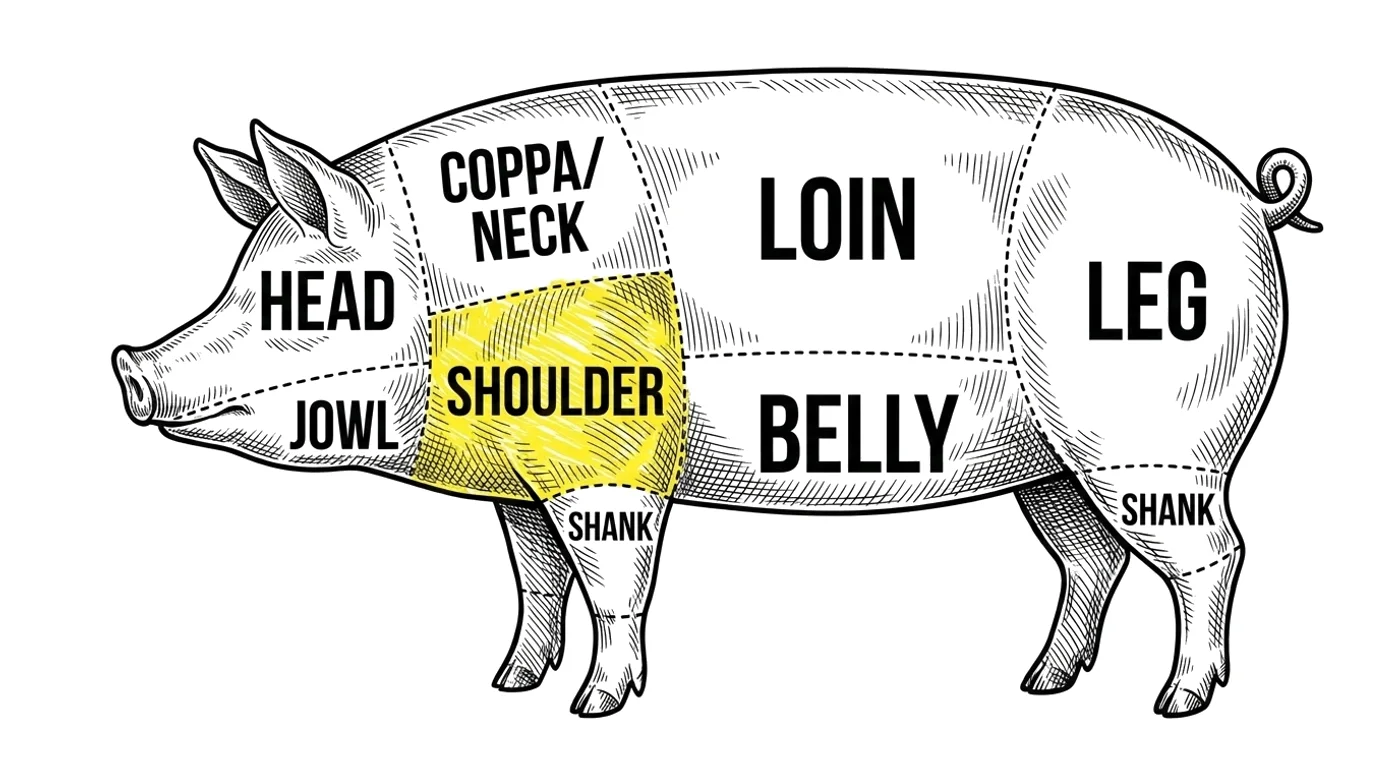
Pork is the usual base, although regional accounts and household formulas may include beef. The seasoning is restrained: salt, pepper and garlic allow the meat and fat to dominate. This version uses shoulder and belly, producing a juicy cooked crumb without blood, rice, starch or the sweet spices encountered in some Spanish white botifarres.
Making the pearl chain
Chilled meat and belly are ground and mixed to a light bind, then filled as one uncut coil. Twine is tied every few centimetres to create the characteristic string of rounded portions. Gentle poaching cooks each bead evenly. Trapped air should be vented before cooking rather than puncturing hot, pressurised sausage midway through the process.
Street service
Butifarra Soledeña is commonly eaten in small numbers as a snack, brightened with fresh lime and paired with Caribbean coastal starches such as bollo de yuca. The linked format lets a vendor cut off the required number of beads while keeping the remaining chain intact.
Boundaries
The Colombian product is not Catalan botifarra blanca, botifarra d'ou or raw botifarra crua, despite the shared Iberian-derived name. It is also unrelated to the Peruvian butifarra sandwich made with jamón del país. Geography, pearl-like form and cooked street-food use define the Soledeña identity.
Recipe and cure
This is not a finished recipe. It is a window into how this meat is traditionally cured. Before you follow any process, run it through one of our curing calculators so the salt, cure and timings are right and safe for your own batch.
Make this — the measured Curesmith version →“Make this” opens the same cure as a measured recipe, scaled to your batch.
- Meat
- Pork shoulder
- Cut
- Pork shoulder
- Salt (%)
- 1.5
- Curing salt
- None
- Fermented
- No
- Smoked
- No
- Maturation
- Refrigerate at 0–4°C; use within 4 days or freeze
- Basis
- per 1,000 g pork shoulder
- Style
- Colombian uncured cooked pork street sausage
Ingredients
- Pork shoulder100% · 1000 g
- Skinless pork belly45% · 450 g
- Fine salt1.5% · 21.5 g
- Black pepper0.2% · 3 g
- Fresh garlic0.39% · 5.5 g
- Ice water3% · 43 g
Method
- Trim, dice and chill all meat and fat to 0–2°C; chill grinder parts.
- Grind chilled shoulder and belly separately through 6 mm.
- Dissolve salt in ice water; mix shoulder to a bind, then add pepper, garlic and belly.
- Stuff into natural hog casing, 30–32 mm; tie into a connected pearl chain; remove air pockets and form the specified links.
- Poach gently at 78–80°C until every bead reaches 71°C. If venting is needed, prick trapped air before cooking with a sanitised needle.
- Shower or immerse briefly in clean cold water, then chill from 57°C to 21°C within 2 hours and to 5°C or below within 6 hours total.
Safety. Poach each bead to 71°C, cool under a two-stage schedule and keep refrigerated; it is not shelf stable.