
Cambridge Sausage (alternative 2)
Also known as Cambridge rice and cracker sausage, Cambridge Sausage with Rice and Cracker Meal
Cambridgeshire, United Kingdom
Overview
Cambridge Sausage with Rice and Cracker Meal is one of several historical trade formulas sold under the Cambridge name. This branch combines pork with cooked rice and finely crushed cracker meal, producing a soft, economical fresh sausage.
Where it's from
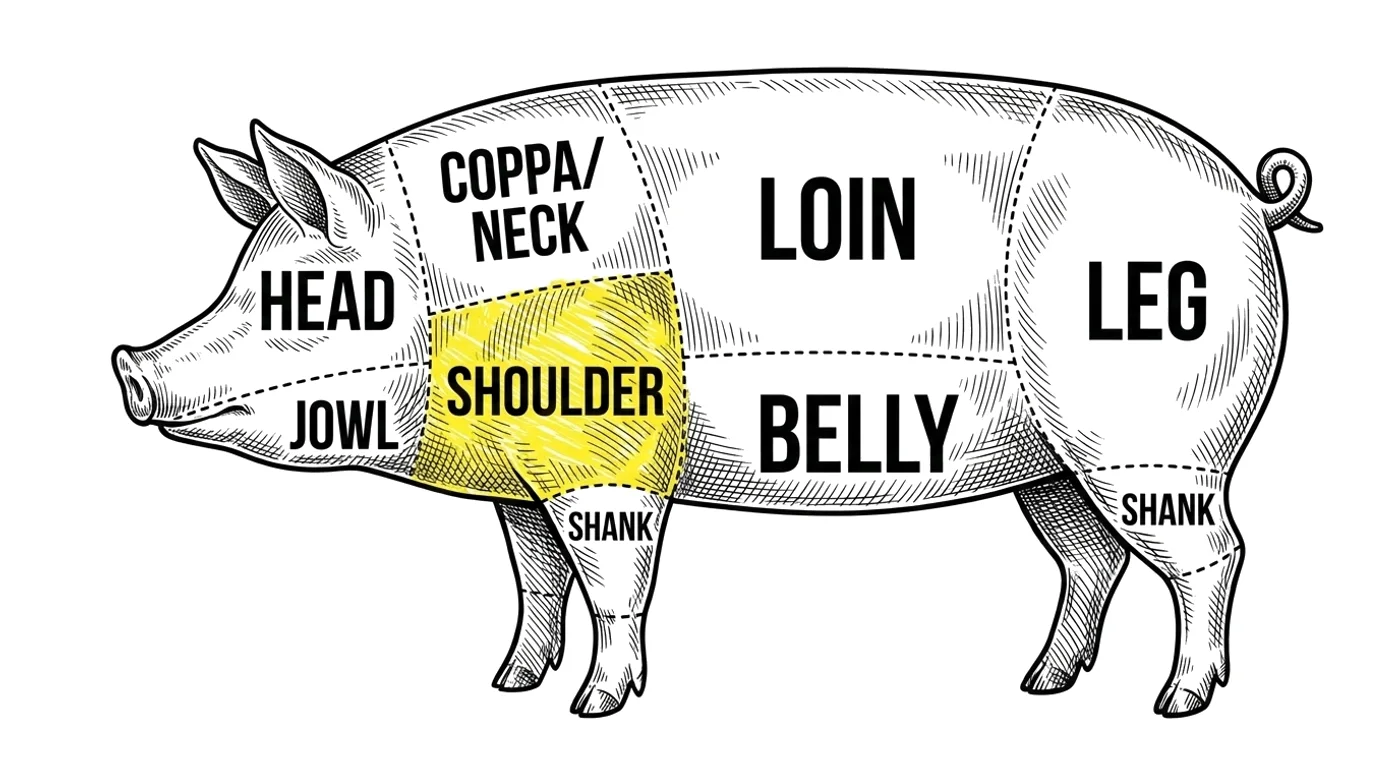
The cut
Identity and terminology
Cambridge sausage was never reduced to one protected county recipe. Professional manuals printed multiple versions using rice, rusk, bread or cracker meal. The variant title is therefore necessary because the cereal system materially changes the texture.
Composition and characteristics
Cooked rice contributes visible soft grains and moisture, while cracker meal binds released juices. Pork and fat remain the flavour base, commonly seasoned with pepper, sage, mace or nutmeg. The finished link is finer and softer than a coarse regional sausage.
Production and process
Rice must be cooked, cooled and handled hygienically before mixing with chilled minced pork. Cracker meal is incorporated evenly, and the sausage is stuffed and sold raw. The cereal mixture makes temperature control especially important.
History and regional forms
The Cambridge name appears in British butcher and catering literature from the nineteenth and early twentieth centuries. Its repeated use for different formulas suggests a commercial style associated with mild seasoning and cereal extension rather than a single ancient Cambridge household recipe.
Use, storage and related products
It is grilled, fried or baked and served as a breakfast or supper sausage. It is distinct from the rice-and-rusk and rusk-only Cambridge records, which should remain separate recipe variants under one article family.
Recipe and cure
This is not a finished recipe. It is a window into how this meat is traditionally cured. Before you follow any process, run it through one of our curing calculators so the salt, cure and timings are right and safe for your own batch.
Make this — the measured Curesmith version →“Make this” opens the same cure as a measured recipe, scaled to your batch.
- Meat
- Pork shoulder
- Cut
- Pork shoulder
- Salt (%)
- 2
- Curing salt
- None
- Fermented
- No
- Smoked
- No
- Maturation
- Raw sausage ≤4°C for up to 2 days; freeze for longer storage
- Basis
- per 1,000 g pork shoulder
- Style
- Fresh extended pork sausage; cook before eating
Ingredients
- Pork shoulder100% · 1000 g
- Pork back fat50% · 500 g
- Cooked long-grain rice, fully chilled17.6% · 300 g
- Fine cracker meal20% · 200 g
- Fine salt1.8% · 30 g
- Ground white pepper0.94% · 16 g
- Ground nutmeg0.12% · 2 g
- Ground mace0.12% · 2 g
- Rubbed sage0.2% · 2 g
- Ground cloves0.03% · 0.5 g
- Ground ginger0.06% · 1 g
- Cayenne pepper0.03% · 0.5 g
Method
- Cook the rice without added fat. Spread it in a shallow tray and cool rapidly to 4°C or below. Weigh exactly 150 g.
- Chill pork, back fat, rice and equipment to 0–4°C.
- Grind shoulder and back fat once through 6 mm.
- Add salt and spices, then fold in the chilled rice and cracker meal. Mix until uniformly distributed and lightly cohesive.
- Stuff into 28–32 mm hog casings and form links.
- Refrigerate for 4–12 hours at 2–4°C.
Safety. Cooked rice can support rapid microbial growth if mishandled. Cool it promptly, keep the mixed sausage cold and cook fully.