
Capocollo di Martina Franca
Martina Franca, Puglia, Italy
Sweet, smoky and aromatic, its cooked-wine brush and almond-and-oak smoke unmistakable.
Overview
Capocollo di Martina Franca is the aromatic neck cure of the Valle d’Itria. After salting and seasoning, the meat is treated with cooked wine, cased and lightly smoked with local fragno oak bark and almond material, producing a sweet, winey smoke unlike ordinary coppa.
Where it's from
Climate. The Valle d'Itria around Martina Franca in Puglia, in the Murgia hills.
Altitude. Murgia plateau
The cut
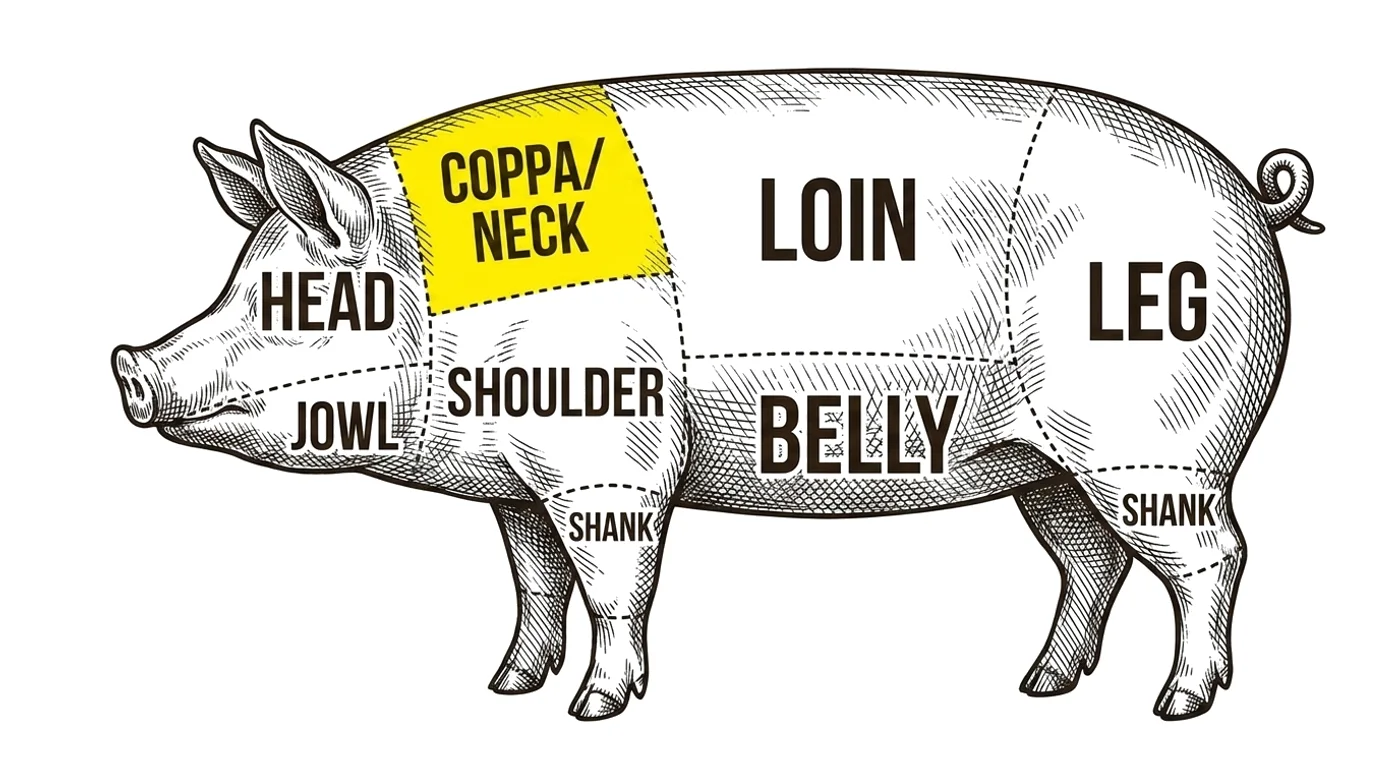
How to recognise it
The whole piece is broad and cased, with a dark wine-red exterior and a marbled ruby slice. Aroma should combine cured pork, cooked wine and a restrained sweet woodland smoke. Harsh soot, excessive sweetness, a grey centre, rancid fat or trapped air beneath the casing are faults.
- Shape and size
- Cased neck muscle, amber-smoked
- Lean colour
- Deep red
- Fat and marbling
- Marbled
- Casing
- Natural casing
- Surface bloom
- Possible
Origins and history
The white towns and mixed farms of the Valle d'Itria developed a butchery culture based on pigs, wine, almonds and local woodland. Neck meat was cured as a prestige whole piece, but the defining step was regional: brushing or soaking with vino cotto and smoking with fragno, the local Macedonian oak, together with almond husks or shells. The smoke was never intended to dominate; it joined the sweetness of reduced wine and the natural marbling of the neck. Artisan production survived through Martina Franca, Cisternino and Locorotondo and later gained Slow Food support. After a long national application process, the EU application for Capocollo di Martina Franca PGI was published on 22 June 2026. At this review date it remains published and pending registration, not yet a registered PGI.
Name. Capocollo, 'head-neck'; Martina Franca names the town.
- Production today
- Small producers around Martina Franca.
- Protection
- A Slow Food Presidium, not a registered DOP/IGP as far as our records show. Verify the current EU status before publishing.
- Tradition vs modern
- The almond-and-oak smoke and vino cotto are the local signature.
- Seasonality
- Winter slaughter.
Compare with. Capocollo di Calabria, Speck Alto Adige
Serving and cultural significance
Slice it thinly and serve with Puglian bread, burrata, caciocavallo, olives and local wine. The wine-and-smoke character is distinctive enough that simple accompaniments work best. It can also be served over warm bread so the marbling softens.
Recipe and cure
This is not a finished recipe. It is a window into how this meat is traditionally cured. Before you follow any process, please run it through one of our curing calculators, so the salt, cure and timings are right and safe for your own batch.
Curesmith home adaptation — not designation-compliant
Make this — the measured Curesmith version →The cure below is the traditional reference. “Make this” opens the measured Curesmith home recipe, scaled to your batch.
Traditional or protected production
The published application covers neck muscles of 2.5–4.5 kg, cured in the Valle d'Itria and enclosed in natural pig casing. Vino cotto or concentrated grape must and smoke from fragno oak and dry local vegetation define the product. As of July 2026, the application is published but not yet registered.
- Meat
- pork
- Salt (%)
- 3
- Curing salt
- Salt, then a light oak-and-almond smoke; traditionally a touch of nitrate
- Fermented
- No
- Starter or mould
- Light natural mould possible
- Smoked
- Yes
- Target aW or weight loss
- ~30% weight loss
- Temperature (°C)
- 12 to 15
- Humidity (%)
- 75 to 80
- Maturation
- 3 to 4 months
- Basis
- percentage of green meat weight
- Style
- Traditional dry salting, cased, lightly smoked
Ingredients
- sea salt3% · 30 g/kg
- black pepper0.4% · 4 g/kg
- cooked wine (vino cotto)2% · 20 g/kg
Method
- Rub the muscle with salt and seasoning and rest cold.
- Rinse and rest so the salt equalises.
- Case, tie and net.
- Dry and age to the target loss.
Notes
- The official protected specification controls the named product. Any Curesmith EQ, starter-culture, curing-salt or home-scale adaptation is a separate method and must not be presented as designation-compliant.
- A more efficient way of curing this product is using the EQ Method. No more than 2.5% salt to meat weight is required. To follow the EQ method, please use our whole-muscle EQ curing calculator to work out proper ratios and curing times.
In the Codex
What this product teaches, and where to read more.
Temple. Roof, Microclimate