
Cervelatpølse
Also known as Danish cervelat sausage, Danish saveloy-type sausage
Denmark
Where it's from
The cut
What it is
Cervelatpølse is a Danish fine-textured pork-and-beef sausage made for slicing. Denmark's official food-composition database describes it in English as a pork and beef sausage of saveloy type. It belongs to the cooked luncheon-sausage counter, not to the fermented cervelat traditions found elsewhere in Europe.
Terminology and related Danish names
The source pairs Cervelatpølse with Kødpølse, literally meat sausage. Current Danish monitoring reports list Cervelatpølse and Kødpølse as separate labelled samples, showing that the terms overlap in market style but are not safe to treat as exact legal synonyms in every case. Cervelatpølse is the controlling name.
Formulation and appearance
Beef and pork provide the protein matrix, while a substantial share of firm back fat gives the smooth, supple slice. Pepper, nutmeg and ginger form a mild northern-European seasoning. A red exterior is traditional in some presentations, but the interior should remain a uniform cured pink rather than be dyed through.
From cutter to casing
The chilled beef is ground finer than the pork and fat, then all components are emulsified with ice water, salt and cure while the batter stays cold. Medium hog casings give the sausage more substance than a cocktail saveloy. Beech or oak smoke precedes gentle water cooking and controlled chilling.
How it is eaten
Cervelatpølse is commonly handled as pålæg, the Danish category of sliced toppings for bread. Thin slices suit rye bread, cucumber and mustard; thicker pieces can be warmed. Its mild smoke and fine texture distinguish it from coarse medister and from dry spegepølse.
Regulatory and safety boundary
Danish official monitoring treats it as a heat-treated meat product and checks preservative use and declarations. A home formula must use an approved curing salt precisely, treat red casing colour as a labelled additive rather than a safety control, verify the cooking endpoint and prevent post-cook contamination.
Recipe and cure
This is not a finished recipe. It is a window into how this meat is traditionally cured. Before you follow any process, run it through one of our curing calculators so the salt, cure and timings are right and safe for your own batch.
Make this — the measured Curesmith version →“Make this” opens the same cure as a measured recipe, scaled to your batch.
- Meat
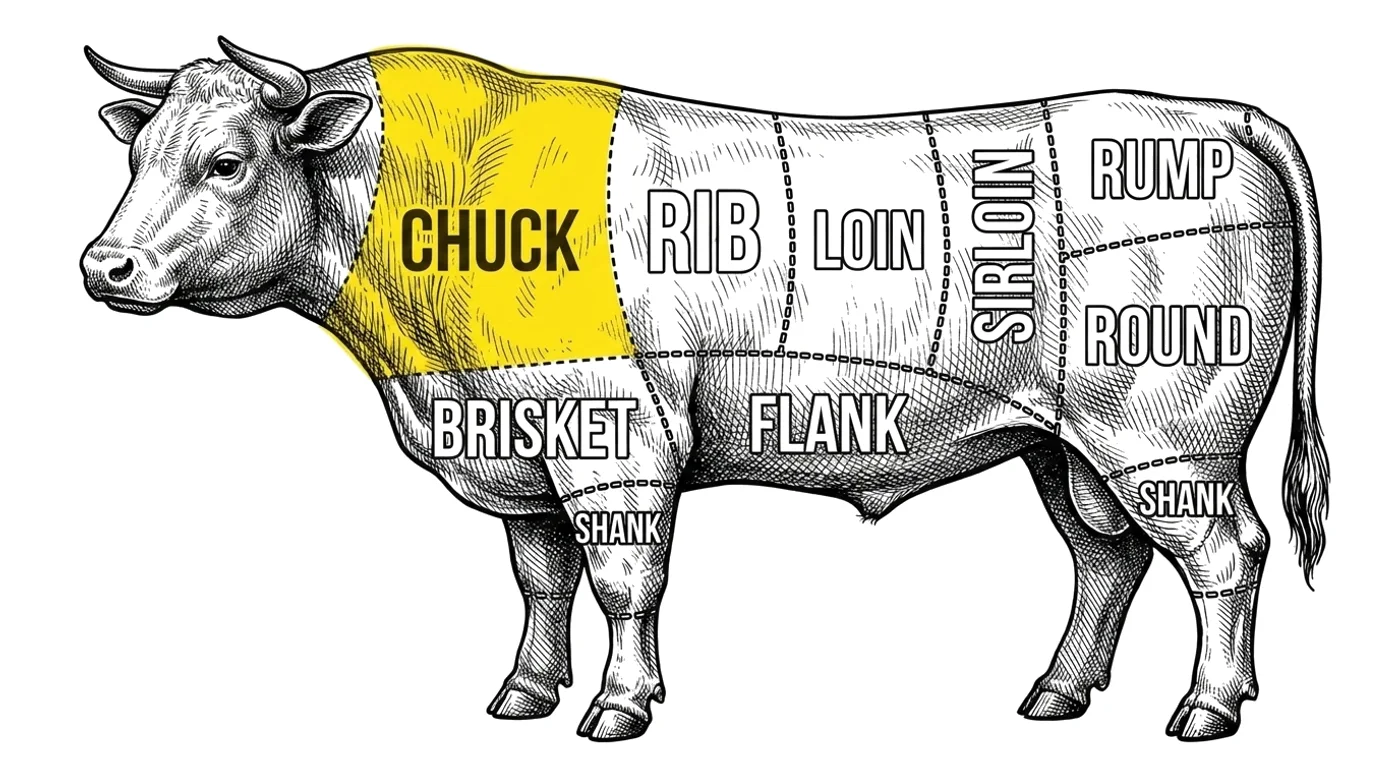
- Lean beef chuck
- Cut
- Lean beef chuck
- Salt (%)
- 1.8
- Curing salt
- Cure #1 as specified in the recipe
- Fermented
- No
- Starter or mould
- None; this sausage is emulsified and cooked, not fermented
- Smoked
- Yes
- Maturation
- Refrigerate at 0–4°C; use within 4 days or freeze
- Basis
- per 1,000 g lean beef chuck
- Style
- Danish cured, emulsified, smoked and cooked pork-beef luncheon sausage
Ingredients
- Lean beef chuck100% · 1000 g
- Pork shoulder100% · 1000 g
- Pork back fat85% · 850 g
- Ice water6% · 171.5 g
- Fine salt1.8% · 51.5 g
- Cure #1, 6.25% sodium nitrite0.25% · 7 g
- White pepper0.2% · 5.5 g
- Ground nutmeg0.05% · 1.5 g
- Ground ginger0.05% · 1.5 g
Method
- Trim, dice and chill all meat and fat to 0–2°C; chill grinder parts.
- Grind pork and back fat separately through 6 mm and beef through 3 mm.
- Fine-process beef and pork with ice water, salt and Cure #1; add fat and spices without exceeding 10°C.
- Stuff into natural hog casing, 34–36 mm; remove air pockets and form the specified links.
- Rest the filled links for 8–12 hours.
- Dry the casing, then smoke over beech or oak at 55–60°C until evenly coloured.
Safety. Keep the emulsion below 10°C, dose nitrite precisely, cook to 71°C, cool promptly and refrigerate.