
Overview
Ćevapčići, more commonly called ćevapi in much of the Balkans, are small skinless grilled meat sausages. They are formed by hand or machine without casing and are a major street, restaurant and home food across Bosnia and Herzegovina, Serbia, Croatia, Montenegro, Kosovo and North Macedonia.
Where it's from
The cut
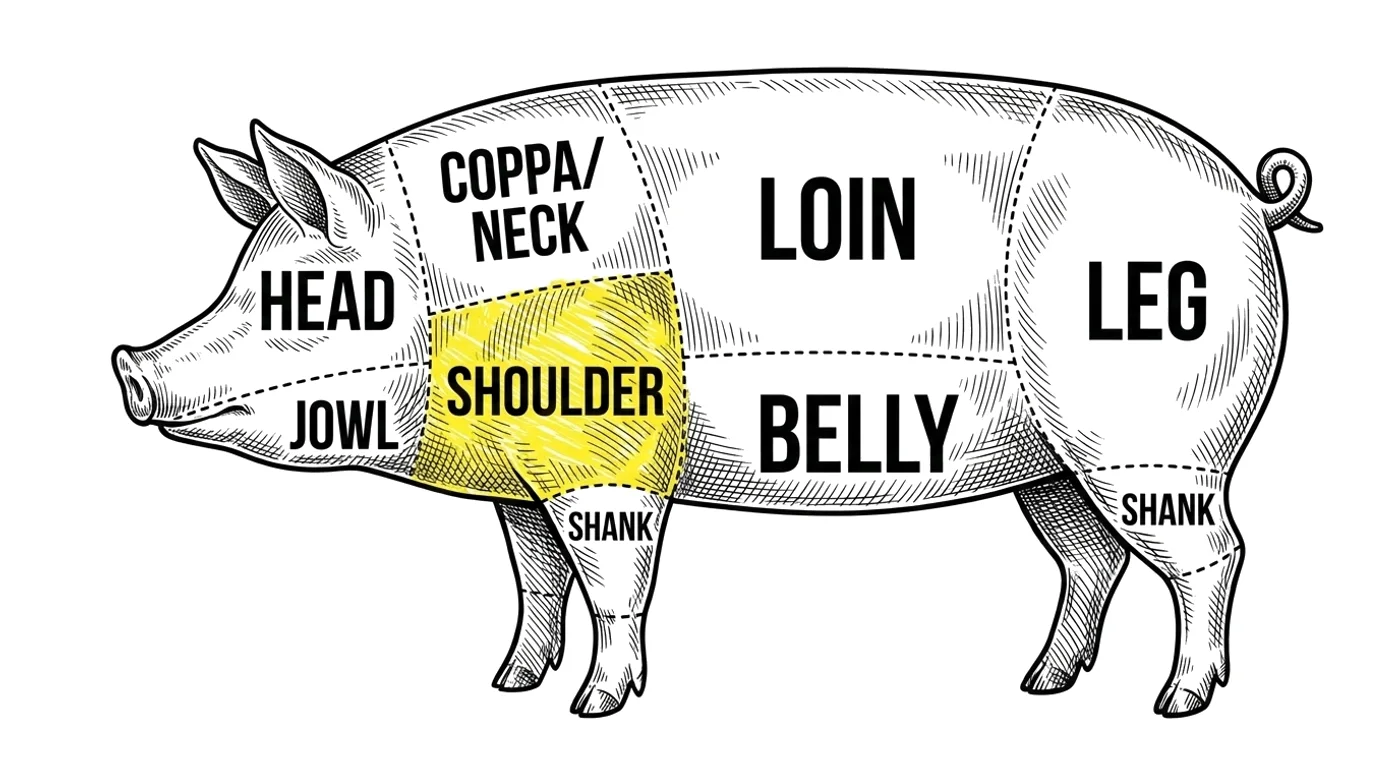
Identity and terminology
Ćevapčići is a diminutive plural derived from ćevap, itself connected to Ottoman kebab terminology. National and city styles differ sharply, so no single mixed-meat recipe is the Balkan identity.
Composition and characteristics
Formulas use beef, lamb, mutton or pork in different combinations. Sarajevo ćevapi are strongly associated with beef and lamb, while Serbian forms often include pork. The texture is fine but not emulsified, with garlic and pepper varying by region.
Production and process
The seasoned meat is rested, shaped into short cylinders and grilled over high heat. The absence of casing is defining. Traditional charcoal grilling produces a browned exterior while keeping the centre juicy.
History and regional forms
The dish reflects centuries of Ottoman influence in the Balkans and subsequent localisation in urban grill culture. Distinct city identities developed in Sarajevo, Banja Luka, Travnik, Leskovac and elsewhere, including different link arrangements, meats and accompaniments.
Use, storage and related products
Ćevapi are served in lepinja or somun with chopped onion, kajmak or ajvar. They are related to köfte and mici but have their own Balkan forms and service traditions.
Recipe and cure
This is not a finished recipe. It is a window into how this meat is traditionally cured. Before you follow any process, run it through one of our curing calculators so the salt, cure and timings are right and safe for your own batch.
Make this — the measured Curesmith version →“Make this” opens the same cure as a measured recipe, scaled to your batch.
- Meat
- Pork shoulder
- Cut
- Pork shoulder
- Salt (%)
- 1.2
- Curing salt
- None
- Fermented
- No
- Smoked
- No
- Maturation
- Raw mixture ≤4°C for up to 2 days; freeze formed pieces for longer storage
- Basis
- per 1,000 g pork shoulder
- Style
- Fresh uncased mixed-meat sausage; cook before eating
Ingredients
- Pork shoulder100% · 1000 g
- Skinless pork belly25% · 250 g
- Beef chuck90% · 900 g
- Lamb shoulder40% · 400 g
- Fine salt1.2% · 30 g
- Ground black pepper0.2% · 5 g
- Cayenne pepper0.05% · 1.5 g
- Sweet paprika0.1% · 2.5 g
- Fresh garlic, finely minced0.68% · 17.5 g
- Egg white2.9% · 75 g
- Fresh onion, finely chopped3.9% · 100 g
- Baking soda0.5% · 5 g
Method
- Chill all meats and equipment to 0–3°C.
- Grind pork shoulder, belly, beef chuck, lamb shoulder and onion together through 6 mm.
- Add salt, pepper, cayenne, paprika, garlic, egg white and baking soda. Mix until evenly bound.
- Cover and refrigerate for 8–12 hours at 2–4°C.
- Shape into uniform 20 mm cylinders, 7–9 cm long.
- Grill or pan-cook over moderate-high heat, turning frequently, until the cold point reaches 71°C.
Safety. The small pieces brown quickly, but the centre still requires safe cooking. Keep the raw mixture refrigerated.