
Chakalaka Wors
Also known as Chakalaka Boerewors, chakalaka sausage
South Africa
Overview
Chakalaka Wors is a modern South African fresh sausage flavoured to evoke chakalaka, the hot vegetable relish commonly served with pap, grilled meat and braai food. It is not an old regional sausage with a documented farm or town of origin. Rather, it belongs to the contemporary practice of translating familiar South African meal flavours into butcher's sausages. Chakalaka itself varies widely, but commonly uses onion, tomato, chilli and sweet pepper, with versions that may also include carrot, beans, cabbage or curry seasoning. In sausage form, those flavours can be expressed through spices, sauces and finely prepared aromatics.
Where it's from
The cut
Identity and terminology
The phrase Chakalaka Boerewors is widely understandable as a chakalaka-flavoured South African sausage, but it creates a legal problem when used commercially in South Africa. The current raw processed meat regulations apply the boerewors standard to any name in which the word appears. That standard has a closed ingredient structure and does not automatically accommodate every sauce, vegetable preparation or flavouring used in a modern chakalaka sausage. The developed Curesmith formula therefore belongs under the identity Chakalaka Wors. This preserves the South African cultural reference without making a false boerewors compliance claim.
Composition and characteristics
Chakalaka Wors is generally a robustly seasoned fresh sausage with the warm colour and savoury-sweet heat associated with chakalaka. Depending on the formula, the flavour may include onion, garlic, ginger, chilli, tomato, pepper, curry-like spice notes and a light vinegar tang. The meat mixture is usually coarser than a hot-dog emulsion and may be made from beef, pork or a combination. The cut face should remain recognisably meaty rather than resembling a vegetable paste. Its identity comes from the layered relish-like seasoning, not from one mandatory chakalaka recipe.
Production and process
Production begins with chilled meat and fat, followed by coarse mincing and even distribution of the chakalaka flavour components. Wet ingredients must be controlled so that the mixture binds and the casing does not weep during cooking. Fresh onion, tomato products or sauces increase perishability and may introduce allergens or undeclared ingredients, so industrial and butcher-made versions often use standardised seasoning blends. The sausage may be formed as links or a coil and is intended for braaiing, grilling or pan-cooking. It is not fermented, dried or made shelf stable merely by spice or acidity.
History and regional forms
Chakalaka is recognised in official South African cultural material as one of the country's familiar foods, but accounts of a single inventor or precise birthplace are not securely documented. It is strongly associated with urban and township eating, communal meals and accompaniments to pap and grilled meat. Chakalaka Wors is a later commercial and butcher's development, created by combining that relish profile with South Africa's established wors and braai traditions. The sausage therefore reflects modern flavour innovation rather than an unbroken historical boerewors formula. Beef-led, mixed-meat, mild, hot and sauce-rich versions all occur.
Use, storage and related products
Chakalaka Wors is served from the braai, in bread rolls or with pap, relish and salads. Because the sausage already carries a chakalaka-style flavour, it may be paired with a simpler tomato-and-onion sauce or with additional chakalaka for a more intense plate. It is a raw refrigerated sausage and must be cooked thoroughly. It should be distinguished from legally compliant boerewors, from braaiwors, and from ordinary fresh sausage served alongside chakalaka. The existing Atlas alias must not be allowed to override the legal identity of the actual formula.
Recipe and cure
This is not a finished recipe. It is a window into how this meat is traditionally cured. Before you follow any process, run it through one of our curing calculators so the salt, cure and timings are right and safe for your own batch.
Make this — the measured Curesmith version →“Make this” opens the same cure as a measured recipe, scaled to your batch.
- Meat
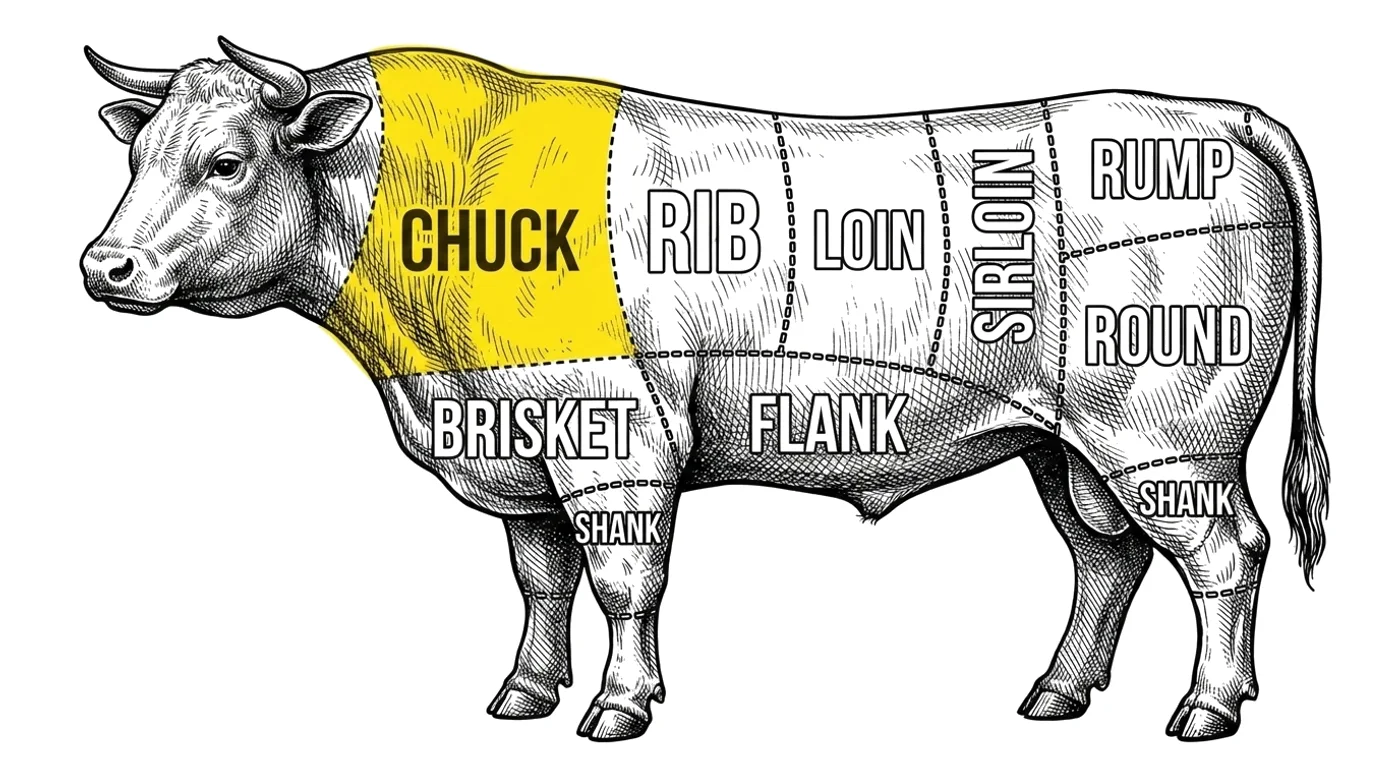
- Beef chuck
- Cut
- Beef chuck
- Salt (%)
- 1.8
- Curing salt
- None
- Fermented
- No
- Smoked
- No
- Maturation
- Raw sausage ≤4°C for up to 2 days; freeze for longer storage
- Basis
- per 1,000 g beef chuck
- Style
- Fresh flavoured mixed-species sausage; cook before eating
Ingredients
- Beef chuck100% · 1000 g
- Pork shoulder100% · 1000 g
- Pork back fat50% · 500 g
- Fine salt1.7% · 45 g
- Ground black pepper0.19% · 5 g
- Fresh onion, finely chopped3.9% · 100 g
- Ground nutmeg0.05% · 1.5 g
- Ground cloves0.03% · 0.8 g
- Curry powder3.8% · 37.5 g
- Tomato ketchup3.8% · 37.5 g
- Ground ginger0.05% · 1.5 g
- Cayenne pepper0.05% · 1.5 g
- Fresh garlic, finely minced0.77% · 20 g
- Worcestershire sauce1.3% · 12.5 g
- Cider vinegar2.9% · 75 g
Method
- Chill meats, fat, vinegar and equipment to 0–3°C.
- Grind beef, pork and back fat together through 8 mm.
- Add salt, spices, onion, ketchup, Worcestershire sauce, garlic and vinegar. Mix until evenly distributed.
- Pass the complete mixture once through 6 mm.
- Stuff into 32 mm hog casing as a continuous coil.
- Refrigerate for 4–12 hours at 2–4°C.
Safety. This is a raw fresh sausage. Sauces and fresh aromatics do not preserve it, and acidity or chilli must not be treated as a safety control. Keep refrigerated and cook fully.