
Chinese Liver Sausage (Yun Cheong)
Also known as Goin Chong, Chinese liver sausage, Yun cheong, Liver lap cheong
Southern China and Hong Kong, China
Overview
Chinese liver sausage belongs to the broader world of Lap-mei, the preserved meats associated with the cooler months and Lunar New Year cookery in southern China and Hong Kong. Hong Kong's Centre for Food Safety distinguishes Chinese pork sausage from Chinese liver sausage in its surveillance and risk material. The source page presents a cooked version made from lean pork, back fat and pork liver, sweetened and seasoned with soy sauce, rice wine and warm spices. That cooked formula is useful, but it should not be confused with the drier commercial liver sausages normally sold as preserved products.
Where it's from
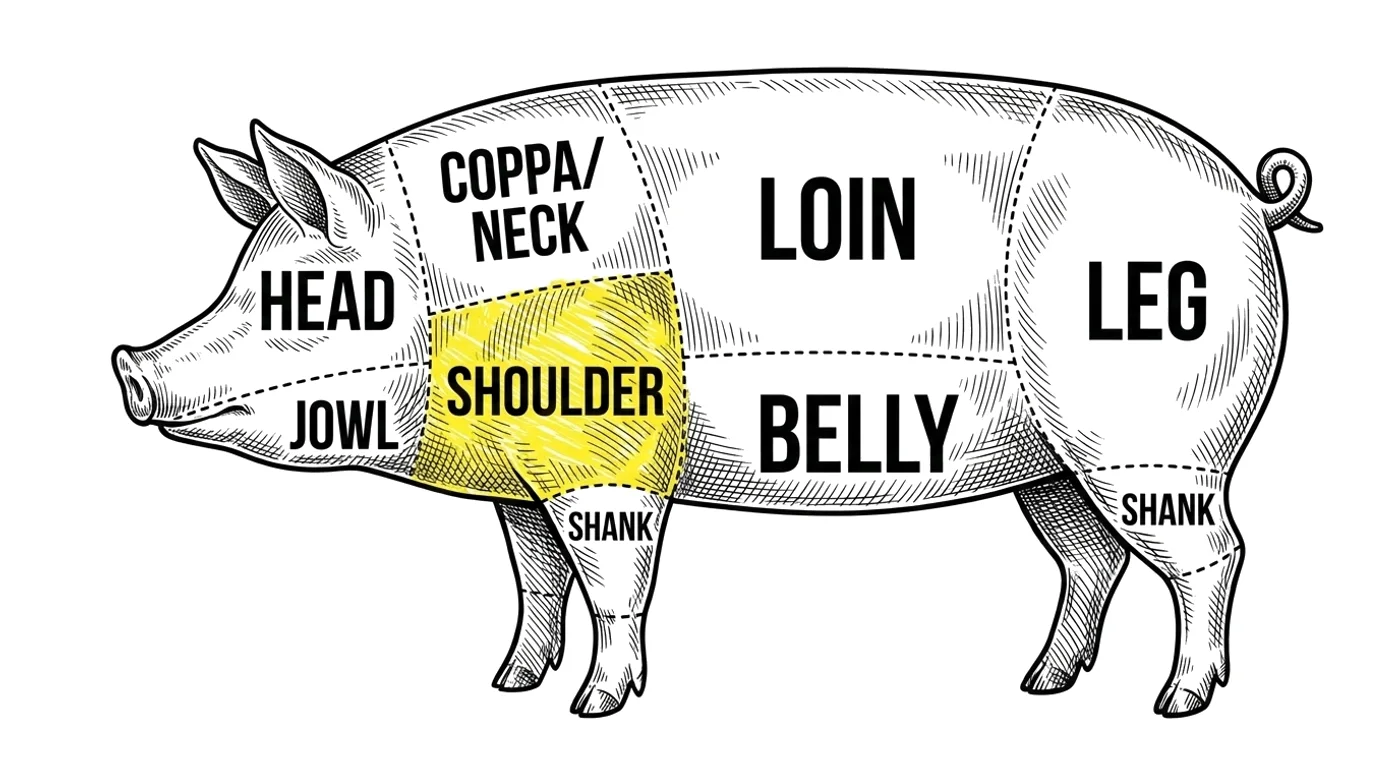
The cut
Identity and terminology
English spellings vary because Cantonese names have been romanised through several systems and commercial conventions. Yun cheong is a widely encountered market name for liver sausage; the source uses Goin Chong. The official material confirms the product category but does not establish Goin Chong as the authoritative transliteration, so it stands as an alias. The word cheong or chang refers broadly to sausage or filled intestine. This entry remains separate from meat-only Lap Cheong because liver changes the flavour, texture, colour and handling risks.
Composition and characteristics
The cooked branch uses equal parts lean pork and a combined block of pork liver and firm back fat. Potato starch holds moisture, while sugar, soy sauce and rice wine create the sweet-savoury profile associated with Chinese cured sausages. Cinnamon, nutmeg, cumin and cardamom give the source formula an unusually broad aromatic range. Unlike a spreadable European liver sausage, the filling remains sliceable: lean pork is coarse, liver is medium-ground and fat stays in visible dice. The finished casing is brown-red, with a firm mosaic and a definite but controlled liver note.
Production and process
Clean liver is trimmed of ducts and handled separately before mixing. Cure #1 is dissolved through the liquid seasonings and distributed across the entire pork, liver and fat block. Refrigerated curing replaces any ambient colour-development hold. The sausage is then poached rather than dried to shelf stability, reaching a measured 74°C at its cold point before rapid chilling. This processing route creates a refrigerated cooked sausage. It does not reproduce the water-activity reduction, preservative controls or verified storage stability of commercial Lap-mei, and the recipe makes no such claim.
History and regional forms
Preserved Chinese sausages traditionally form part of winter food culture because drying conditions and festive demand meet around the final lunar month. Liver sausage developed as a distinctive member of that family rather than a minor seasoning variation. Modern food surveillance treats Chinese pork sausage and Chinese liver sausage as separate product groups, which supports a dedicated Atlas identity. The batch does not assign the product to one town or invent a single origin date, since the available official sources describe the market category and safety context more securely than a precise birthplace.
Use, storage and related products
Cooked Chinese liver sausage can be sliced into steamed rice, clay-pot rice, noodles or stir-fried vegetables, where its sweetness and liver richness season the whole dish. Thin slices also work with mustard greens or other bitter vegetables. Keep the cooked branch at 0–4°C and use it within four days unless frozen. Soy must be declared. The boundary is straightforward: meat-only Lap Cheong lacks the defining liver fraction, while European liverwurst is generally softer, less sweet and seasoned through a different culinary tradition.
Recipe and cure
This is not a finished recipe. It is a window into how this meat is traditionally cured. Before you follow any process, run it through one of our curing calculators so the salt, cure and timings are right and safe for your own batch.
Make this — the measured Curesmith version →“Make this” opens the same cure as a measured recipe, scaled to your batch.
- Meat
- Lean pork shoulder
- Cut
- Lean pork shoulder
- Salt (%)
- 1.8
- Curing salt
- Cure #1 as specified in the recipe
- Fermented
- No
- Starter or mould
- None; this product is not fermented
- Smoked
- No
- Maturation
- Refrigerate at 0–4°C; use within 4 days or freeze promptly
- Basis
- per 1,000 g lean pork shoulder
- Style
- cured cooked Chinese pork-liver sausage
Ingredients
- Lean pork shoulder100% · 1000 g
- Pork back fat50% · 500 g
- Fresh inspected pork liver50% · 500 g
- Fine salt1.8% · 36 g
- Cure #1, 6.25% sodium nitrite0.25% · 5 g
- White pepper0.1% · 2 g
- White sugar3% · 60 g
- Potato starch3% · 60 g
- Naturally brewed soy sauce3% · 30 g
- Chinese rice wine1.5% · 30 g
- Ground cinnamon0.1% · 2 g
- Ground nutmeg0.1% · 2 g
- Ground cumin0.1% · 2 g
- Ground cardamom0.1% · 0.6 g
Method
- Trim the pork and liver, remove ducts and chill meat, fat and equipment to 0–2°C.
- Grind shoulder and liver separately, then dice the semi-frozen back fat.
- Dissolve Cure #1 through the soy sauce and wine, mix it into pork and liver with salt, sugar, starch and spices, then fold in fat.
- Stuff firmly into hog casing, link at 20 cm and refrigerate for 8–12 hours.
- Poach in 78–80°C water until the cold point reaches 71°C.
- Shower briefly and complete controlled chilling.
Safety. Use inspected liver, distribute Cure #1 through the full animal block, reach 71°C, cool rapidly and keep refrigerated; soy is an allergen.