
Overview
Chorizo Asturiano is a dark red smoked sausage with coarse pork, white fat, garlic, oregano and a clean hardwood-smoke aroma.
Where it's from
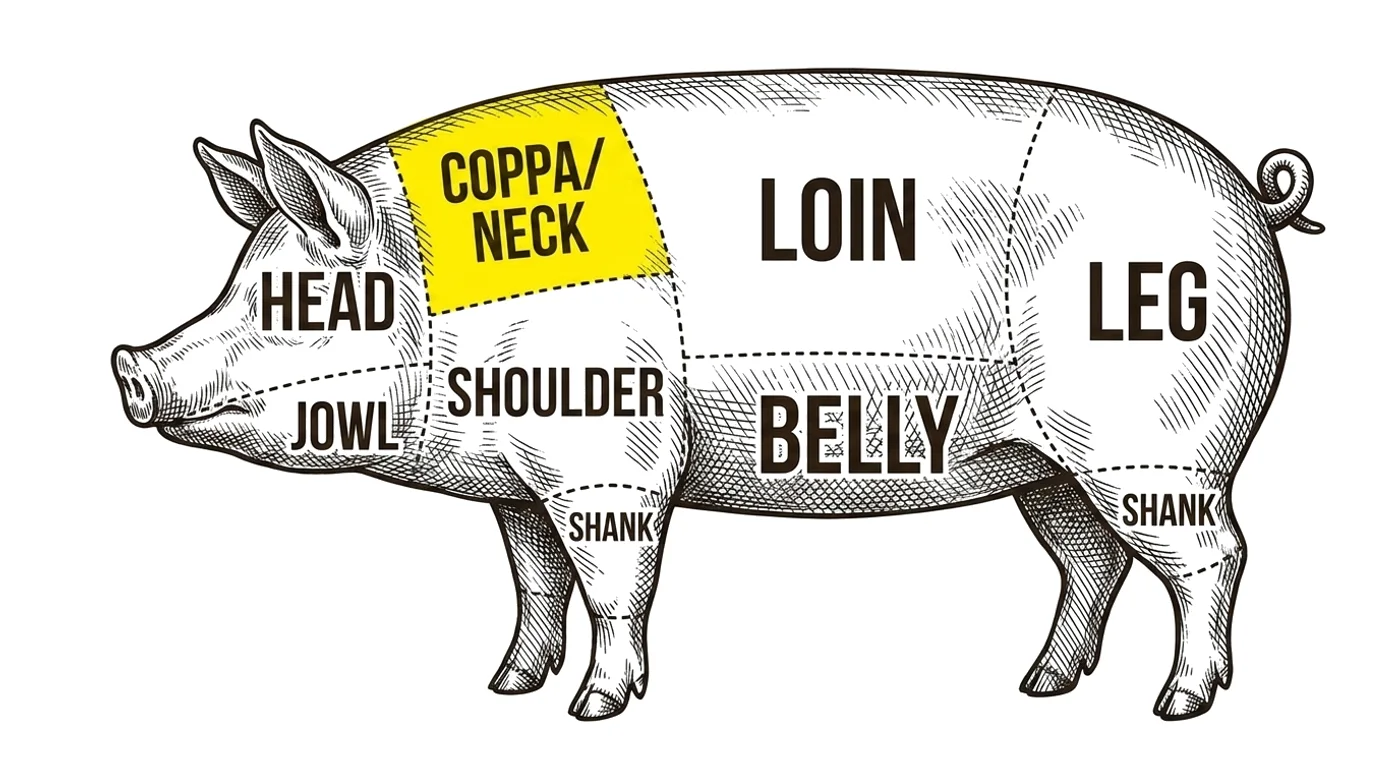
The cut
How to recognise it
A dark red smoked sausage with coarse pork, white fat, garlic, oregano and a clean hardwood-smoke aroma. Casing or exterior: Hog casing, 32 to 34 mm in loops, or 50 to 60 mm bungs. Grease smear, hollow pockets, case hardening, a wet centre, rancidity or uncontrolled dark mould is a production fault.
- Casing
- Hog casing, 32 to 34 mm in loops, or 50 to 60 mm bungs
Origins and history
Asturias sits on the Atlantic, green and wet, with none of the dry heat that cures the chorizos of the meseta. The Asturian answer was the hearth. Sausages made at the winter matanza were hung above the kitchen fire or in a smokehouse and cured slowly in oak smoke, a method shared across the region's larder. The result became the backbone of the compango, the cured-meat trio that makes a fabada, and one of the few Spanish chorizos defined as much by wood smoke as by pimenton. Asturian farmhouse kitchens preserved sausages above the hearth, where damp Atlantic winters made smoke a practical part of drying. The resulting chorizo became inseparable from bean and cabbage dishes. Asturias adapted chorizo to a cool, humid Atlantic climate through hearth and smokehouse curing, and the sausage became indispensable in fabada and other bean and cabbage dishes.
- Protection
- Unprotected.
- Seasonality
- The winter matanza.
Compare with. Chorizo de Cantimpalos
Serving and cultural significance
Cook it in fabada, pote asturiano, cabbage or potatoes, where smoke and paprika season the whole dish. A fully validated dry example may be sliced, but the conservative home use is cooked unless measured pH and water activity confirm ready-to-eat status.
Recipe and cure
This is not a finished recipe. It is a window into how this meat is traditionally cured. Before you follow any process, please run it through one of our curing calculators, so the salt, cure and timings are right and safe for your own batch.
Curesmith home adaptation — not designation-compliant
Make this — the measured Curesmith version →The cure below is the traditional reference. “Make this” opens the measured Curesmith home recipe, scaled to your batch.
Traditional or protected production
Chorizo Asturiano is associated with the collective quality mark covering Asturian chorizo and morcilla. It is a paprika-and-garlic pork sausage characteristically smoked and used both for slicing and in dishes such as fabada.
- Meat
- pork
- Cut
- neck, jowl and fat blend
- Salt (%)
- 2.5
- Curing salt
- Cure #2
- Fermented
- Yes
- Target pH
- 4.9
- Starter or mould
- T-SPX
- Smoked
- Yes
- Maturation
- ferment then dry
- Basis
- per 1000 g of lean pork (main meat); back fat and spices are added as a percentage of the lean
- Style
- Asturian chorizo
Ingredients
- lean pork (base)100% · 1000 g/kg
- back fat33.35% · 333 g/kg
- smoked paprika (pimenton dulce)2.8% · 28 g/kg
- hot paprika (pimenton picante)0.5% · 5 g/kg
- oregano, ground0.2% · 2 g/kg
- garlic0.35% · 3.5 g/kg
Notes
- The official protected specification controls the named product. Any Curesmith EQ, starter-culture, curing-salt or home-scale adaptation is a separate method and must not be presented as designation-compliant.
- Meat and spice base follows the standard Spanish chorizo; no distinct regional formula is documented, so the regional character lives in the smoke, casing and cut.
In the Codex
What this product teaches, and where to read more.
Temple. Roof, pH