
Chorizo de Cantimpalos
Cantimpalos (Segovia), Castile-Leon, Spain
Smoky and garlicky, firm and clean, from the cold Segovian plateau.
Overview
Chorizo de Cantimpalos is a Segovian pork sausage seasoned with pimentón, garlic and salt, matured in the dry continental climate around Cantimpalos. Its protected identity is restrained and meat-led: the formula excludes many flavourings common in generic commercial chorizo.
Where it's from
Climate. The cold, dry Segovian plateau of Castile.
Altitude. High Castilian plateau
The cut
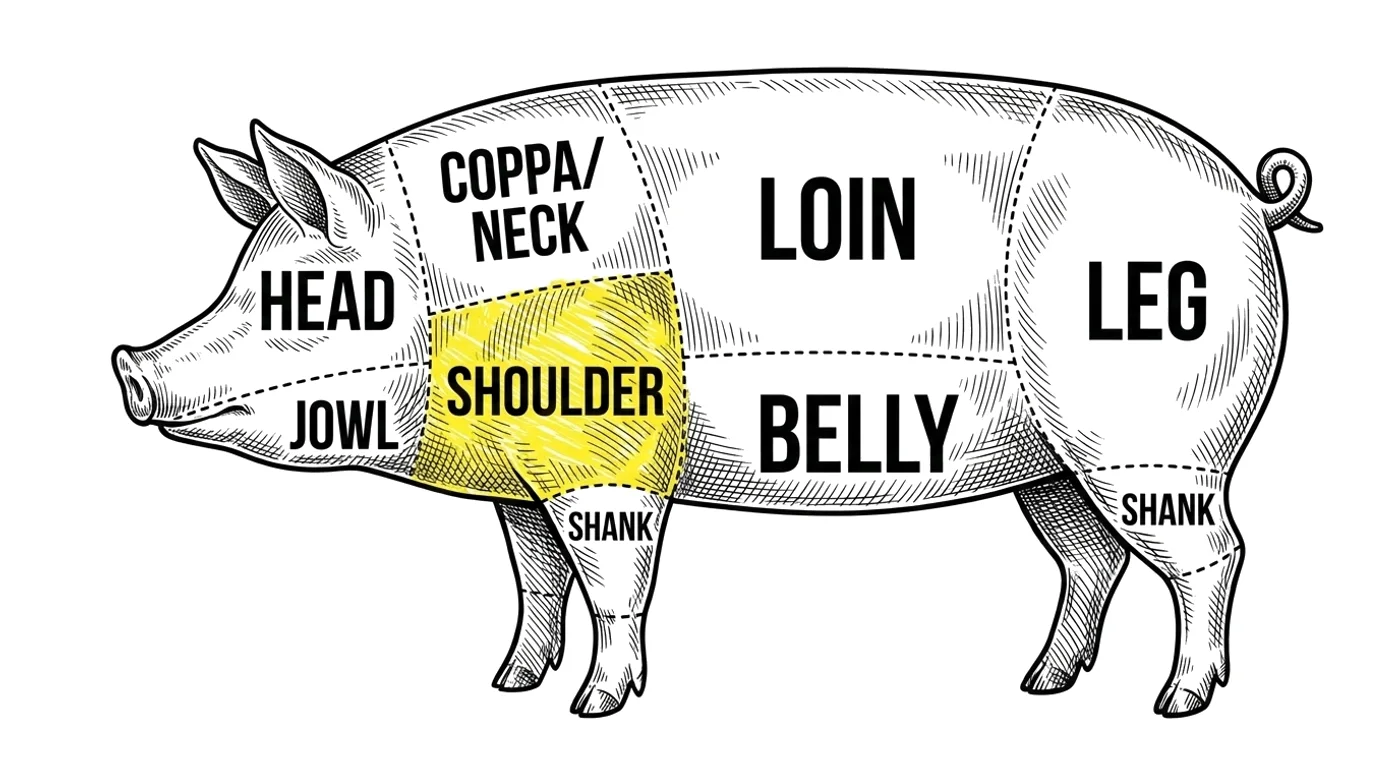
How to recognise it
The sausage may be presented as narrow links, horseshoes or larger formats, with a red-brown casing and firm red slice. White fat remains clearly defined. Garlic and paprika should be clean and balanced, not sweetened or heavily herbed. Smear, harsh acidity, internal voids, wet centre or rancidity are faults.
- Shape and size
- Sarta, achorizado or fat cular
- Lean colour
- Deep red
- Fat and marbling
- White flecks
- Casing
- Hog casing: sarta 25 to 35 mm, achorizado 30 to 50 mm, cular over 35 mm
- Surface bloom
- Possible
Origins and history
Cantimpalos lies on the Castilian plateau, where winter cold and dry moving air favoured sausage curing after the matanza. Pig farming and grain production supplied the raw material, while local pimentón and garlic created a recognisable regional profile. By the early twentieth century the town's chorizos were sufficiently well known to be sold beyond Segovia, and producers increasingly used Cantimpalos as a quality name. That success invited imitation. Local organisations pursued legal protection so that the place name would remain linked to the area's husbandry and restrained recipe. The current PGI specification, consolidated in July 2023, preserves the permitted pork, seasoning, forms and production territory.
Name. Chorizo; Cantimpalos names the Segovian town.
- Production today
- Producers in the Cantimpalos zone.
- Protection
- IGP.
- Tradition vs modern
- Cold-plateau curing and smoked paprika.
- Seasonality
- Traditionally the winter matanza.
Compare with. Chorizo Riojano, Chorizo
Serving and cultural significance
Slice the dry sausage for tapas with bread and cheese, or add pieces to lentils and chickpeas. It is substantial enough for rural picnic food but should not be confused with soft fresh chorizo intended for grilling.
Recipe and cure
This is not a finished recipe. It is a window into how this meat is traditionally cured. Before you follow any process, please run it through one of our curing calculators, so the salt, cure and timings are right and safe for your own batch.
Curesmith home adaptation — not designation-compliant
Make this — the measured Curesmith version →The cure below is the traditional reference. “Make this” opens the measured Curesmith home recipe, scaled to your batch.
Traditional or protected production
The PGI specification tightly controls the meat, fat, pimentón, garlic and salt formula, together with casing, size and production area. Unauthorised spice or a generic industrial flavour profile is inconsistent with the protected identity.
- Meat
- pork
- Cut
- minced pork and fat
- Salt (%)
- 2.5
- Curing salt
- Cure #2
- Fermented
- Yes
- Target pH
- 4.9
- Starter or mould
- Natural surface mould
- Smoked
- No
- Target aW or weight loss
- ~30% weight loss
- Temperature (°C)
- ferment 22 to 24, then dry 13 to 15
- Humidity (%)
- ferment ~90, then 75 to 80
- Maturation
- 3 to 6 weeks
- Basis
- per 1000 g of lean pork (main meat); back fat and spices are added as a percentage of the lean
- Style
- Traditional fermented and dried sausage, lightly smoked
Ingredients
- lean pork (base)100% · 1000 g/kg
- back fat33.35% · 333 g/kg
- smoked paprika (pimenton dulce)2.8% · 28 g/kg
- hot paprika (pimenton picante)0.5% · 5 g/kg
- oregano, ground0.2% · 2 g/kg
- garlic0.35% · 3.5 g/kg
Method
- Mince pork and fat and mix with all ingredients to green meat weight.
- Stuff into casing.
- Ferment to the target pH.
- Dry to the target weight loss.
Notes
- The official protected specification controls the named product. Any Curesmith EQ, starter-culture, curing-salt or home-scale adaptation is a separate method and must not be presented as designation-compliant.
- This traditional recipe uses no nitrite. For safety we recommend adding Cure #2: in a low-oxygen, slow-dried product nitrite is the specific guard against Clostridium botulinum, while salt, acidity and drying control Salmonella, E. coli, Listeria and Staphylococcus.
- Recipe reconciled to the fuller traditional cure, with the starter culture, curing salt and the complete spicing recorded as ingredients.
- Meat and spice base follows the standard Spanish chorizo; no distinct regional formula is documented, so the regional character lives in the smoke, casing and cut.
In the Codex
What this product teaches, and where to read more.
Temple. Roof, Water Activity