
Chorizo de Soria
Soria, Castile-Leon, Spain
Firm, clean and lightly smoked, a cold-plateau chorizo.
Overview
Chorizo de Soria is firm, clean and lightly smoked, a cold-plateau chorizo. A firm paprika-red sausage with coarse pork, clean white fat and a dry mountain-cured texture. Thin and broad formats show different drying times.
Where it's from
Climate. The cold, high plateau of Soria in Castile.
Altitude. High Castilian plateau
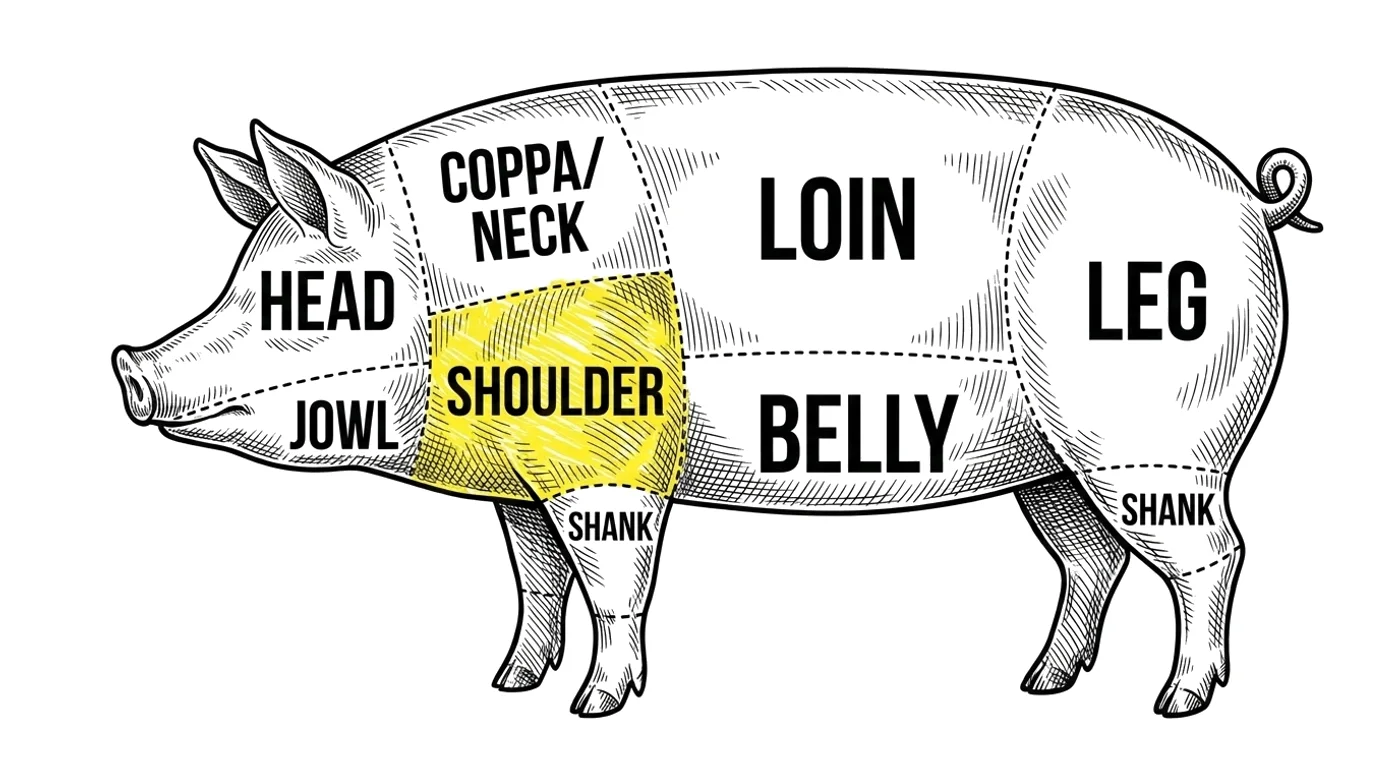
The cut
How to recognise it
A firm paprika-red sausage with coarse pork, clean white fat and a dry mountain-cured texture. Thin and broad formats show different drying times. Shape and size: Cylindrical or looped. Lean colour: Deep red. Fat and marbling: White flecks. Casing or exterior: Hog or beef casing, commonly 30 to 40 mm. Surface: Possible. The form is cylindrical or looped. the lean is deep red. the fat or marbling is white flecks. and the exterior uses hog or beef casing, commonly 30 to 40 mm. Grease smear, hollow pockets, case hardening, a wet centre, rancidity or uncontrolled dark mould is a production fault.
- Shape and size
- Cylindrical or looped
- Lean colour
- Deep red
- Fat and marbling
- White flecks
- Casing
- Hog or beef casing, commonly 30 to 40 mm
- Surface bloom
- Possible
Origins and history
The chorizo of Soria belongs to one of the coldest and highest corners of Castile, a thinly settled plateau where winter comes early and the dry north wind, the cierzo, blows for weeks. That climate does much of the work. Made in the old way during the winter matanza, it is seasoned simply with pimenton, garlic and salt, stuffed mostly into natural pork or beef casings, and hung to cure in the cold mountain air rather than over a fire. The result is lean and firm, closer to a seasoned dried loin than to the softer, smokier chorizos of wetter regions. Producers in the Sierra soriana still tend to cure only through the cold months, and the name is working towards protected IGP status.
Soria's long cold winters and dry plateau air made it possible to cure sausages naturally. When temperatures fell too far, a small fire warmed the drying room, but smoke is not the defining feature of the style.
Name. Chorizo; Soria the province.
- Production today
- Producers in Soria.
- Protection
- Not EU-protected as a general name.
- Tradition vs modern
- Cold-plateau curing, sometimes lightly smoked.
- Seasonality
- Traditionally the winter matanza.
Compare with. Chorizo de Pamplona, Chorizo Riojano
Serving and cultural significance
At its best sliced thin and eaten as it is, where the leanness and clean paprika seasoning carry the plate. It also holds up in the pot, lending colour and depth to lentils, chickpeas and slow bean stews.
Recipe and cure
This is not a finished recipe. It is a window into how this meat is traditionally cured. Before you follow any process, please run it through one of our curing calculators, so the salt, cure and timings are right and safe for your own batch.
Make this — the measured Curesmith version →The cure below is the traditional reference. “Make this” opens the measured Curesmith home recipe, scaled to your batch.
Traditional or protected production
Chorizo de Soria is a high-plateau dry sausage made principally from pork and fat, with a limited beef allowance in some traditional formulas. Pimentón and garlic define the seasoning, while casing diameter creates ring, chain and large straight formats.
The reference process can be summarised as follows: Grind pork and fat, optionally include the permitted small beef proportion, season with salt, pimentón and garlic, stuff into the selected casing and dry to the format-specific endpoint.
- Meat
- pork and beef
- Cut
- minced pork and beef
- Salt (%)
- 2.5
- Curing salt
- Cure #2
- Fermented
- Yes
- Target pH
- 4.9
- Starter or mould
- Natural surface mould
- Smoked
- No
- Target aW or weight loss
- ~30% weight loss
- Temperature (°C)
- ferment 22 to 24, then dry 13 to 15
- Humidity (%)
- ferment ~90, then 75 to 80
- Maturation
- 4 to 6 weeks
- Basis
- per 1000 g of lean pork (main meat); beef, back fat and spices are added as a percentage of the lean
- Style
- Traditional fermented and dried sausage, smoked
Ingredients
- lean pork (base)100% · 1000 g/kg
- beef30% · 300 g/kg
- back fat25% · 250 g/kg
- smoked paprika (pimenton dulce)2.8% · 28 g/kg
- hot paprika (pimenton picante)0.5% · 5 g/kg
- oregano, ground0.2% · 2 g/kg
- garlic0.35% · 3.5 g/kg
Method
- Mince pork and fat and mix with all ingredients to green meat weight.
- Stuff into casing.
- Ferment to the target pH.
- Dry to the target weight loss.
Notes
- This traditional recipe uses no nitrite. For safety we recommend adding Cure #2: in a low-oxygen, slow-dried product nitrite is the specific guard against Clostridium botulinum, while salt, acidity and drying control Salmonella, E. coli, Listeria and Staphylococcus.
- A pork and beef blend. No source gives a ratio, so the house default is used: pork as the main meat, beef at 30% and back fat at 25% of the pork.
In the Codex
What this product teaches, and where to read more.
Temple. Roof, Water Activity