
Chorizo Rojo de Teror
Also known as chorizo de Teror, chorizo rojo canario
Canary Islands, Spain
Overview
Chorizo Rojo de Teror is a soft red spreadable sausage from the municipality of Teror on Gran Canaria. It is one of the Canary Islands' best-known local meat products and is commonly spread on bread rather than sliced.
Where it's from
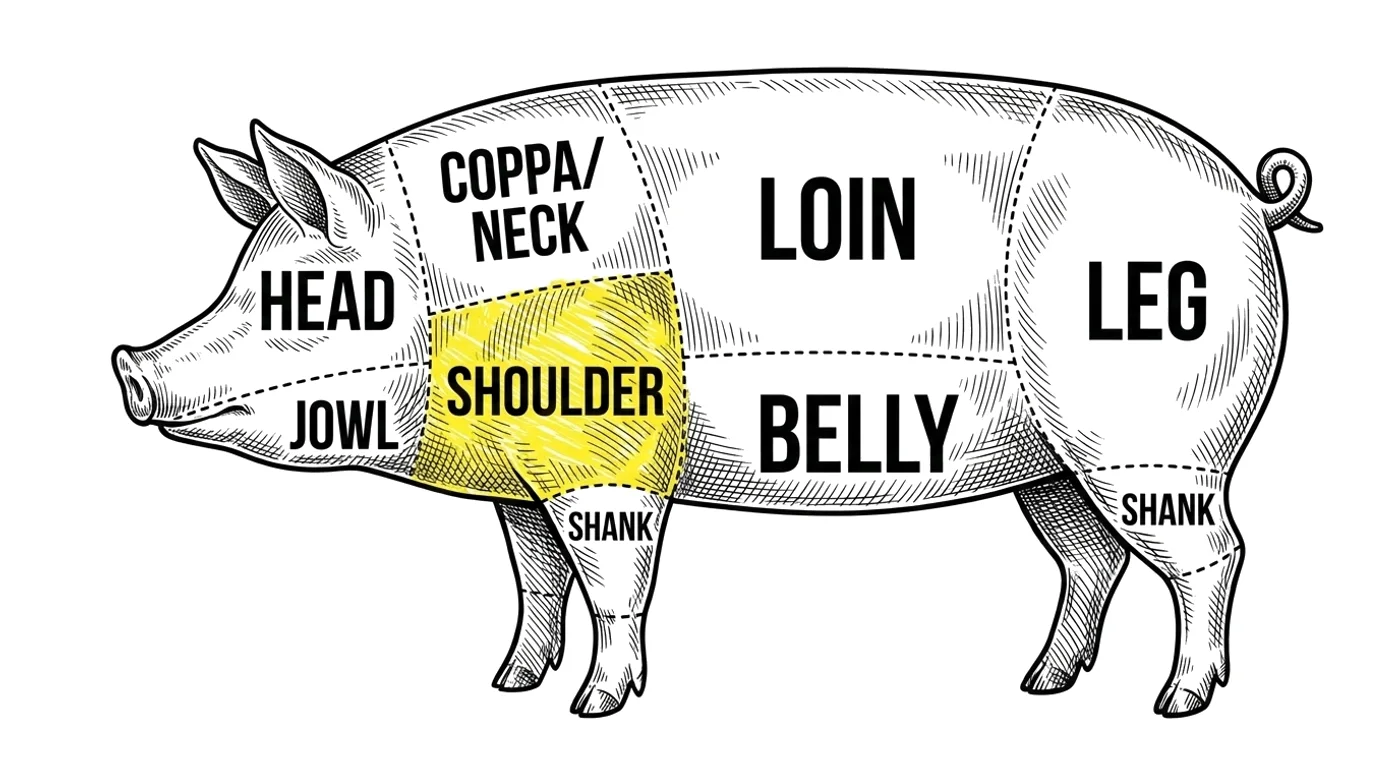
The cut
Identity and terminology
Chorizo de Teror refers to a geographical tradition, but it is not currently an EU protected designation. Rojo distinguishes the paprika-coloured form from paler versions. Despite the name, it does not have the firm cured texture of mainland Spanish chorizo.
Composition and characteristics
Finely minced pork and fat are heavily seasoned with paprika, garlic, salt and spices. The high fat content and fine comminution give a soft paste-like consistency and vivid red-orange colour.
Production and process
The mixture is finely processed, stuffed into relatively broad casing and allowed to develop flavour under controlled conditions. Home or source instructions suggesting raw consumption cannot override validated safety requirements.
History and regional forms
Teror developed the product through local pork butchery and market trade, and the sausage became strongly associated with the town's Sunday market and pilgrimage culture. It is now sold across the Canary Islands as a regional speciality.
Use, storage and related products
It is spread on bread, toast or arepas and may be used in sauces and fillings. It differs from sobrasada, although both are red spreadable sausages, and from firm sliced chorizo.
Recipe and cure
This is not a finished recipe. It is a window into how this meat is traditionally cured. Before you follow any process, run it through one of our curing calculators so the salt, cure and timings are right and safe for your own batch.
Make this — the measured Curesmith version →“Make this” opens the same cure as a measured recipe, scaled to your batch.
- Meat
- Pork shoulder
- Cut
- Pork shoulder
- Salt (%)
- 2
- Curing salt
- Cure #1 as specified in the recipe
- Fermented
- Yes
- Starter or mould
- Flora Italia LC, 0.25 g/kg or manufacturer-directed dose
- Smoked
- No
- Maturation
- 0–4°C for up to 7 days
- Basis
- per 1,000 g pork shoulder
- Style
- Soft fermented spreadable pork sausage; professional validation required
Ingredients
- Pork shoulder100% · 1000 g
- Skinless pork belly20% · 200 g
- Soft pork jowl fat55% · 550 g
- Pork back fat45% · 450 g
- Fine salt2% · 44.5 g
- Cure #1, 6.25% nitrite0.2% · 4.5 g
- Pimentón2% · 44.5 g
- Rubbed oregano0.2% · 4.5 g
- Fresh garlic, crushed0.71% · 15.5 g
- Ground cinnamon0.05% · 1 g
- Ground nutmeg0.03% · 0.7 g
- Ground cloves0.03% · 0.7 g
- Ground ginger0.03% · 0.7 g
- Dry white wine4.5% · 100 g
- Dextrose0.3% · 6.5 g
- Non-chlorinated water2% · 44.5 g
- Flora Italia LC0.1% · 0.6 g
Method
- Chill all materials and equipment to 0–3°C.
- Grind meats and fats through 3 mm.
- Mix meat with salt, Cure #1, pimentón, spices, wine and dextrose.
- Rehydrate Flora Italia LC in non-chlorinated water for 15 minutes and mix thoroughly.
- Stuff into 30–40 mm casings.
- Ferment at 20–22°C and 90–95% RH until pH is 5.1 or below, within a maximum of 48 hours.
Safety. A soft raw sausage requires a validated process and cold storage. Colour, salt and paprika do not establish safety.