
Ciauscolo
Marche and Umbria, Marche, Italy
Soft, mild and spreadable, gently garlicked, made to go on warm bread.
Overview
Ciauscolo is the soft, spreadable salume of the Marche. A high proportion of fatty pork is ground repeatedly with lean meat, garlic, pepper and wine, then lightly fermented and matured without losing its pâté-like texture. It is eaten by spreading rather than slicing into firm coins.
Where it's from
Climate. The Marche and neighbouring Umbria.
Altitude. Central Apennine hills
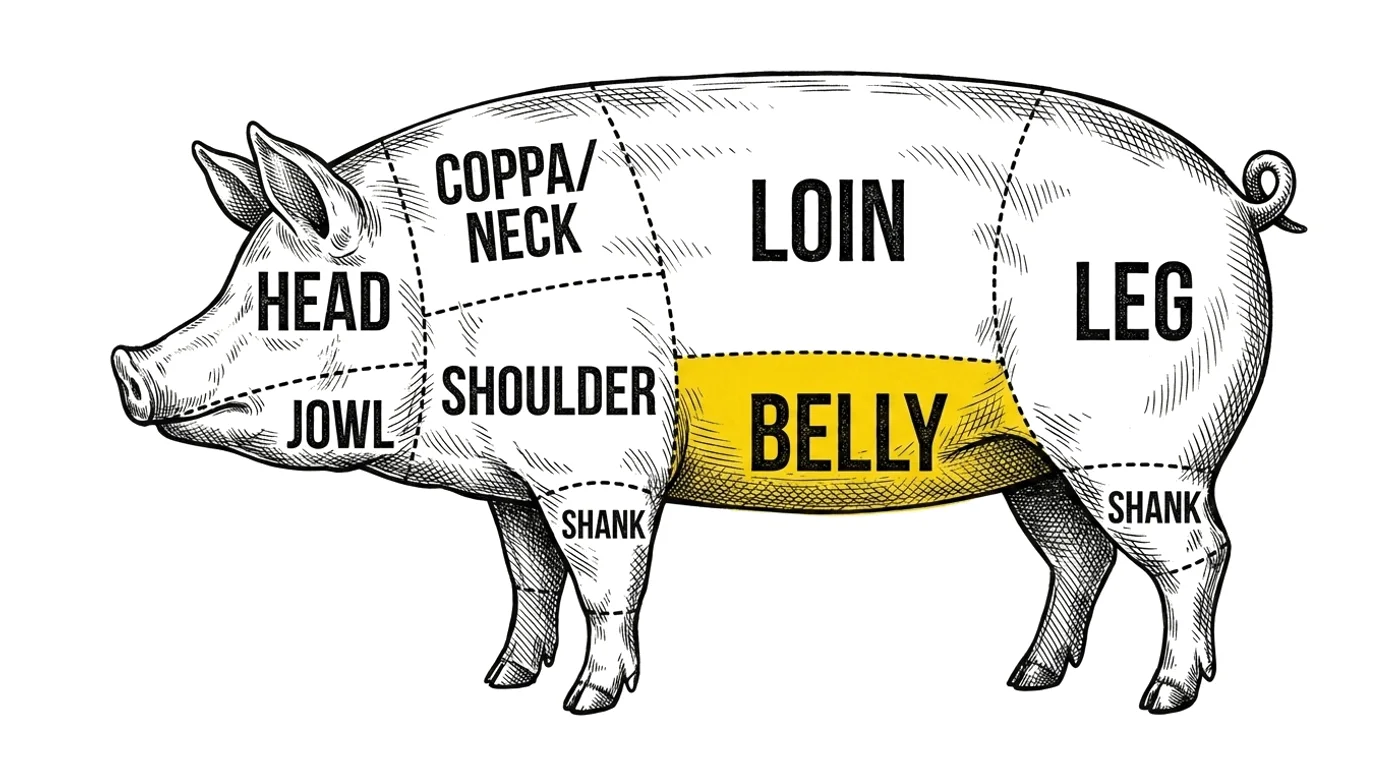
The cut
How to recognise it
Ciauscolo is cylindrical and soft, generally 400 g to 2.5 kg under the updated protected description. The filling is uniform pink-red, finely worked and spreadable, with a clean aroma of garlic, pepper, wine and pork fat. It should not crumble like a dry salami or leak liquid fat. Gas, sharp acid, grey pockets or rancidity are defects.
- Shape and size
- Soft, spreadable, in a casing
- Lean colour
- Homogeneous pink paste
- Fat and marbling
- High, fully blended
- Casing
- Beef middle or large-diameter hog casing, 45 to 100 mm
- Surface bloom
- Possible
Origins and history
Ciauscolo comes from the central Apennine farming culture of the Marche, where the winter pig had to supply protein and fat through the agricultural year. Soft belly, shoulder and lean trimmings were minced finely and repeatedly, producing a sausage that could be smeared onto bread as a small meal between larger ones. Etymologists commonly connect the name with the Latin ciabusculum, a little food or snack, although local spellings and explanations vary. The product became especially associated with Macerata and the inland provinces. PGI registration in 2009 fixed the protected area and spreadable character. In 2025 the Italian government formally recognised a dedicated protection consortium, giving the product stronger collective representation.
Name. Possibly from the Latin cibusculum, 'little food', from its role as a between-meals snack.
- Production today
- Producers across the Marche.
- Protection
- IGP.
- Tradition vs modern
- Traditionally very finely ground.
- Seasonality
- Year-round.
Compare with. 'Nduja di Spilinga, Sobrasada de Mallorca
Serving and cultural significance
Spread on warm bread, crostini or crescia so the fat softens and the garlic becomes aromatic. It can also enrich pasta fillings, beans, eggs or sauces. Serve it as a smear or quenelle rather than treating it as a firm slicing salami.
Recipe and cure
This is not a finished recipe. It is a window into how this meat is traditionally cured. Before you follow any process, please run it through one of our curing calculators, so the salt, cure and timings are right and safe for your own batch.
Curesmith home adaptation — not designation-compliant
Make this — the measured Curesmith version →The cure below is the traditional reference. “Make this” opens the measured Curesmith home recipe, scaled to your batch.
Traditional or protected production
PGI production uses permitted pork cuts, especially fatty belly and lean shoulder or ham trimmings. The meat is finely minced in repeated passes, seasoned, stuffed and matured so that the sausage remains soft. The protected specification controls area, composition, size, analytical characteristics and release form.
- Meat
- pork
- Salt (%)
- 3
- Curing salt
- Not included in the base recipe below
- Fermented
- Yes
- Target pH
- 4.9
- Starter or mould
- Natural
- Smoked
- Yes
- Target aW or weight loss
- kept soft, limited drying
- Temperature (°C)
- ferment 22 to 24, then dry 13 to 15
- Humidity (%)
- ferment ~90, then 75 to 80
- Maturation
- a few weeks
- Basis
- per 1000 g green meat
- Style
- Traditional fermented, finely ground and spreadable
Ingredients
- Pork belly (base)100% · 1000 g/kg
- Pork shoulder33.33% · 333 g/kg
- Ham and loin trimmings33.33% · 333 g/kg
- Black pepper0.2% · 2 g/kg
- Dextrose0.2% · 2 g/kg
- Garlic, finely diced0.3% · 3 g/kg
- Vino cotto or red wine2% · 20 g/kg
Method
- Mince pork and fat and mix with all ingredients to green meat weight.
- Stuff into casing.
- Ferment warm until the target pH is reached.
- Dry cool, kept soft and spreadable.
Notes
- The official protected specification controls the named product. Any Curesmith EQ, starter-culture, curing-salt or home-scale adaptation is a separate method and must not be presented as designation-compliant.
- This traditional recipe uses no nitrite. For safety we recommend adding Cure #2: in a low-oxygen, slow-dried product nitrite is the specific guard against Clostridium botulinum, while salt, acidity and drying control Salmonella, E. coli, Listeria and Staphylococcus.
In the Codex
What this product teaches, and where to read more.
Temple. Roof, Water Activity