
French-style coppa
Also known as Coppa (française)
-, Corsica and Savoie, France
A dry-cured French pork collar, deep red marbled with sweet fat, Corsican and Savoyard.
Overview
Coppa (française) is a dry-cured french pork collar, deep red marbled with sweet fat, corsican and savoyard. A cylindrical collar with deep red lean and broad white marbling, surrounded by pepper and herbs. The slice should remain supple and sweet rather than dry or heavily smoked. The Codex treats the product as a complete curing or cooking system, not simply a famous name. Raw material, cut or particle size, casing, smoke, fermentation, heat treatment and maturation all contribute to the result. The current legal or quality status is Generic French coppa : no generic EU GI; Coppa di Corsica is a separate AOP. The source tradition and the Curesmith home method are kept separate.
Where it's from
Climate. Corsica and the Savoie Alps.
Altitude. Mountains and hills
The cut
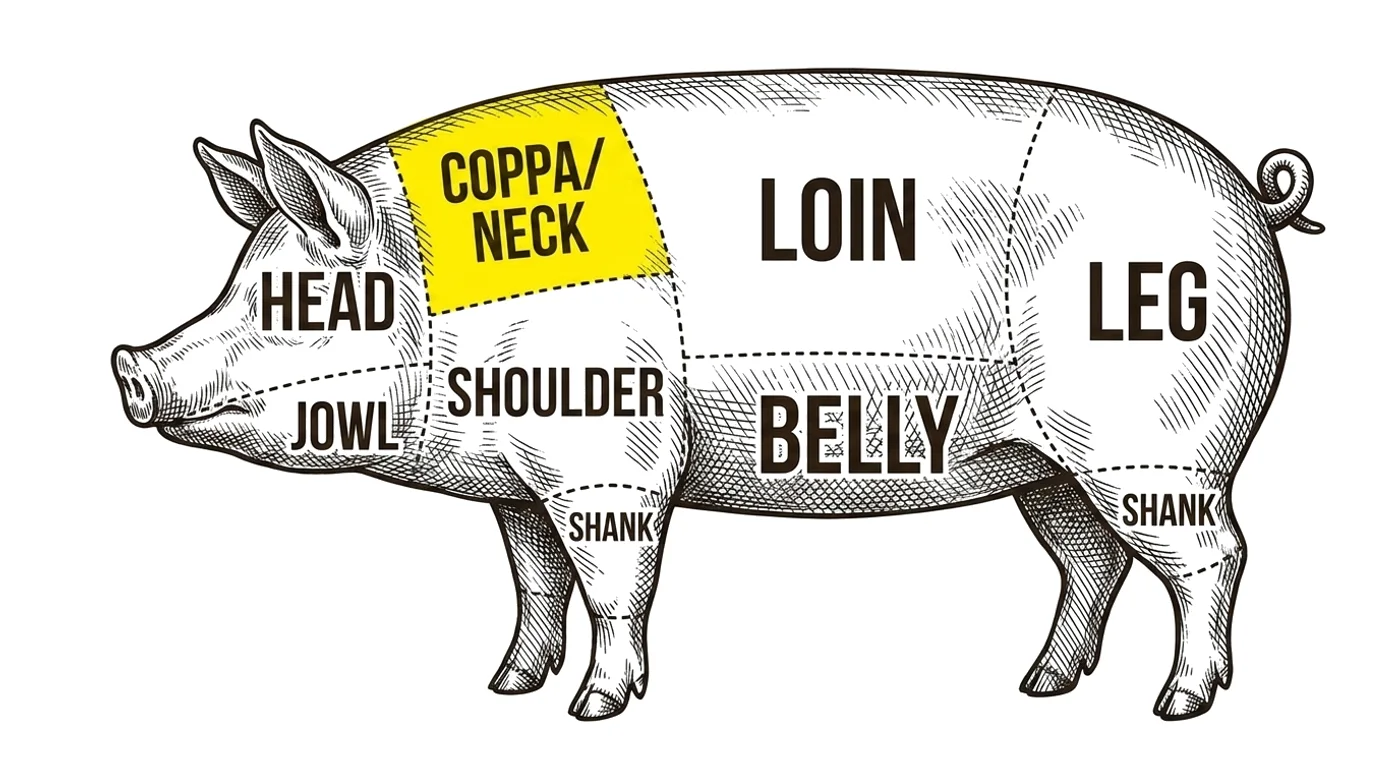
How to recognise it
A cylindrical collar with deep red lean and broad white marbling, surrounded by pepper and herbs. The slice should remain supple and sweet rather than dry or heavily smoked. A hard outer ring, wet grey centre, rancid fat, sourness or air beneath casing indicates an uneven cure.
- Shape and size
- Cased pork collar, cylindrical
- Lean colour
- Deep red rounds
- Fat and marbling
- Sweet marbling
- Casing
- Natural pork casing or a pig-fat wrap, tied with string or netted
- Surface bloom
- Cellar mould
Origins and history
The French coppa is a whole pork collar cured in the mountain manner of Corsica and Savoie. In Corsica it is the protected Coppa di Corsica, made from the echine of the local Nustrale pig cut at the fifth rib, salted with sea salt alone, peppered, cased in pork casing or wrapped in pig fat and tied or netted, then aged at least five months in a natural cellar. Traditionally the pieces hang over the open hearth, the fucone, or take a light chestnut smoke of under a week, which leaves only a faint smoky note. In Savoie the same collar is worked with two cold drying stages and a lighter hand with the salt, seasoned mostly with pepper, and aged around twelve weeks or more. Sliced thin it shows rounds of deep red lean marbled with sweet fat. French producers adapted the Italian collar cure to Alpine and Corsican conditions. Savoyard examples may mature around twelve weeks, while other artisan versions remain in cellar for three to six months. Legends and commercial origin stories are identified as such rather than used as proof of the current specification.
Name. Coppa, from the nape or collar cut of the pig.
- Production today
- Corsican and Savoyard artisans.
- Protection
- Not separately protected as a name; Coppa di Corsica is AOP.
- Tradition vs modern
- An artisan whole-muscle cure.
- Seasonality
- Traditionally the winter slaughter.
Compare with. Coppa di Parma, Lonzo de Corse / Lonzo de Corse – Lonzu
Serving and cultural significance
Best sliced very thin, across the grain, so each slice shows the marbling. Serve it at room temperature on a board with bread, or beside a Corsican or Alpine cheese with a glass of red. It also lifts a mountain omelette or a plate of figs. This is not a cooking meat; eat it as it is. Do not borrow the AOP status of Coppa di Corsica for generic French coppa. Standardise the home cure to 2.5% salt and 0.25% Cure #2. it shows how place, material and process create identity. The reader can compare authenticity, legal status and practical home safety without confusing them. Serve thinly across the grain with bread, fruit or Alpine cheese, allowing the marbled fat to soften briefly.
Recipe and cure
This is not a finished recipe. It is a window into how this meat is traditionally cured. Before you follow any process, please run it through one of our curing calculators, so the salt, cure and timings are right and safe for your own batch.
Curesmith home adaptation — not designation-compliant
Make this — the measured Curesmith version →The cure below is the traditional reference. “Make this” opens the measured Curesmith home recipe, scaled to your batch.
Traditional or protected production
French coppa is a cured pork collar or neck fillet made in several regions. Generic French coppa is not protected; Coppa di Corsica is a separate AOP with its own breed and process requirements.
Sea salt, black pepper, garlic and nutmeg. Salt-box method; no fixed percentage.
- Meat
- pork
- Cut
- collar (coppa muscle)
- Salt (%)
- traditional, no fixed %
- Curing salt
- Sea salt, black pepper, garlic and nutmeg.
- Fermented
- No
- Starter or mould
- Possible
- Smoked
- No
- Target aW or weight loss
- ~ weight loss
- Temperature (°C)
- cold salting, then 12 to 15
- Humidity (%)
- 75 to 80
- Maturation
- 3 to 6 months
- Basis
- percentage of green meat weight
- Style
- Traditional dry salting (salt-box)
Method
- Salt and season by the traditional method and rest cold.
- Case or wrap as the style requires.
- Air-dry in cool, humid air.
- Age to the target loss.
Notes
- The official protected specification controls the named product. Any Curesmith EQ, starter-culture, curing-salt or home-scale adaptation is a separate method and must not be presented as designation-compliant.
- A more efficient way of curing this product is using the EQ Method. No more than 2.5% salt to meat weight is required. To follow the EQ method, please use our whole-muscle EQ curing calculator to work out proper ratios and curing times.
In the Codex
What this product teaches, and where to read more.
Temple. Pillar, Meat Quality