
Corallina
-, Umbria/Lazio, Italy
Studded with coral-like lard, peppery and festive, the salame of a Roman Easter.
Overview
Corallina is studded with coral-like lard, peppery and festive, the salame of a roman easter. A red cohesive slice containing conspicuous white lardons, with black pepper, garlic and wine aromas and a firm but not dry texture.
Where it's from
Climate. Umbria and Lazio, central Italy.
Altitude. Central hills
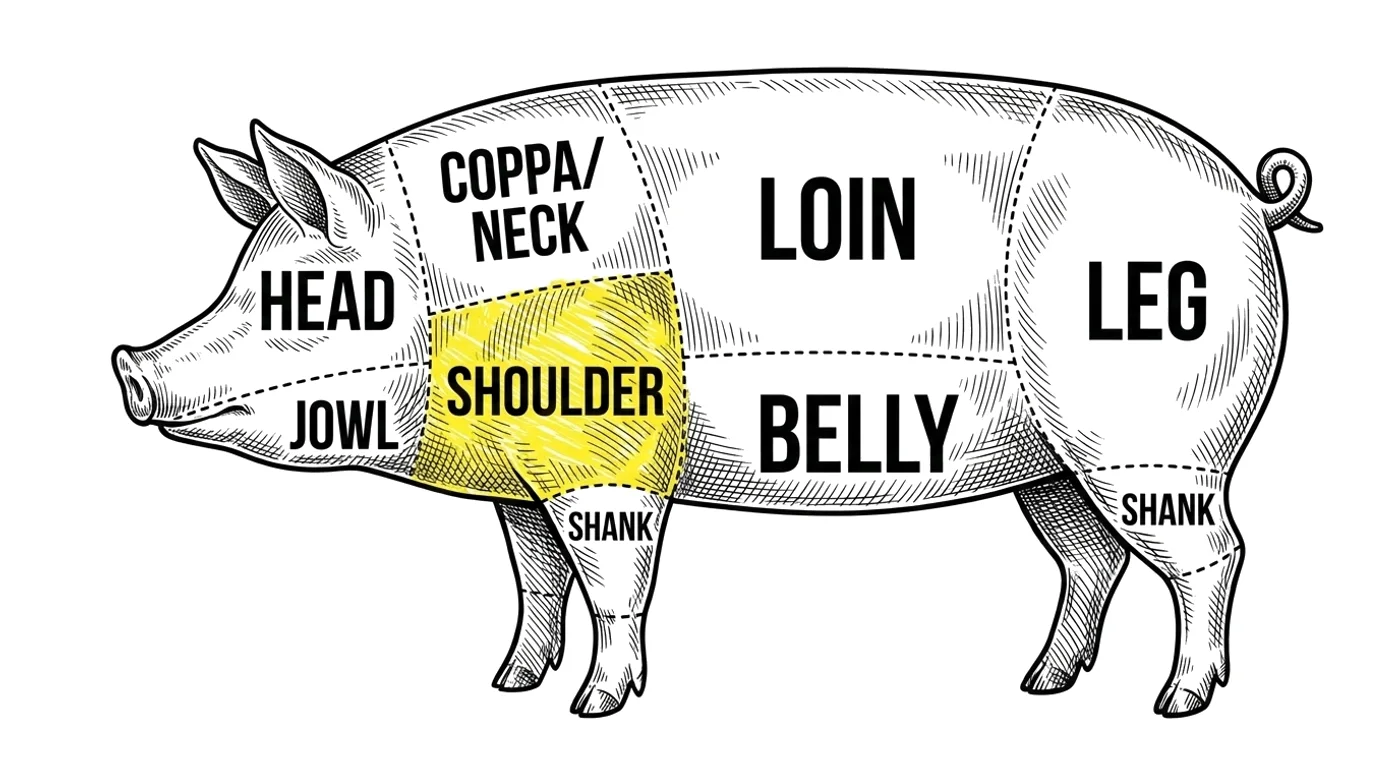
The cut
How to recognise it
A red cohesive slice containing conspicuous white lardons, with black pepper, garlic and wine aromas and a firm but not dry texture. Large lardons should be clean and firm, not smeared, rancid or surrounded by grey meat.
- Shape and size
- Cylindrical, flecked with lard
- Lean colour
- Red with white lard cubes
- Fat and marbling
- Distinct lard cubes
- Casing
- Natural gut casing, pale pink, hand-tied, 55 to 60 mm
- Surface bloom
- White mould
Origins and history
This salame was born in the mountain town of Norcia, long the heartland of Italian pork craft. From the Middle Ages its reputation travelled south into Lazio and above all Rome, where it became so bound to the city that people spoke of the Roman corallina. It earned its place at the Easter table, cut on Easter morning to break the long fast of Lent. The name nods to the coral-pink cubes of fat that stud each slice.
The sausage became part of the Roman spring breakfast served with boiled eggs, cheese and bread. Its large white fat cubes make it visually distinct from finely marbled salami. The verified production area is Rome, Lazio and neighbouring central Italian regions. Stories and etymologies are retained when they help explain the tradition, but legends are not used as evidence for the modern specification.
Name. Corallina, from corallo, 'coral', for the flecks of lard.
- Production today
- Producers across central Italy.
- Protection
- Not EU-protected as a general name.
- Tradition vs modern
- A festive, seasonal salame.
- Seasonality
- Especially at Easter.
Compare with. Salame Milano
Serving and cultural significance
Corallina is traditionally served at the Roman and Umbrian Easter breakfast with hard-boiled eggs, cheese, savoury breads and wine. Slice it thin enough to balance the large fat cubes. Outside Easter it works on an antipasto board with bitter greens and pickled vegetables.
Recipe and cure
This is not a finished recipe. It is a window into how this meat is traditionally cured. Before you follow any process, please run it through one of our curing calculators, so the salt, cure and timings are right and safe for your own batch.
Make this — the measured Curesmith version →The cure below is the traditional reference. “Make this” opens the measured Curesmith home recipe, scaled to your batch.
Traditional or protected production
Corallina is a central Italian salame associated particularly with the Roman Easter table. Fine or medium lean pork surrounds large visible lardons, with pepper, garlic and wine providing the characteristic seasoning.
- Meat
- pork
- Salt (%)
- 2.2
- Curing salt
- Not included in the base recipe below
- Fermented
- Yes
- Target pH
- 4.9
- Starter or mould
- Natural surface mould
- Smoked
- No
- Target aW or weight loss
- ~30% weight loss
- Temperature (°C)
- ferment 22 to 24, then dry 13 to 15
- Humidity (%)
- ferment ~90, then 75 to 80
- Maturation
- 3 to 6 weeks
- Basis
- per 1000 g green meat
- Style
- Traditional fermented and dried salame
Ingredients
- Lean pork, finely minced (base)100% · 1000 g/kg
- Pork back fat, hand-cut into large cubes42.86% · 429 g/kg
- Black pepper, ground0.5% · 5 g/kg
- Garlic, optional0.2% · 2 g/kg
- Red wine4% · 40 g/kg
Method
- Mince or hand-cut pork and fat and mix with all ingredients to green meat weight.
- Stuff into casing.
- Ferment to the target pH.
- Dry to the target weight loss.
Notes
- This traditional recipe uses no nitrite. For safety we recommend adding Cure #2: in a low-oxygen, slow-dried product nitrite is the specific guard against Clostridium botulinum, while salt, acidity and drying control Salmonella, E. coli, Listeria and Staphylococcus.
In the Codex
What this product teaches, and where to read more.
Temple. Roof, Water Activity