
Overview
Cotechino is a thick Italian pork sausage made with striated pork muscle, fat and rind. The rind gives the cooked filling its characteristic rich, gelatinous texture. Products may be sold fresh and raw for long cooking or pre-cooked and packaged for reheating.
Where it's from
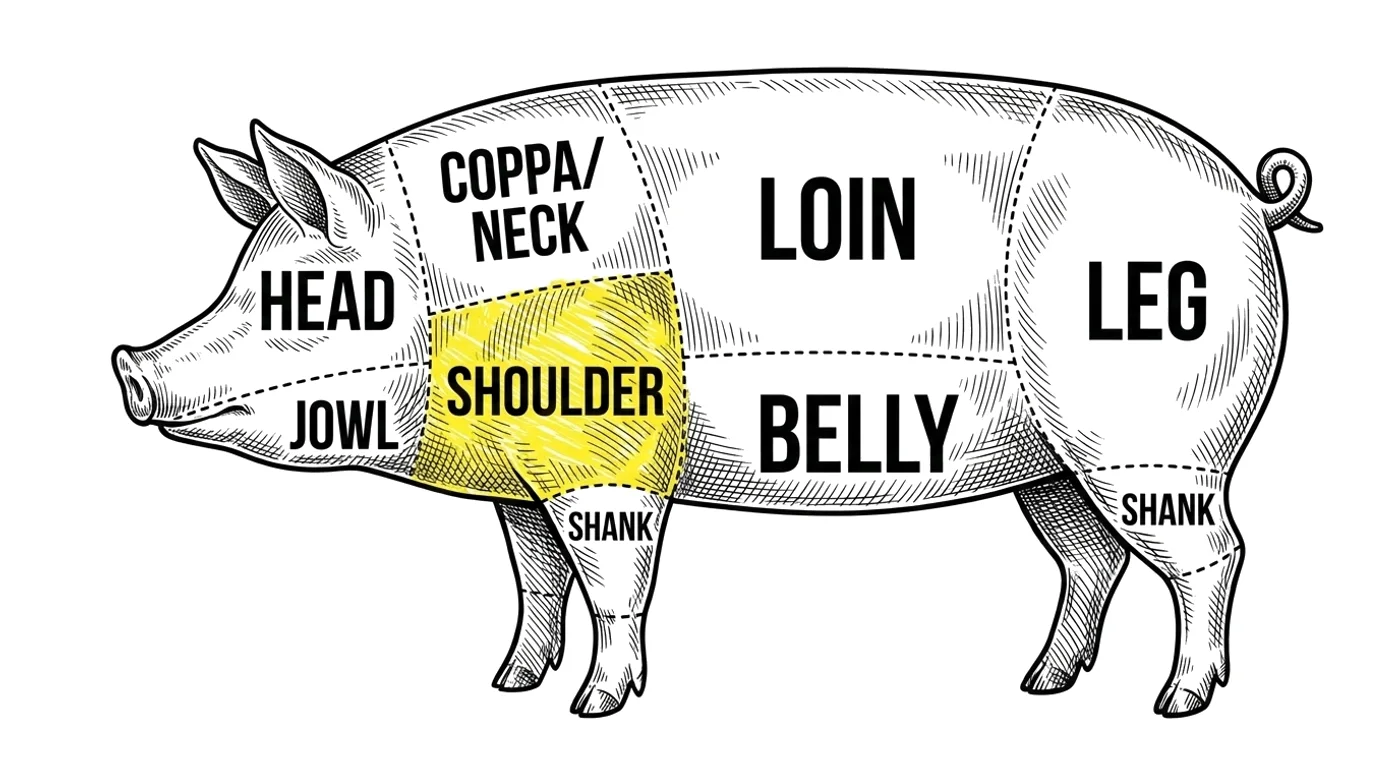
The cut
Identity and terminology
Cotechino is the generic family. Cotechino Modena PGI is a protected child with defined raw materials, ratios, processing area and labelling rules. Zampone Modena uses a related filling but is stuffed in a deboned pig trotter and remains a separate product. Generic fennel, spice or household variations must not be presented as PGI-compliant.
Composition and characteristics
The meat block combines pork muscle with fat and pork rind. Rind proportion and particle size influence firmness and gelatinisation. Seasonings are generally warm and restrained. The protected Modena specification controls compositional ratios, permits nitrite within a stated limit and prohibits smoke flavourings. The balance between lean meat, fat and rind determines whether the cooked sausage is meaty, greasy or excessively rubbery. Rind must be cleaned and prepared carefully because it contributes both collagen and a distinctive gelatinous mouthfeel.
Production and process
Meat, fat and rind are trimmed and comminuted to the required texture, mixed with salt and seasonings and stuffed into a large casing. Fresh cotechino may undergo a short drying or surface-setting stage before sale and must later be cooked thoroughly. Pre-cooked products receive a validated heat treatment and are sealed for distribution. The two branches require different labelling, storage and consumer instructions.
History and regional forms
Cotechino is associated with the Po Valley and especially Modena. Its use of rind reflects economical whole-carcass butchery and creates a rich winter sausage. It became closely linked to New Year's meals, where it is served with lentils as a symbol of prosperity. Regional and household forms exist outside the protected Modena product. The product's connection with lentils at New Year is now national in Italy, even though the protected Modena identity is regional. Generic cotechino made elsewhere may be traditional and legitimate, but it cannot borrow the protected geographical claim.
Use, storage and related products
Fresh cotechino is simmered gently for an extended period, then sliced. Pre-cooked versions are reheated according to package instructions. It is commonly served with lentils, polenta, beans or mashed potato. Fresh product requires refrigeration and full cooking. Related entries include Cotechino Modena and Zampone Modena.
Recipe and cure
This is not a finished recipe. It is a window into how this meat is traditionally cured. Before you follow any process, run it through one of our curing calculators so the salt, cure and timings are right and safe for your own batch.
Make this — the measured Curesmith version →“Make this” opens the same cure as a measured recipe, scaled to your batch.
- Meat
- Pork shoulder
- Cut
- Pork shoulder
- Salt (%)
- 2
- Curing salt
- Cure #1/#2 as specified
- Fermented
- No
- Smoked
- No
- Basis
- per 1,000 g pork shoulder
- Style
- Generic rind-rich cooked sausage; not Cotechino Modena PGI.
Ingredients
- Pork shoulder100% · 1000 g
- Pork jowl or fatty belly85% · 850 g
- Pork rind100% · 1000 g
- Fine salt2% · 57 g
- Cure #1 containing 6.25% sodium nitrite0.25% · 7 g
- Black pepper0.25% · 7 g
- Ground coriander0.1% · 3 g
- Ground nutmeg0.05% · 1.5 g
- Ground cloves0.02% · 0.6 g
- Ground cinnamon0.02% · 0.6 g
- Garlic0.2% · 5.5 g
- Chilled water5% · 143 g
Safety. Fresh cotechino is raw and must be cooked thoroughly before eating. Pre-cooked products follow a separate validated thermal and packaging process. The protected Cotechino Modena composition, geographical steps and labelling must not be applied to generic products. Cure use, where permitted, must follow the relevant specification and full food-block calculation.