
Cotechino Modena
Modena, Emilia-Romagna, Italy
Soft, rich and gelatinous, warming and savoury, the heart of a New Year plate with lentils.
Overview
Cotechino Modena is a raw sausage of pork meat, fat and finely prepared rind. Slow cooking dissolves the rind's collagen, giving the finished slice its rich, yielding and gelatinous texture. It is one of Italy's classic New Year foods.
Where it's from
Climate. Modena and Emilia.
Altitude. Po plain
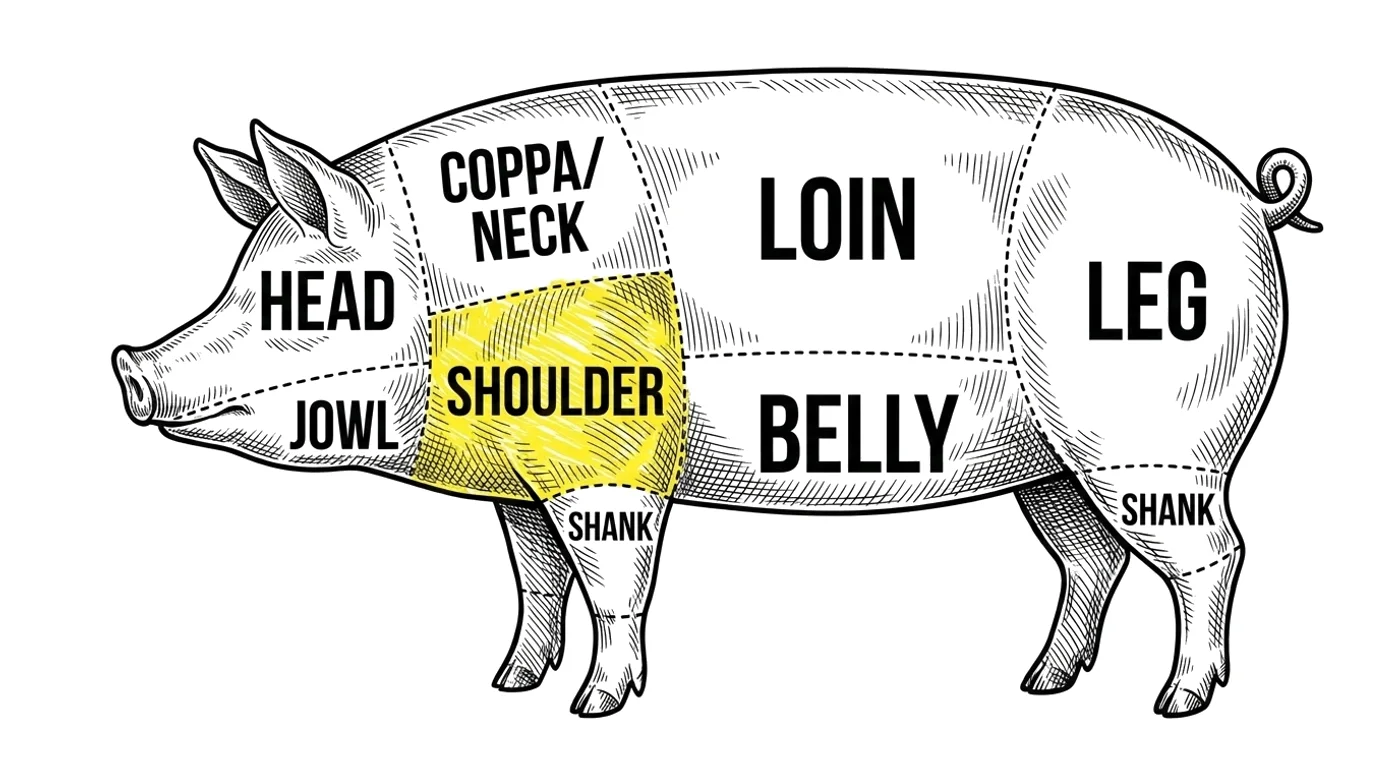
The cut
How to recognise it
Before cooking, the sausage is thick and raw in a natural or artificial casing. After long gentle cooking, the slice is pink-red, rich and soft, with a glossy gelatinous bind. It should hold together but yield easily. A tough rind, dry crumbly centre, split casing or undercooked raw core is defective.
- Shape and size
- Large fresh sausage, sold to boil
- Lean colour
- Coarse pink-grey raw
- Fat and marbling
- Soft, gelatinous when cooked
- Casing
- Wide casing
- Surface bloom
- None
Origins and history
The famous origin story begins during the 1511 siege of Mirandola by troops of Pope Julius II. Faced with losing their pigs to the attackers, townspeople are said to have minced the meat and packed it with rind so it could be kept and cooked later. The tale cannot document every detail of the modern recipe, but it has been repeated for centuries and expresses the product's real logic: use the whole animal and turn collagen-rich material into a luxurious cooked sausage. By the late eighteenth century cotechino made in Modena was known beyond the duchy, and nineteenth-century production spread across northern Italy. It became associated with lentils at New Year, their coin-like shape symbolising prosperity. PGI protection now regulates the Modena form and its traditional production area.
Name. From cotica, 'pork rind'.
- Production today
- Producers across the Modena zone.
- Protection
- IGP.
- Tradition vs modern
- Sold both fresh-to-boil and pre-cooked.
- Seasonality
- A New Year dish, eaten with lentils for luck.
Compare with. Zampone Modena
Serving and cultural significance
Serve hot with lentils on New Year’s Eve or New Year’s Day, or with mashed potato, beans, mustard fruit and braised greens. Modern cooks also use slices in sandwiches and small plates, but the sausage must first receive its complete cooking process.
Recipe and cure
This is not a finished recipe. It is a window into how this meat is traditionally cured. Before you follow any process, please run it through one of our curing calculators, so the salt, cure and timings are right and safe for your own batch.
Curesmith home adaptation — not designation-compliant
Make this — the measured Curesmith version →The cure below is the traditional reference. “Make this” opens the measured Curesmith home recipe, scaled to your batch.
Traditional or protected production
Cotechino Modena is a pork-meat, fat and rind sausage intended to be cooked before eating. The rind creates the characteristic gelatinous texture. The protected mixture is packed in sausage casing rather than a trotter.
- Meat
- pork
- Salt (%)
- 2
- Curing salt
- Cure #1 at 2.5 g/kg (0.25%)
- Fermented
- No
- Smoked
- No
- Target aW or weight loss
- cooked, not dried
- Temperature (°C)
- cooked through to a safe core temperature
- Humidity (%)
- n/a
- Maturation
- fresh; boiled before serving
- Basis
- per 1000 g green meat
- Style
- Traditional, cooked
Ingredients
- pork (base)100% · 1000 g/kg
- pork rind30% · 300 g/kg
- sea salt2.2% · 22 g/kg
- Cure #10.25% · 2.5 g/kg
- black pepper0.3% · 3 g/kg
- nutmeg0.05% · 0.5 g/kg
- clove0.03% · 0.3 g/kg
Method
- Mix coarse pork with cooked-down rind, salt, cure and spices.
- Stuff into a wide casing.
- Traditionally sold fresh, then boiled gently for hours before serving.
- Serve hot.
Notes
- The official protected specification controls the named product. Any Curesmith EQ, starter-culture, curing-salt or home-scale adaptation is a separate method and must not be presented as designation-compliant.
- This is a cooked product. It must be cooked through before eating. Where a cure is used it is Cure #1 (nitrite), suited to the shorter, cooked process rather than long drying.
In the Codex
What this product teaches, and where to read more.
Temple. Pillar, Meat Quality