
Culatello di Zibello
koo-lah-TEL-loh dee dzee-BEL-loh
Zibello (Bassa Parmense), Emilia-Romagna, Italy
Deep, sweet and aromatic, with a silky texture and a long finish. The humid cellar and the bladder casing give it a character no whole-leg ham matches.
Overview
Culatello di Zibello is made from the most prized rear section of the pork leg after the bone, rind, excess fat and fiocchetto have been removed. The pear-shaped muscle is seasoned, enclosed in a pig bladder and tied into a wide irregular net before long cellar maturation. Its texture is dense but silky, with a deep aroma shaped by the damp seasonal climate of the Po lowlands.
Where it's from
Climate. The Bassa Parmense along the Po is famously foggy, damp and still. That air is exactly why a whole leg cannot be cured cleanly here, and why the bladder-cased culatello ages so slowly and sweetly.
Altitude. Low river plain, roughly 30 to 50 m
The cut
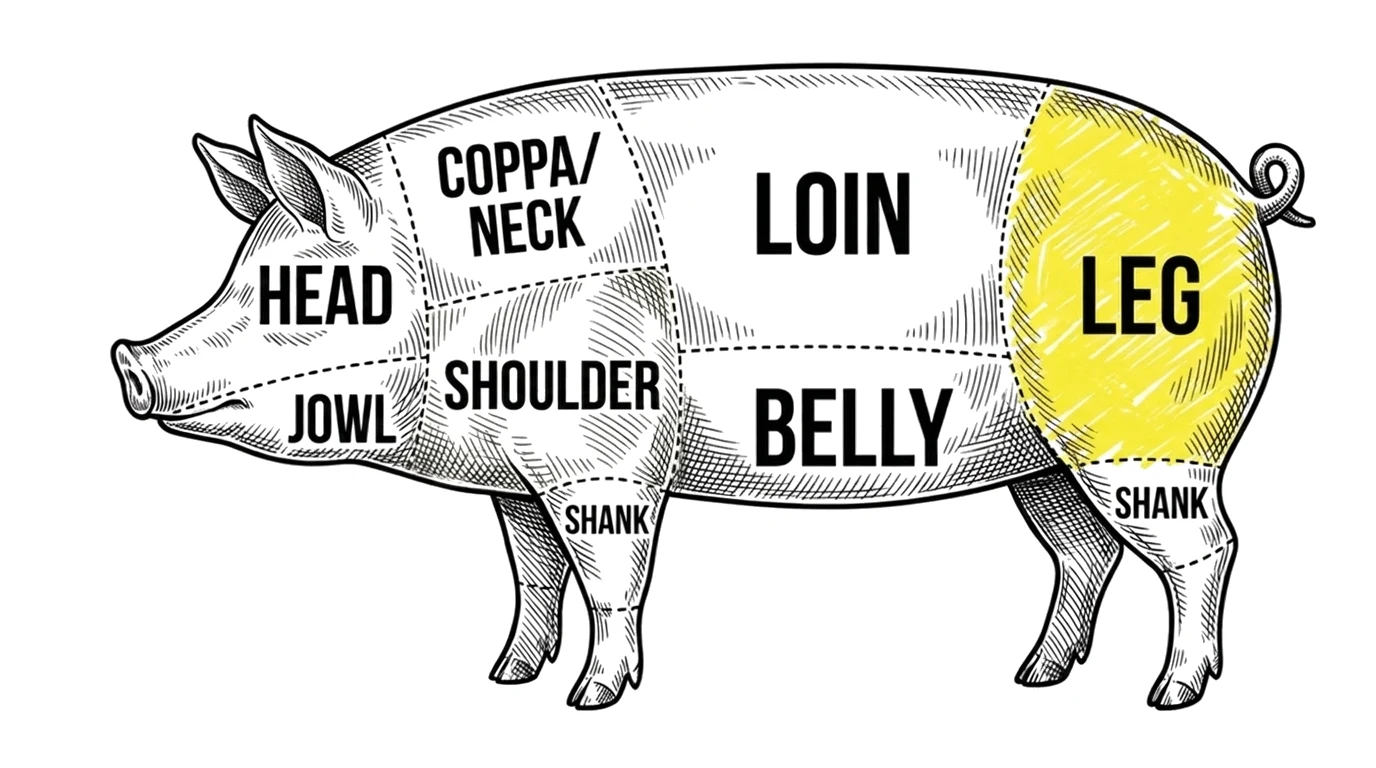
How to recognise it
A whole culatello is pear-shaped and enclosed in a dry natural bladder marked by a broad, irregular string lattice. The cut surface is deep ruby red with small white fat seams. The texture should be compact yet tender, and the aroma may be earthy, cellar-like and slightly winey without becoming musty. A hollow casing, sticky surface, sharp ammonia, sourness or a dry brown centre indicates poor maturation.
- Shape and size
- Large pear or teardrop, netted; typically 3 to 5 kg
- Lean colour
- Deep ruby to garnet
- Fat and marbling
- Fine white fat, light marbling; leaner than a whole prosciutto
- Casing
- Pig bladder, tied with twine into the classic pear shape
- Surface bloom
- Natural cellar mould on the casing, brushed and managed through ageing
Origins and history
Culatello belongs to the foggy Bassa Parmense, where whole hams were difficult to dry evenly in damp riverside cellars. Butchers solved the problem by separating the valuable inner muscles from the bone and rind, reducing the mass and allowing the meat to mature in a bladder casing. Documentary references appear from the early modern period, while local tradition places the craft much earlier. The product was historically reserved for wealthy households, landlords and honoured guests, which explains the title often given to it, the king of salumi. Its making remained concentrated in villages near the Po and was seasonal, beginning during the cold months. Culatello di Zibello received PDO protection in 1996, and its tightly limited area preserves the relationship between cellar climate and craft.
Name. Culatello means 'little rump', from culatta, the rump of the pig it is cut from.
- Production today
- A small number of artisan producers in the protected communes; low volume and premium, sold whole or hand-carved.
- Protection
- DOP since 1996. Production is limited to eight communes of the Bassa Parmense, with rules on pig rearing, the muscle used, and cellar ageing, overseen by the protection consortium.
- Tradition vs modern
- Traditionally aged in natural cellars through the seasons. Modern producers may use humidity-controlled rooms, but the DOP protects the traditional zone and method.
- Seasonality
- Traditionally salted in the cold months and aged through the following seasons; a winter cure.
Compare with. Prosciutto di Parma, Jamón Ibérico de Bellota
Serving and cultural significance
Traditionally, a mature culatello may be softened by wrapping or brief wine treatment before the casing is removed. Slice it extremely thinly and serve with buttered bread, Parmigiano Reggiano, mild pickles or sparkling wine from Emilia. The best slices need little accompaniment because the cellar aroma and sweet fat are the point.
Recipe and cure
This is not a finished recipe. It is a window into how this meat is traditionally cured. Before you follow any process, please run it through one of our curing calculators, so the salt, cure and timings are right and safe for your own batch.
Curesmith home adaptation — not designation-compliant
Make this — the measured Curesmith version →The cure below is the traditional reference. “Make this” opens the measured Curesmith home recipe, scaled to your batch.
Traditional or protected production
PDO production is limited to the defined Bassa Parmense area and the traditional cool-season processing period. The selected leg section is trimmed by hand, salted and seasoned, then invested in a pig bladder and tied. Maturation lasts at least ten months and exposes the product to the area's changing winter fog, summer warmth and cellar humidity. The casing is cleaned and monitored throughout ageing.
Sea salt (by feel), black pepper, garlic and a little dry white wine, to traditional practice.
- Meat
- pork (traditional heavy pigs permitted under the DOP)
- Cut
- the large inner rump muscle of the hind leg, boned, rind removed, hand-trimmed
- Salt (%)
- traditional, no fixed %
- Curing salt
- Traditionally sea salt; some recipes add a little nitrate
- Other agents
- black pepper, crushed garlic, a splash of dry white wine
- Fermented
- No
- Starter or mould
- Natural cellar mould on the bladder
- Smoked
- No
- Target aW or weight loss
- ~30% weight loss
- Temperature (°C)
- 12 to 15
- Humidity (%)
- 80 to 85 (deliberately humid)
- Maturation
- minimum 10 months under the DOP specification
- Basis
- percentage of green meat weight
- Style
- Traditional dry salting, bladder-cased
Method
- Bone out the culatello muscle from the leg.
- Salt and season by traditional practice.
- Case in a pig bladder and tie into the pear shape.
- Age in a humid cellar, brushing and managing the surface mould.
Notes
- The official protected specification controls the named product. Any Curesmith EQ, starter-culture, curing-salt or home-scale adaptation is a separate method and must not be presented as designation-compliant.
- A more efficient way of curing this product is using the EQ Method. No more than 2.5% salt to meat weight is required. To follow the EQ method, please use our whole-muscle EQ curing calculator to work out proper ratios and curing times.
Safety. Humid, slow whole-muscle cure where mould management is part of the process. Advanced. Judge by weight loss and water activity. Verify before serving.
In the Codex
What this product teaches, and where to read more.
Temple. Roof, Microclimate (part of the Safety Triangle)