
Cumberland Sausage
Also known as Traditional Cumberland sausage, Cumberland coil, Cumberland Sausage-Traditional
Cumbria, United Kingdom
Overview
Traditional Cumberland Sausage is the protected coarse pork sausage of Cumbria in north-west England. It is characteristically sold as a long continuous coil rather than as separate links.
Where it's from
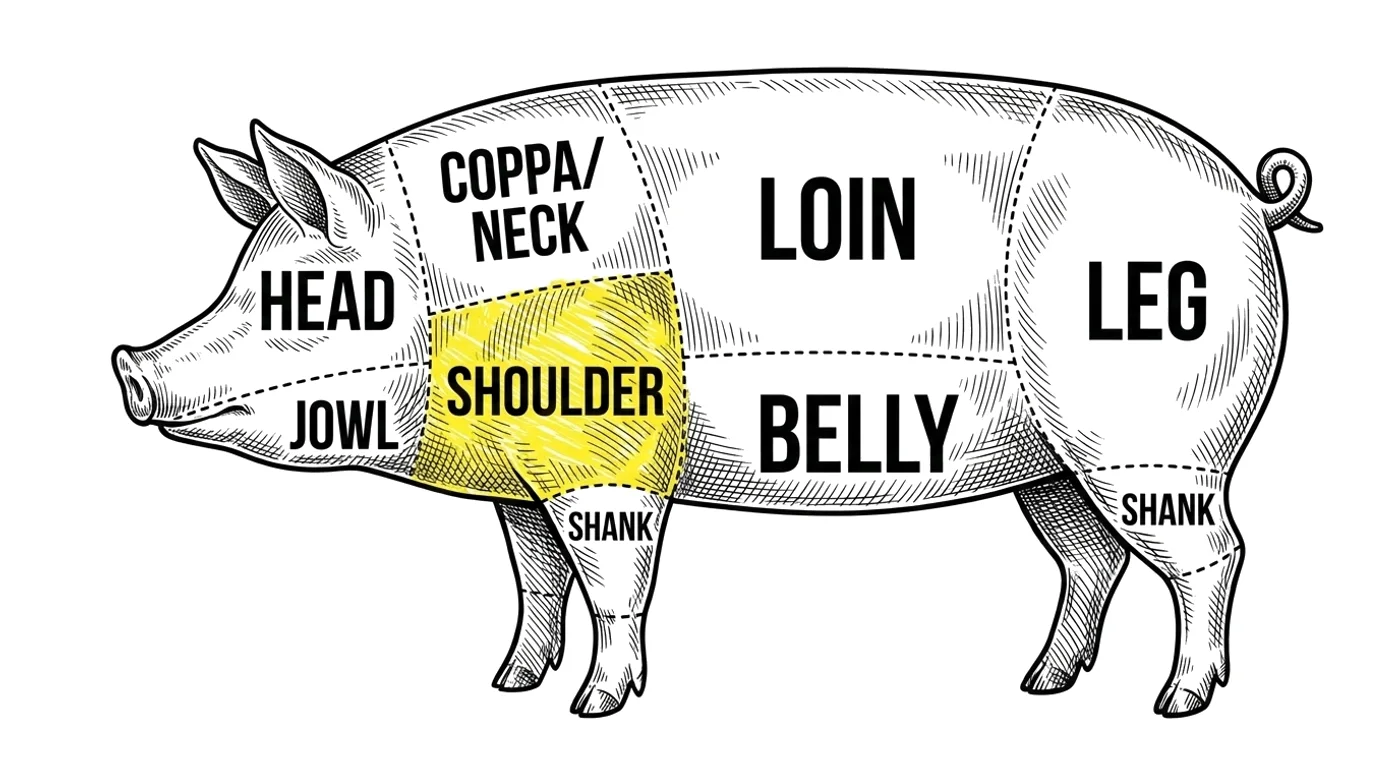
The cut
Identity and terminology
The registered name is protected under the UK geographical indication scheme. Production, processing and preparation must take place in Cumbria and the product must follow the specification. A home or out-of-area version may be Cumberland-style but cannot use the protected name commercially.
Composition and characteristics
The specification requires a high pork content, coarse texture, a minimum diameter and seasoning in which pepper is prominent. The cut face is chunky, with clearly visible meat and fat rather than a smooth paste.
Production and process
Pork is chopped or coarsely minced, seasoned and filled into casing without twisting into links, producing the familiar spiral. The sausage is sold raw and cooked by frying, grilling or baking.
History and regional forms
Cumberland's sheep and cattle landscape also supported pig keeping and local butcheries. The coiled sausage became a county emblem, and producers pursued legal protection to distinguish the traditional coarse product from fine, low-meat imitations. EU registration was achieved in 2011 and continued under the UK scheme.
Use, storage and related products
It is served with mash, gravy, eggs or in casseroles. It differs from Lincolnshire sausage, which is sage-led, and from ordinary coiled pork sausage that does not meet the geographical specification.
Recipe and cure
This is not a finished recipe. It is a window into how this meat is traditionally cured. Before you follow any process, run it through one of our curing calculators so the salt, cure and timings are right and safe for your own batch.
Make this — the measured Curesmith version →“Make this” opens the same cure as a measured recipe, scaled to your batch.
- Meat
- Pork shoulder
- Cut
- Pork shoulder
- Salt (%)
- 1.8
- Curing salt
- None
- Fermented
- No
- Smoked
- No
- Maturation
- ≤4°C for up to 2 days or freeze
- Basis
- per 1,000 g pork shoulder
- Style
- Coarse fresh pork coil; cook before eating
Ingredients
- Pork shoulder100% · 1000 g
- Pork back fat20% · 200 g
- Fine rusk8.1% · 97 g
- Ice-cold water5.1% · 61 g
- Fine salt1.8% · 22 g
- Coarsely ground black pepper0.47% · 5.5 g
- Ground white pepper0.23% · 3 g
- Dried thyme0.23% · 3 g
- Rubbed sage0.3% · 3 g
- Ground nutmeg0.06% · 0.7 g
- Ground mace0.06% · 0.7 g
- Cayenne0.06% · 0.7 g
Method
- Use at least 80% boneless pork meat/fat; water/ice must not exceed 5% of meat block.
- Chill pork, fat, water and equipment to 0–3°C.
- Hand-cut or grind through a plate of at least 4.5 mm.
- Mix rusk with the measured water for 5 minutes.
- Combine pork with salt, permitted seasonings and hydrated rusk without emulsifying.
- Stuff natural casing and form one continuous spiral coil.
Safety. The protected identity does not change the fact that the sausage is sold raw and requires refrigeration and full cooking.