
Debreziner (Austrian)
Also known as Debrezeiner, Austrian Debreziner
Austria
Overview
Austrian Debreziner is a narrow, paprika-associated smoked and scalded sausage established in Austrian sausage culture from a Hungarian Debrecen ancestor. It is commonly sold in pairs or short links and reheated gently in water. Its fine bound base and small casing distinguish it from many coarse Hungarian forms.
Where it's from
The cut
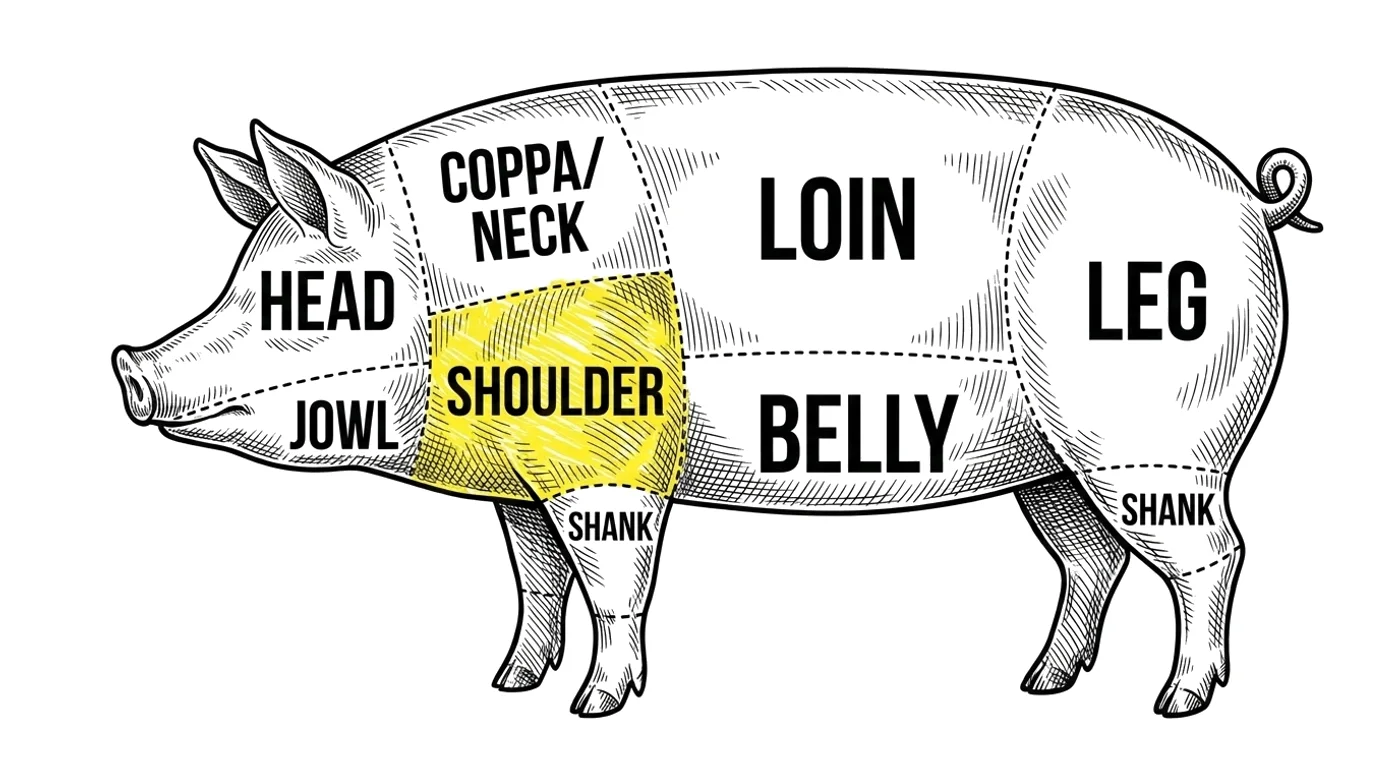
Identity and terminology
The name is the Austrian German form of Debreceni, meaning from Debrecen. Austrian usage has become a national product identity rather than a simple translation. The Austrian Food Codex lists Debreziner among meat sausages and also recognises a separate dry raw-sausage form, so the process class must always be stated.
Composition and characteristics
For the scalded sausage, Codex B14 specifies a structure of lean pork, first-quality back fat and Brät 50, a fine sausage batter. Paprika, garlic, pepper, marjoram and related warm spices shape the familiar flavour. The link is narrow, reddish, lightly smoked and fine-textured, sometimes with small visible inclusions.
Production and process
Pork and beef are ground and fine-processed with curing salt and chilled water, then fat and seasonings are incorporated. The batter is stuffed into sheep casings, dried, smoked, scalded and cooled. The dry Debreziner or Pusztawürstel branch follows a different maturation logic and must not be inferred from the cooked sausage recipe.
History and regional forms
Debreziner travelled west with trade and migration across the Habsburg lands and became a familiar Viennese sausage-stand item during the nineteenth and early twentieth centuries. Austrian codification preserved a composition distinct from the several Hungarian Debreceni Páros branches while retaining the place-derived name.
Use, storage and related products
It is warmed in hot water and served with mustard, bread, sauerkraut or peppers; grilling is less characteristic but common outside Austria. Austrian Debreziner is related to Hungarian Debreceni Páros and German Debreziner, yet its Codex composition makes it a separate Atlas entry. Cooked links require refrigeration.
Recipe and cure
This is not a finished recipe. It is a window into how this meat is traditionally cured. Before you follow any process, run it through one of our curing calculators so the salt, cure and timings are right and safe for your own batch.
Make this — the measured Curesmith version →“Make this” opens the same cure as a measured recipe, scaled to your batch.
- Meat
- Lean pork shoulder
- Cut
- Lean pork shoulder
- Salt (%)
- 1.8
- Curing salt
- Cure #1 as specified in the recipe
- Fermented
- No
- Starter or mould
- None; this product is not fermented
- Smoked
- Yes
- Maturation
- Refrigerate at 0–4°C; use within 4 days or freeze promptly
- Basis
- per 1,000 g lean pork shoulder
- Style
- Austrian cured, paprika-seasoned, smoked and scalded fine sausage
Ingredients
- Lean pork shoulder100% · 1000 g
- Pork back fat65% · 650 g
- Lean beef chuck35% · 350 g
- Ice water10% · 200 g
- Fine salt1.8% · 36.5 g
- Cure #1, 6.25% sodium nitrite0.25% · 5 g
- Sweet paprika0.45% · 9 g
- White pepper0.22% · 4.5 g
- Dried marjoram0.11% · 2 g
- Ground ginger0.22% · 4.5 g
- Fresh garlic, crushed0.39% · 8 g
Method
- Chill meats, fat, water and equipment; grind pork, beef and back fat separately through 5–6 mm.
- Fine-process pork and beef with salt, Cure #1 and ice water; add paprika, pepper, marjoram, ginger, garlic and back fat.
- Stuff into sheep casings, form 15 cm links and refrigerate for 8–12 hours.
- Dry the surface, then apply a light warm smoke until evenly coloured.
- Poach at 75–78°C until the cold point reaches 71°C.
- Shower with clean cold water and chill under the two-stage rule.
Safety. Distinguish the cooked scalded sausage from dry raw Debreziner. The cooked branch needs measured thermal processing, rapid cooling and refrigeration.