
Debreziner (German)
Also known as German Debreziner, Debrecziner, Debreziner Brühwurst
Germany
Overview
German Debreziner is a paprika-associated, cured sausage derived from the wider Debrecen sausage tradition but shaped by German butcher practice. In its scalded form it combines a fine bound base with particles no larger than a pea, is stuffed in narrow sheep casings, smoked and heat-treated. The current German meat guidelines place it with Pfälzer, Regensburger, Krainer and related scalded sausages rather than treating it as a translation of the Hungarian product.
Where it's from
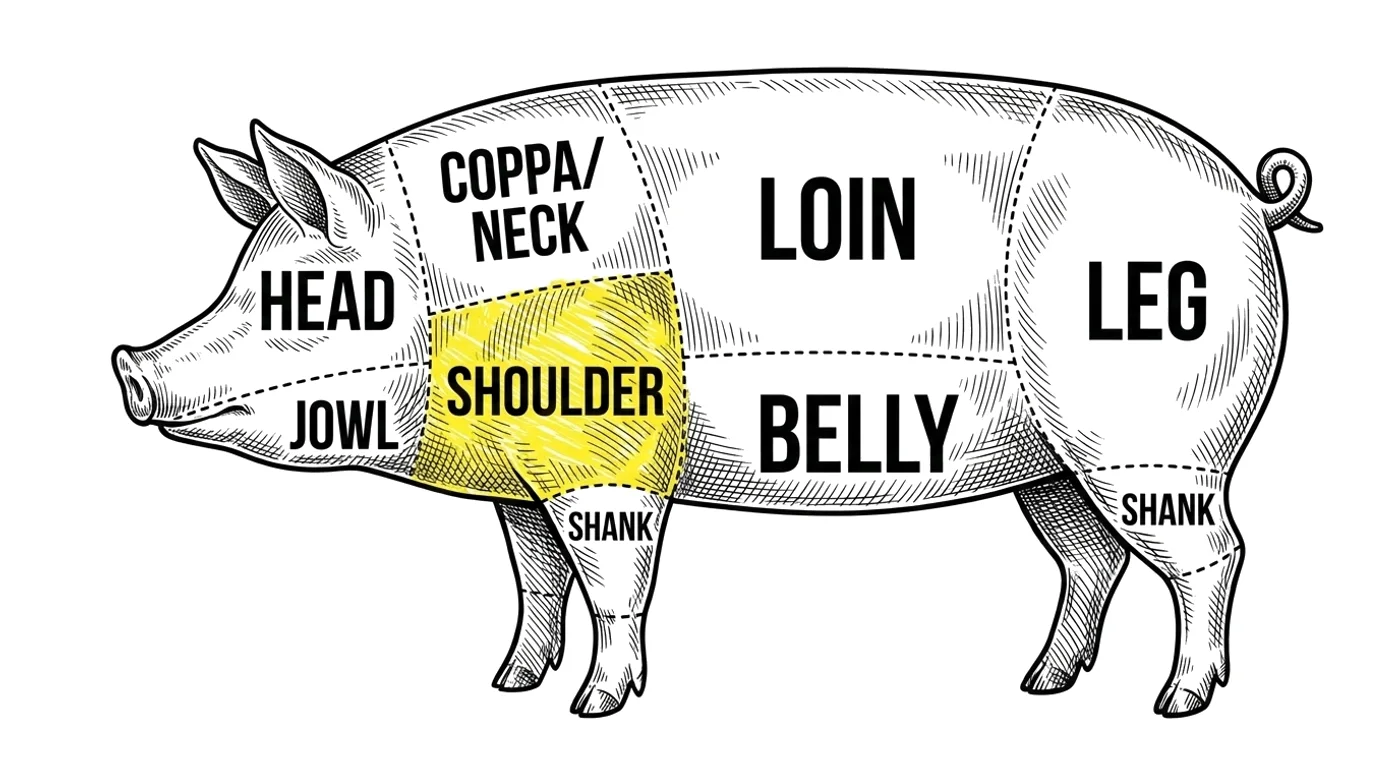
The cut
Identity and terminology
The name means a sausage in the manner of Debrecen, but national usage matters. German Debreziner, Austrian Debreziner and Hungarian Debreceni Páros Kolbász share a place-derived ancestry without having identical composition rules. German guidance also recognises a raw Debreziner in the raw-sausage section. A recipe, label or article must therefore state whether it concerns the raw, potentially storage-stable semi-product or the scalded ready-to-eat sausage.
Composition and characteristics
The guideline composition is expressed by meat quality classes rather than a single fixed recipe: coarsely denuded beef, lean pork, fatty pork and bacon are typical. The cut face should show a finely comminuted base with small visible particles. Paprika, pepper and garlic provide the familiar warm colour and savoury profile, while curing salt develops the cured flavour and stable pink colour associated with the cooked product.
Production and process
Production begins with cold grinding and extraction of a tacky base from the lean meat, salt, curing salt and chilled water. The remaining meat and fat are incorporated without smearing, and the batter is filled into sheep casings. After refrigerated curing and casing drying, the links are smoked and scalded to a measured cold-point endpoint. The German raw form follows a different maturation and release logic and must not be improvised from this cooked process.
History and regional forms
Debrecen's sausage name spread through the Habsburg and German-speaking markets during the nineteenth and early twentieth centuries. German butchers absorbed it into their own classification system, where it came to describe both a scalded sausage and a raw durable semi-product. This double use explains why apparently similar German recipes can differ sharply in heat treatment, texture and storage expectations.
Use, storage and related products
Scalded Debreziner is commonly reheated gently and served with bread, mustard, potatoes or cabbage. It is related to the Austrian and Hungarian forms but is not interchangeable with either. The cooked branch requires refrigeration. A raw Debreziner needs a separately validated cure, drying programme and release gate; the name alone does not establish shelf stability.
Recipe and cure
This is not a finished recipe. It is a window into how this meat is traditionally cured. Before you follow any process, run it through one of our curing calculators so the salt, cure and timings are right and safe for your own batch.
Make this — the measured Curesmith version →“Make this” opens the same cure as a measured recipe, scaled to your batch.
- Meat
- Lean pork shoulder
- Cut
- Lean pork shoulder
- Salt (%)
- 1.8
- Curing salt
- Cure #1 as specified in the recipe
- Fermented
- No
- Starter or mould
- None; this product is not fermented
- Smoked
- Yes
- Maturation
- Refrigerate at 0–4°C; use within 4 days after opening or freeze promptly
- Basis
- per 1,000 g lean pork shoulder
- Style
- cured, smoked and scalded German sausage
Ingredients
- Lean beef chuck85% · 850 g
- Lean pork shoulder100% · 1000 g
- Pork belly, skinless100% · 1000 g
- Pork back fat50% · 500 g
- Ice water9.9% · 333.5 g
- Fine salt1.8% · 60 g
- Cure #1, 6.25% sodium nitrite0.25% · 8.5 g
- Sweet paprika0.2% · 6.5 g
- Hot paprika0.1% · 3.5 g
- Black pepper0.1% · 3.5 g
- Fresh garlic, crushed0.3% · 10 g
Method
- Trim, weigh and chill all meat, fat and equipment to 0–2°C.
- Grind beef and lean pork through 3 mm; grind belly and back fat through 5 mm.
- Mix lean meat with salt, Cure #1 and liquid until tacky, then incorporate the remaining meat, fat and seasonings.
- Stuff into 24–26 mm sheep casing, remove air pockets and refrigerate 8–12 hours.
- Dry the casing, then apply light hot smoke at 55–60°C for 30–45 minutes.
- Cook until the cold point reaches 71°C.
Safety. Confirm the process class. The scalded branch needs measured cooking, rapid cooling and refrigeration; a raw branch requires separate validated hurdles.