
Overview
Dekorsalami is an Austrian salami product designed for decorative presentation. A finished salami is peeled and coated with edible gelatin carrying coarse spices, spice mixtures or grated cheese. The coating is intended to be eaten with the sausage.
Where it's from
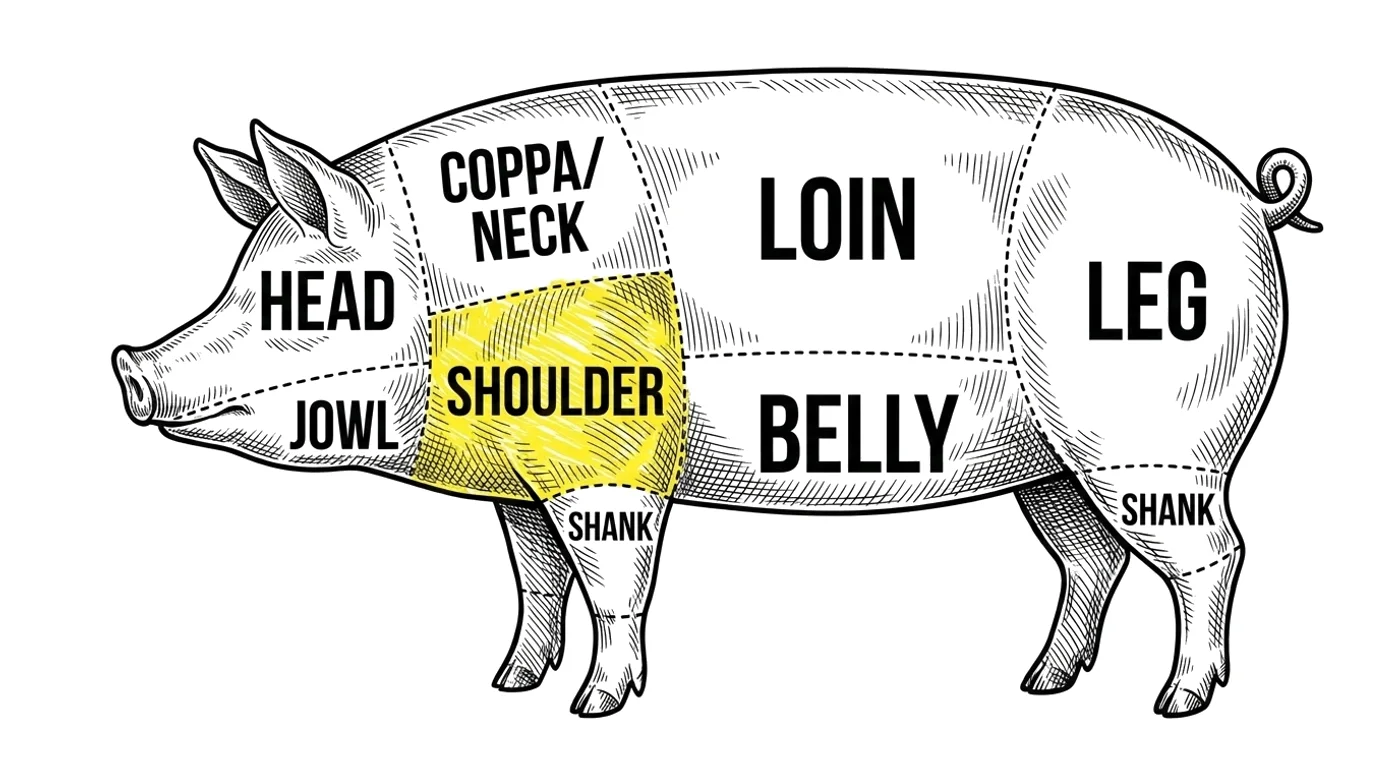
The cut
Identity and terminology
The Austrian Food Book defines the product by its edible decoration rather than by one universal salami formula. The name should therefore be used only where the coating is part of the product identity. Ordinary moulded salami, spice-crusted sausage and non-edible display coatings remain separate.
Composition and characteristics
The base is a matured salami with its own meat, fat, seasoning, fermentation and drying requirements. After peeling, the surface receives a gelatin layer and a clearly named decoration such as pepper, paprika, mixed spices or Parmesan-type cheese. The finished slice should show a normal salami interior and an even edible coating.
The decoration changes flavour at the surface and can influence slicing and moisture exchange. A thick wet coating may soften the exterior, while uneven cheese or spice application can create spoilage pockets or misleading ingredient distribution.
Production and process
The underlying salami is manufactured and dried to its validated endpoint before decoration. The casing is removed, the surface is coated with edible gelatin and the selected garnish is applied uniformly. The Austrian guidance records substantial drying loss for the base salami. Decoration must occur under hygienic conditions without re-wetting or contaminating the product.
History and regional forms
Decorative salami developed as a retail and buffet presentation style within Austrian meat processing. It allows one base product to be finished with different visual and flavour profiles. Because the coating is eaten, modern allergen and ingredient declarations are central to the identity.
Modern retail versions use decoration for differentiation and gift presentation. The family remains technically subordinate to the underlying salami: a poor or under-dried base cannot be corrected by an attractive coating.
Use, storage and related products
Dekorsalami is sliced for cold platters, gifts and display counters. Storage follows the validated status of the base salami and the stability of the coating. Cheese-coated and spice-coated forms should be identified separately. Related entries include ordinary Salami and other edible-coated dry sausages.
Recipe and cure
This is not a finished recipe. It is a window into how this meat is traditionally cured. Before you follow any process, run it through one of our curing calculators so the salt, cure and timings are right and safe for your own batch.
Make this — the measured Curesmith version →“Make this” opens the same cure as a measured recipe, scaled to your batch.
- Meat
- Pork shoulder
- Cut
- Pork shoulder
- Salt (%)
- 2.5
- Curing salt
- Cure #1/#2 as specified
- Fermented
- Yes
- Target pH
- 5.3 or lower
- Smoked
- No
- Basis
- per 1,000 g pork shoulder
- Style
- A fermented dry salami with an edible pepper-and-herb coating applied after drying.
Ingredients
- Pork shoulder100% · 1000 g
- Lean beef35% · 350 g
- Pork back fat35% · 350 g
- Fine salt2.5% · 41.5 g
- Cure #2 containing 6.25% sodium nitrite0.25% · 4 g
- Dextrose0.39% · 6.5 g
- Black pepper0.25% · 4 g
- Garlic0.19% · 3.5 g
- Flora Italia LC or equivalent starter culture0.02% · 0.4 g
- Food-grade gelatine1.2% · 20 g
- Coarsely cracked black and pink pepper2% · 33.5 g
- Dried parsley and chive mixture0.78% · 13.5 g
Safety. The decorative coating does not establish preservation. The underlying salami requires a fully validated fermentation, drying and release process. Gelatin, cheese and spice coatings must be hygienically applied and accurately declared, including allergens and ingredients named on the label.