
Devon Sausage
Also known as Devon, Fritz, Polony, Luncheon sausage
Australia and New Zealand, Australia
Overview
Devon is an Australian and New Zealand processed luncheon meat sold as a large, uniformly textured cooked sausage. It is normally sliced for sandwiches, eaten cold with tomato sauce, or fried until browned. FSANZ food data records Devon or fritz as a processed sandwich meat containing pork, beef, starch, soy protein, cereal, sugar, spices, curing agents and water, which captures the product's commercial identity more accurately than treating it as a regional English sausage.
Where it's from
The cut
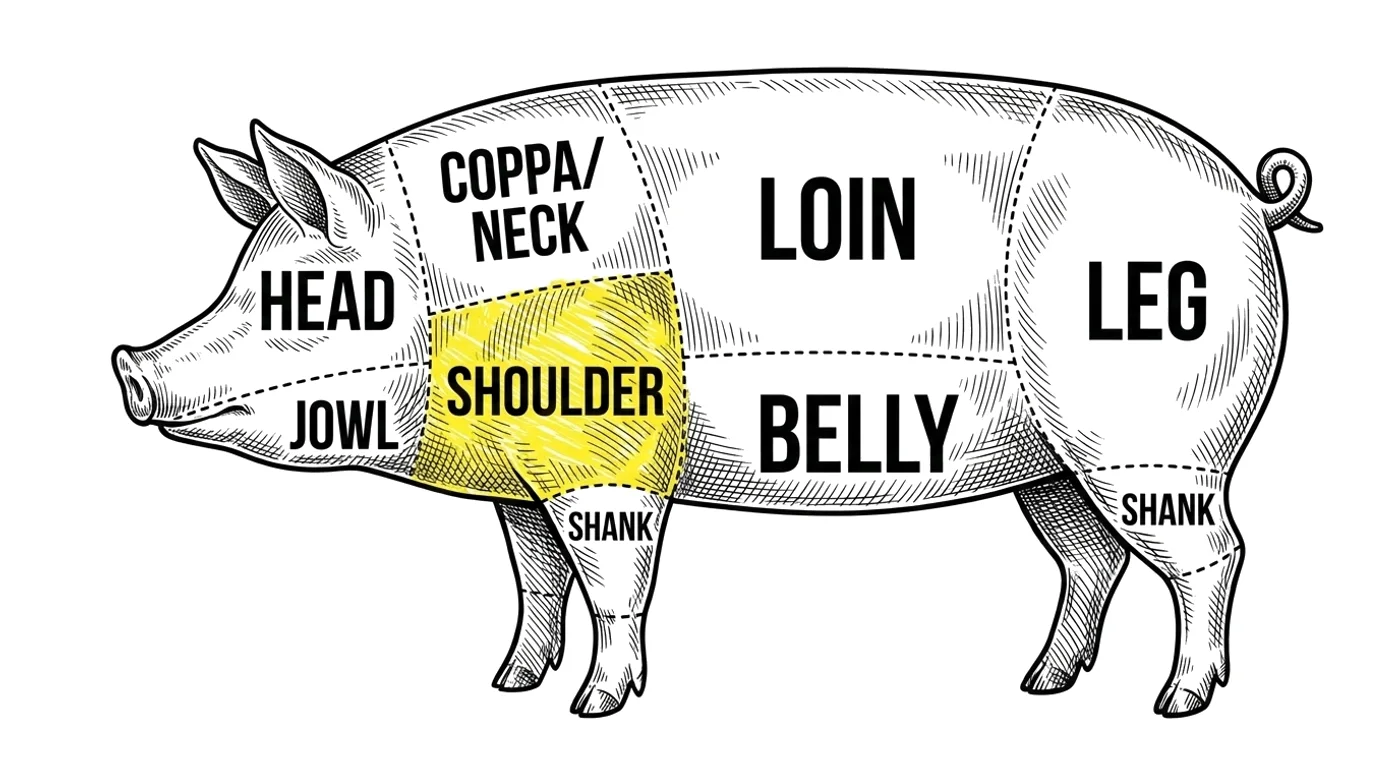
Identity and terminology
Names vary sharply across Australia. Devon is common in New South Wales and several other states, fritz is strongly associated with South Australia, and polony, luncheon or Belgian may be encountered elsewhere. These words can describe overlapping but not always identical products, so they are aliases for search and comparison rather than proof that every formula is the same. Devon has no connection to a Devonshire fresh sausage simply because the place-name is shared.
Composition and characteristics
The product is usually pork-led with beef or, in some commercial versions, poultry. Fat, chilled water, starch and protein binder produce a smooth, springy slice that holds together in a sandwich and fries without crumbling. White pepper, coriander, nutmeg, onion and mild paprika are typical. Tomato juice appears in some formulas but is not universal. A large cellulose or fibrous chub gives the familiar broad round slice.
Production and process
Meat and fat are chilled, ground and fine-processed with salt, curing salt, ice and binder to create a stable emulsion. The batter is stuffed into a large impermeable or fibrous casing and heat-treated slowly enough for the cold point to reach its endpoint without fat separation. Rapid cooling is especially important in a thick chub. Commercial ready-to-eat production falls within the Australian food-safety framework for manufactured and luncheon meats.
History and regional forms
Devon belongs to the family of inexpensive urban smallgoods that expanded with industrial emulsification, refrigeration and sliced-lunch culture during the twentieth century. Its regional names became markers of Australian vocabulary as well as food. The product's everyday status, especially in school lunches and simple sandwiches, helps explain why the name carries strong nostalgia despite considerable variation among manufacturers.
Use, storage and related products
Cold slices are paired with white bread, butter, pickles, cheese or tomato sauce; fried slices may be served at breakfast or in a hot sandwich. Devon is related to polony, baloney and bologna-style sausage, but the Australian name, seasoning and use justify a separate entry. It is ready to eat after manufacture, yet once cut it must be protected from Listeria recontamination and kept refrigerated.
Recipe and cure
This is not a finished recipe. It is a window into how this meat is traditionally cured. Before you follow any process, run it through one of our curing calculators so the salt, cure and timings are right and safe for your own batch.
Make this — the measured Curesmith version →“Make this” opens the same cure as a measured recipe, scaled to your batch.
- Meat
- Pork shoulder
- Cut
- Pork shoulder
- Salt (%)
- 1.8
- Curing salt
- Cure #1 as specified in the recipe
- Fermented
- No
- Starter or mould
- None; this product is not fermented
- Smoked
- No
- Maturation
- Refrigerate at 0–4°C; use within 4 days after opening or freeze promptly
- Basis
- per 1,000 g pork shoulder
- Style
- cured, emulsified and cooked Australian luncheon meat
Ingredients
- Pork shoulder100% · 1000 g
- Lean beef chuck30% · 300 g
- Pork back fat15% · 150 g
- Ice water5.6% · 85.5 g
- Tomato juice7.1% · 71.5 g
- Fine salt1.7% · 25.5 g
- Cure #1, 6.25% sodium nitrite0.23% · 3.5 g
- Soy protein concentrate1.4% · 14.5 g
- Potato starch4.6% · 71.5 g
- White pepper0.19% · 3 g
- Ground coriander seed0.09% · 1.5 g
- Sweet paprika0.09% · 1.5 g
- Cayenne0.05% · 0.7 g
- Ground nutmeg0.05% · 0.7 g
- Onion powder0.19% · 3 g
Method
- Trim, weigh and chill all meat, fat and equipment to 0–2°C.
- Grind pork, beef and fat through 8 mm, then fine-process with ice water and tomato juice.
- Mix lean meat with salt, Cure #1 and liquid until tacky, then incorporate the remaining meat, fat and seasonings.
- Stuff into 75–90 mm cellulose or smoke-permeable fibrous casing, remove air pockets and refrigerate 8–12 hours.
- Fine-process with binder and seasonings to a uniform batter, stopping before it exceeds 10°C.
- Dry the casing; smoke is optional and, if used, should be light and applied before poaching.
Safety. A large emulsified chub needs a verified cold-point cook, rapid cooling and refrigeration. Prevent post-cook contamination during peeling and slicing.